SAEDNEWS: Vank Cathedral, also known as the Cathedral of the Holy Savior (Armenian: Սուրբ Ամենափրկիչ Վանք, pronounced Amna Perkich), is a church located in the Jolfa district of Isfahan. Its name is derived from the Surp Amna Perkich Vank Church in Jugha, Nakhchivan.
According to the History and Culture Service of SaedNews, Vank Cathedral is one of the historic Armenian churches in Isfahan, built during the reign of Shah Abbas II. The word “Vank” in Armenian means “monastery.” This historic building is located on Jolfa Street.
The Armenians had a church in Nakhichevan’s Julfa called “Surp Amenapergich Vank,” meaning the Monastery of the Holy Savior of All. After migrating to Isfahan, they named the newly built cathedral after this original church.
Arakel Davrizhetsi provides a detailed account of the events of this era:
After leaving Yerevan, Shah Abbas ordered his army to retreat while destroying all towns and villages along their route to the borders of Iran to slow the advance of the Ottoman forces. They demolished houses, set fields on fire, slaughtered livestock, and forced the inhabitants to leave their homes. Anyone who resisted or could not move was sentenced to death. In this way, Shah Abbas’s army destroyed most Armenian towns and villages in the Ararat Plain and relocated their residents to Iran.
When the displaced population reached Vagharshapat, Shah Abbas learned that a group of Ottoman soldiers was approaching. Knowing that he could not confront the Ottomans with this large, defenseless crowd, he ordered his commanders to hasten the movement of the refugees. Many, including the elderly, sick, and children, were left behind, facing certain death. Eventually, Shah Abbas reached Julfa with the Armenian migrants. They had to cross the Aras River, which was dangerous and fast-flowing. The Shah ordered his troops to force the people to cross quickly, leaving them no choice but to attempt the river. Of approximately 350,000 Armenians, around 300,000 perished in the river.
Although Shah Abbas relocated most Armenian residents of Armenian towns and villages to Iran, the region was not entirely depopulated. Many Armenians continued to live in these areas, experiencing intermittent hardships and invasions until the first half of the 19th century.
After settling in Julfa, Isfahan, the Armenians sought to establish social institutions and religious buildings. With community funds and local support, they first constructed Vank Cathedral, modeled after the church in Julfa and bearing the same name. Simultaneously, a small church was built on the southwest side, used by clergy for fifty years. In 1655, construction of the current cathedral began and was completed in 1664. Above the entrance, a carved stone depicts the church and reads:
"Vank Amena Perkich, Seat of the Armenian Catholicos, 1606"
Upon completion, a lapis-lazuli tile inscription in gold lettering was placed above the western entrance, marking the construction dates:
"Vank Amena Perkich Church was begun in 1655 during the reign of Shah Abbas II, under Catholicos Philippos and overseer David, with the support of the benevolent people of Julfa, and completed in 1664. May the merit of worship in this church benefit the living and the deceased."
The cathedral covers 8,731 square meters, of which 3,857 square meters are buildings, and the remainder consists of gardens and green spaces. Two reception rooms flank the entrance, and above it, a three-story bell tower houses a 300-kilogram clock on the second level, with four clock faces, each 104 centimeters in diameter. This tower and clock were gifted to the church in 1931 by Mardiros Hordananian. A marble plaque beside the entrance commemorates the gift in memory of his late brother.
Unlike older Armenian churches, which were predominantly stone, Vank was built with raw bricks. The exterior walls are brick, while the interior walls are plastered, painted, and decorated. The cathedral has two domes: a smaller dome above the congregation and a larger one above the sanctuary. Walls rise 11.75 meters from the courtyard to the second-floor roof. Inside, two square columns (2 meters per side) support four high arches (10.25 meters) in the western section, upon which the small dome rests.
The Khachatur Gasratatsi Museum, located in the northeast wing, is one of Iran’s most valuable museums. It houses works attributed to Rembrandt, documents of the Armenian genocide under the Ottomans, government decrees related to Armenians, rare manuscripts, and the earliest printed works in Iran.
While traditional Armenian church domes are conical, Vank’s dome reflects Safavid-era Persian mosque architecture. A second small bell tower sits on the upper roof near the western entrance. Brick columns, connected by wooden beams and pointed arches, support it.
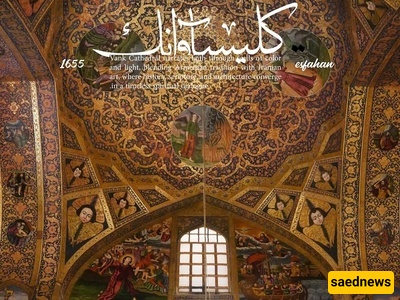
The entire cathedral, including walls, arches, the dome, and interior corners, is decorated with oil paintings. The murals depict scenes from the Gospel, illustrating Jesus’s life from birth to ascension, as well as the Last Judgment and Heaven and Hell. The decorations and gilding were funded by Khaje Avetik Stepanoos, executed by Armenian masters including the clerics Hovhannes Merkuz, Stepanoos, and Minas.
Vank Cathedral is unique among Armenian churches for its gilding and intricate decoration. Khaje Avetik played a key role in the artistic vision. A plaque on the northern interior wall commemorates his contributions.