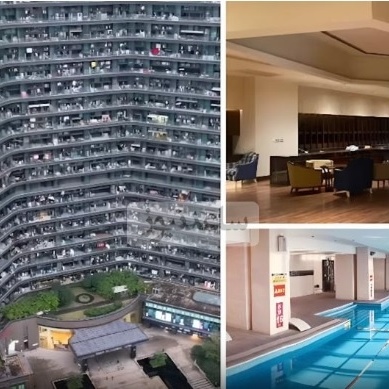
SaedNews: When it comes to urban population density, streets and subways usually come to mind—but in Hangzhou, China, there’s a building that, on its own, resembles a small city.
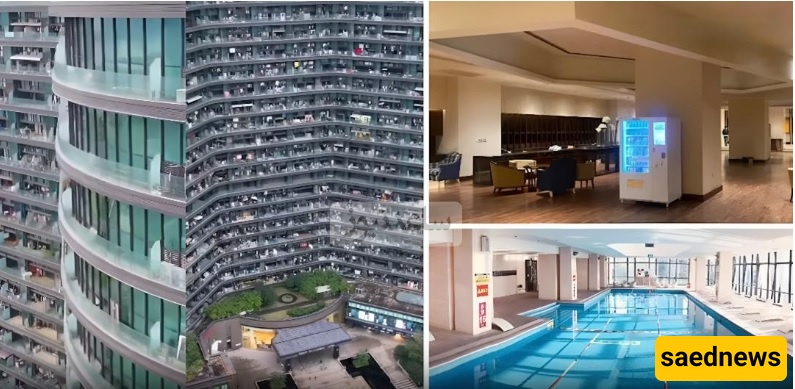
According to SAEDNEWS, A building housing around 20,000 residents contains all their daily-life facilities within the same structure—from supermarkets and hair salons to swimming pools and recreational areas. In Iran, many cities have populations smaller than this number, yet none of them fit entirely in a single building. This structure is an astonishing example of vertical architecture, dense social living, and multifunctional design—and it deserves a closer look.
Name and Location: The building is called Regent International and is located in Qianjiang Century City, Hangzhou, China.
Height and Floors: The building has between 36 and 39 floors, reaching approximately 206 meters (675 feet) in height.
Area: The total floor area is close to 260,000 square meters—comparable to a large urban complex within a single structure.
Resident Population: About 20,000 people live there, though it has a capacity of up to 30,000.
Large food court providing a variety of dining options for residents.
Swimming pools and recreational sports facilities.
Supermarkets, hair salons, beauty parlors, cafes, and internet cafes.
Service facilities and hazard-resistant architecture; designed and built to perform well under adverse weather or natural disasters.
Vertical Living and Functional Integration: This building exemplifies a model where living, daily work, recreation, and services are combined within a confined space—promoting vertical density and efficient land use rather than horizontal urban sprawl.
Advantages and Challenges:
Advantages: Reduced commuting; infrastructure savings; access to urban amenities without leaving the building; enhanced security and centralized service management.
Challenges: Internal elevator congestion, ventilation, and natural light limitations in certain areas; strain on waste and water systems; need for highly precise management of services, maintenance, and hygiene.
Comparison with Iran: Many Iranian cities have populations under 20,000—smaller than a small county. However, buildings with such high density are not yet seen in Iran, and fully integrated complexes with these facilities are still rare. If urban strategies move toward such structures, legal infrastructure, city services, and space management will need serious planning and development.










![[VIDEO] Discovering the Spiritual Splendor of Imam Reza Shrine: A Pilgrimage Destination in Iran](https://en.saednews.com/storage/files/post/4921784e-542d-42df-820e-0fab7aa09fbd-jvKi7UrTwppmPHtu/1x1-image.jpg)