SAEDNEWS: Maximilien Robespierre was a key figure of the French Revolution and a member of the Jacobins. He lived modestly and devoted his life to radical political ideas and democratic ideals. Known for harsh repression during the Reign of Terror, he was executed by guillotine in 1794.
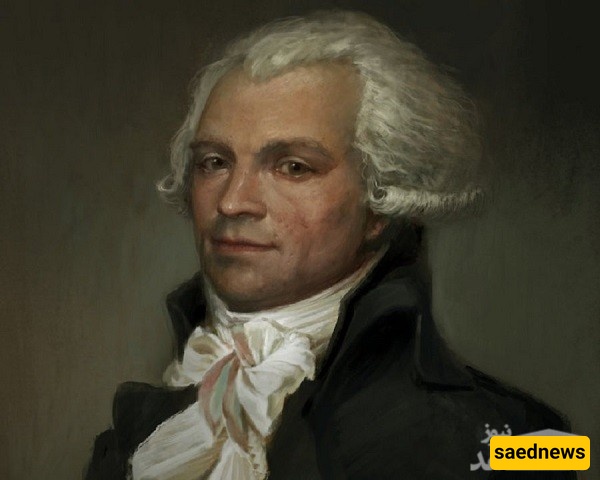
According to the Science and Technology Service of Saednews, and quoted from Mashregh News, Maximilien Robespierre was one of the leaders of the Jacobin Masonic club and one of the influential figures of the French Revolution.
Maximilien was born on May 6, 1758, in Arras, France. He lost his mother in childhood. Following this event, his father abandoned the children and left. Maximilien and his brother Augustin went to live with their maternal grandfather, while their two sisters were raised by their aunt.
Robespierre experienced a poor childhood and adolescence. At the age of eleven, he went to the prestigious Louis-le-Grand College for his studies. He was a diligent and hardworking student. He graduated in 1781 and began working at the Paris court. He became familiar with the works and ideas of Jean-Jacques Rousseau and was strongly influenced by them.
With the outbreak of the French Revolution in 1789, Robespierre found an opportunity to enter the political and social arena and exert influence.
From a political perspective, Robespierre supported a form of radical humanist democracy and followed Rousseau’s ideas regarding the general will. Emotionally, he was described as cold and reserved, dedicating his entire life to his political ideals. He had no interest in wealth and never married. He was short in stature and thin in build. He joined the Jacobin club and gradually became an influential political figure in France from 1791 onward.
Robespierre sought to overthrow the Bourbon monarchy and implement reforms in favor of peasants and the poor. From late 1792, the influence of the radical Jacobin faction gradually increased, and they took control of France.
During his time in power, Robespierre used institutions such as the Committee of Public Safety, the Revolutionary Tribunal, and the Jacobin Club to violently suppress his opponents. During this period, many of his opponents were executed by guillotine on his orders. In 1794, between June 12 and June 28, 1,285 people were beheaded by guillotine.
Robespierre aimed to use harsh repression to overcome opposition from the large capitalist class in France and the Girondins. However, his opponents eventually succeeded in overthrowing his regime. In Thermidor Year III (1795), Maximilien Robespierre, his brother Augustin, and Saint-Just were executed by guillotine by the forces that had overthrown them.
Robespierre’s short-lived government can be seen as representing the interests of the small bourgeois class in France, in competition with the larger republican bourgeoisie as well as royalist aristocrats.