SAEDNEWS: Amid Verbal and Mental Confusion, Focus Turns to Bluffing as Psychological Warfare Strategy
According to Saed News Politics Service, citing Fars News, Iran’s Foreign Minister Seyed Abbas Araghchi wrote on the social platform X that following the announcement of a ceasefire in Lebanon, the transit of all commercial ships through the Strait of Hormuz would be fully free for the remainder of the ceasefire period.
The message, presented as a limited and conditional diplomatic step, immediately triggered a wave of reactions from the U.S. President.
Within hours, he responded through multiple interviews with American media and dozens of posts on his personal social media account, presenting a completely different narrative.
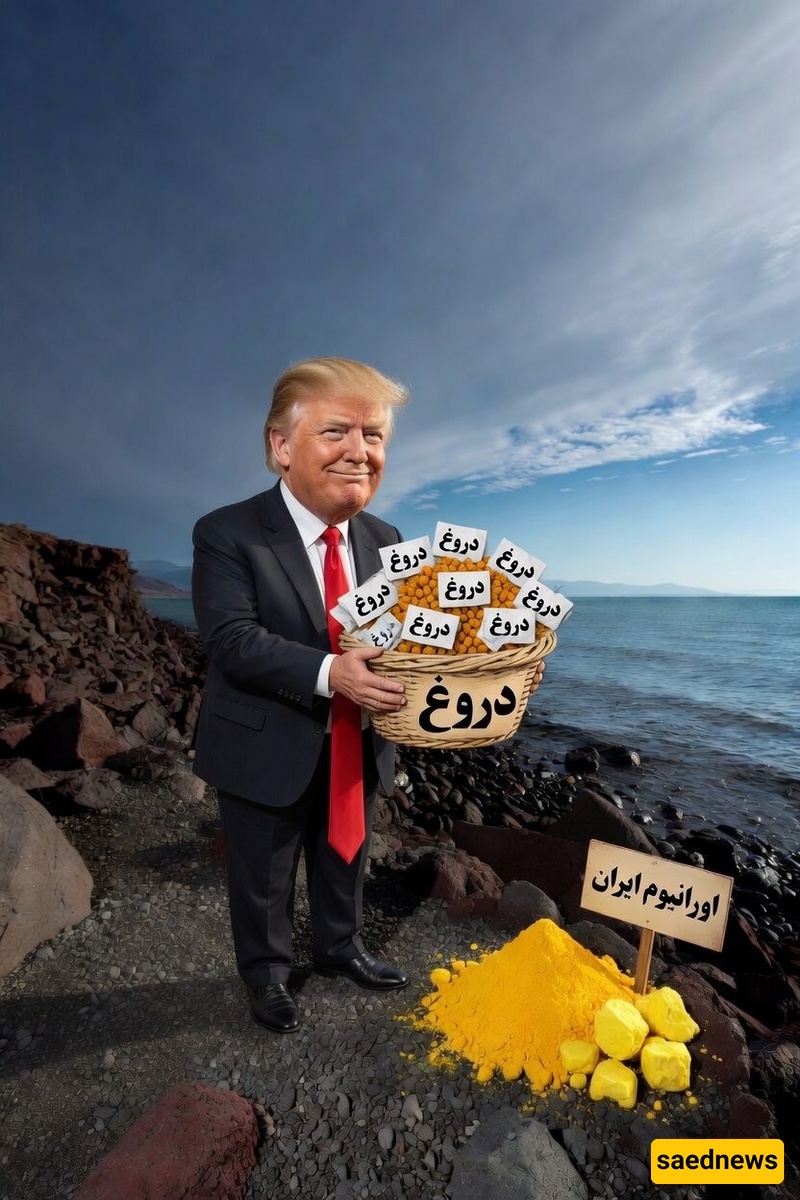
He claimed that Iran had indefinitely suspended its nuclear program, would receive no frozen assets, enriched uranium would be transferred to the United States, support for resistance groups had ended, and even “nuclear dust” would be removed from Iran using bulldozers.
He also said he had ended eight wars and that with the conclusion of the Lebanon conflict, the number would rise to ten. He further claimed the agreement would leave Israel “proud and victorious” and that nearly all issues had been resolved.
These statements, made following initial silence from the Iranian side, created concern and anxiety among segments of the public—although for many, the falsity of his claims was considered obvious.
Shortly afterward, Iranian officials rejected the allegations.
Mohammad-Bagher Ghalibaf stated that the U.S. president made seven claims in one hour, all of which were false, adding that such lies would neither lead to victory in war nor success in negotiations.
Foreign Ministry spokesperson Esmail Baghaei also emphasized that enriched uranium would not be transferred anywhere, including the United States.
Defense Ministry spokesperson Sardar Niktalai said the opening of the Strait of Hormuz was temporary, limited, and conditional on the absence of hostile military vessels, and that restrictions could return if pressure on Lebanon continued.
A senior Iranian official, speaking to CNN, described Trump’s claims as “false statements” and stressed that Tehran has never agreed to transfer its enriched uranium abroad or to halt enrichment indefinitely. He also warned that negotiations could collapse due to Trump’s “propaganda statements and bluffing.”
Independent reports also contradicted Trump’s statements. Data analytics company Kepler, which tracks maritime traffic, reported that ship movement remains restricted to authorized corridors.
The Wall Street Journal reported that Iran continues to impose limitations on shipping, with informed sources stating that Tehran has informed mediators it will collect fees, requires coordination with the Islamic Revolutionary Guard Corps, and retains the right to stop enemy vessels.
Ship tracking data showed that several tankers attempting to pass through the Strait of Hormuz changed course and avoided transit.
The Washington Post also reported that five oil tankers docked at Iranian ports for loading millions of barrels of oil, stating that global shipping data indicates no effective blockade exists.
The stark contradiction between U.S. presidential claims and on-the-ground reality raises a key question: why did he immediately launch such a barrage of statements following a limited diplomatic message from Iran’s foreign minister?
The answer, according to analysts, lies in a strategy of psychological and media warfare. Rather than simple communication, the U.S. president is accused of executing a deliberate bluffing strategy rooted in a consistent behavioral pattern and aimed at specific political and psychological goals.
Bluffing and exaggerating victories is not limited to this incident but is part of a long-standing behavioral pattern, according to American media and analysts—even those who previously supported him.
U.S. media and commentators have repeatedly referred to narcissistic traits and pathological lying tendencies in his behavior. In recent days, several outlets have also reported that he is experiencing a psychological crisis in which reality and imagination merge, turning minor events into “historic victories.”
Clinical psychologists and columnists in major newspapers such as The New York Times and The Washington Post have described this behavior as “professional bluffing,” driven by a strong need to portray himself as an absolute winner.
Even some former Republicans have stated that he replaces reality with what he wants people to believe.
This pattern was also visible during his previous presidency, including claims of the “greatest economy in history” and denial of the 2020 election results.
In the current case, he applied the same mechanism to a limited ceasefire and conditional maritime arrangements, portraying them as unconditional Iranian surrender.
The timing of his response—just hours after the Iranian foreign minister’s message—is not considered coincidental.
Analysts argue the rapid escalation served several strategic goals:
1. Political retaliation and domestic messaging
The U.S. president has faced criticism from Democrats over economic pressure, inflation, and energy prices. His response reframed the situation as a political victory, portraying Democrats as weak and unsuccessful.
2. Rebuilding domestic political support
The Iran conflict reportedly cost him support among segments of the American public concerned about inflation and fuel prices. By claiming “ten wars ended” and presenting a narrative of victory, he attempts to restore his political base ahead of upcoming elections.
3. Creating internal division in Iran
According to analysts, exaggerated claims such as indefinite nuclear suspension and ending support for resistance groups are designed to create confusion inside Iran, potentially weakening trust in negotiating teams and government institutions.
4. International pressure signaling
Statements about Israel emerging “proud and victorious” are interpreted as signals to regional allies that the U.S. remains capable of containing Iran.
5. Maintaining leverage
His insistence on conditions such as maintaining maritime pressure is seen as an attempt to preserve bargaining leverage during a fragile ceasefire.
6. Controlling global media narrative
The rapid flood of statements forces international media to focus on his version of events, marginalizing opposing narratives.
The overall assessment presented in the report is that the discrepancy between claims and reality reflects not battlefield outcomes, but a calculated psychological and political strategy aimed at multiple audiences: domestic voters, political opponents, international allies, and Iranian public opinion.
The core objective, analysts argue, is not accuracy, but influence over perception.