SAEDNEWS: Palestinians in Gaza are observing Ramadan amid a deepening economic collapse. An Al Jazeera analysis of official data shows that the Israeli regime’s two-year war and ongoing blockade have nearly doubled the cost of basic meals.
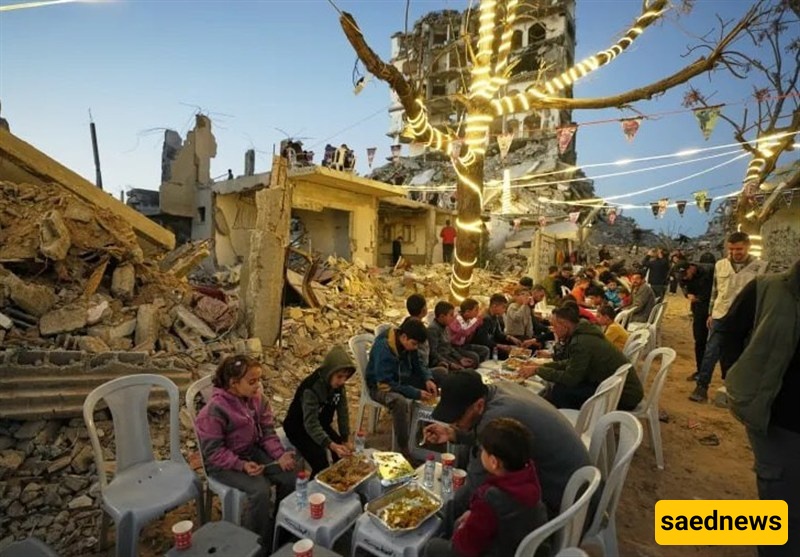
Despite a ceasefire reached in October, the Israeli regime continues to restrict the entry of food and supplies, causing severe shortages and sustained price inflation across Gaza.
For many families, securing bread has replaced the traditional festive preparations that once marked the holy month.
An analysis of data from Gaza’s Ministry of Economy shows that soaring prices for staple goods have made a complete iftar meal unaffordable for much of the population. During periods when the Israeli regime tightened its siege or fully closed Gaza’s crossings, food prices surged by more than 700 percent.
Although prices eased slightly after the October ceasefire, they remain far above pre-war levels. According to Mohammed Barbakh, director general of policy and planning at the Ministry of Economy, official figures tracking prices from before the war began on October 7, 2023, to the early days of Ramadan show sharp increases across essential commodities.
Data analysed by Al Jazeera indicate that chicken prices rose from 14 shekels ($4.49) to 25 shekels ($8.01) per kilogram, an 80 percent increase. Frozen fish climbed from 8 shekels ($2.56) to 23 shekels ($7.37) per kilo, a 190 percent jump. Frozen red meat increased from 23 shekels ($7.37) to 40 shekels ($12.82) per kilo, a 75 percent rise. A tray of 30 eggs now costs 35 shekels ($11.22), up from 13 shekels ($4.17), representing a 170 percent increase.
Vegetables, central to the Palestinian diet, have also recorded steep gains. Tomatoes have doubled in price, while cucumbers have surged by 300 percent, rising from 3 shekels ($0.96) per kilo to 12 shekels ($3.85). Cheese prices have increased by as much as 110 percent, raising the cost of suhoor, the predawn Ramadan meal.
Against this backdrop, the cost of preparing daily meals has escalated sharply. Based on data from the Palestinian Central Bureau of Statistics, Al Jazeera estimated that a basic iftar for a family of six—consisting of two chickens, rice, salad, appetizers, a soft drink, cooking gas, and oil—now costs about 150 shekels ($48), compared with 79 shekels ($25.32) before the war, reflecting a 90 percent increase. A simple suhoor of cheese, hummus, falafel, and bread now costs 31.5 shekels ($10.10), up from 18.6 shekels ($5.96). The combined daily expense to feed a medium-sized family stands at 181.5 shekels ($58.17), an 88 percent rise from pre-war levels.
Meanwhile, purchasing power has collapsed alongside rising prices. A United Nations report released in late 2025 showed annual per capita income in Gaza fell to $161 (503 shekels) in 2024, down from $1,250 (3,900 shekels) in 2022. The labor market has effectively disappeared as Israeli military operations destroyed workshops, farmland, and fishing fleets. In an October statement, Sami al-Amsi, head of the General Federation of Palestinian Trade Unions, said unemployment exceeded 95 percent.
“The worker is no longer looking for a job because there is no work at all,” al-Amsi said. “Today, the Palestinian worker is looking for a food parcel to survive.”
Economists link the sustained inflation directly to Israeli entry restrictions and fees imposed on incoming goods. Economic researcher Ahmed Abu Qamar said the Israeli regime’s policies on truck access and “coordination fees” have constrained supply.
“The humanitarian protocol stipulates the entry of 600 trucks daily, yet the Israeli occupation effectively allows only between 200 and 250 trucks,” Abu Qamar told Al Jazeera. He added that Gaza requires about 1,000 trucks per day to meet minimum demand.
Abu Qamar also pointed to a monopoly structure in which roughly 10 merchants are authorized to import goods through four Israeli companies, limiting competition and keeping prices elevated. He called for a return to a free market system and the full reopening of crossings to ease the burden on a population devastated by war and blockade.