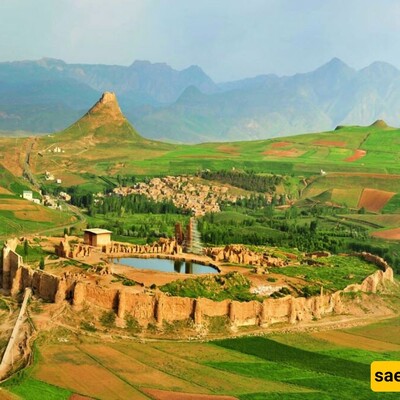
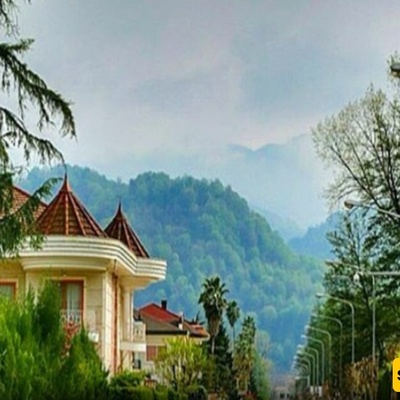
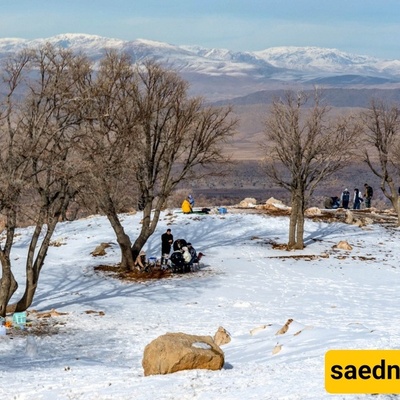
SAEDNEWS: Eyvanki city is located on one of the main and most important routes from the east to the west of the ancient and current time, a route that was once called the Silk Road. Eyvanki is located in Garmsar county , Semnan province, about 70 kilometers from Tehran.
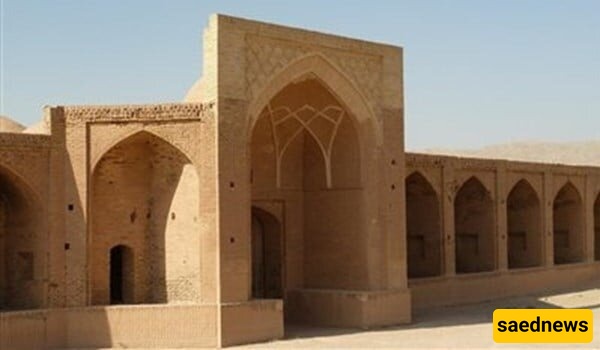
According to SAEDNEWS, Caravanserais of Shah Abbasi, Amiri, and Dadgar, the water mill, the brick kiln, and Haj Nabi Mosque are among the attractions of Eyvanki.
The prehistoric hills and sites in the Eyvanki region indicate that human settlement in Eyvanki dates back thousands of years, but this issue needs to be examined more closely. What emerges from the collection of evidence and the hills and ancient sites around the city of Eyvanki is that the ancient city of Eyvanki was located in a place other than the place where it is today.
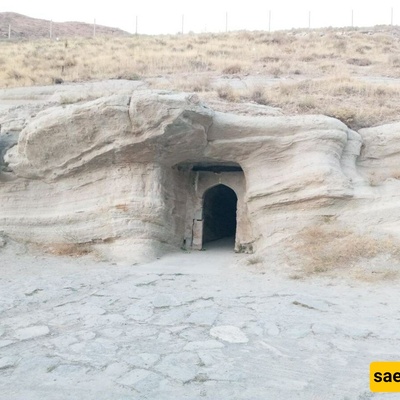
Probably, sites such as Jal Valley, Lower Castle, Malek Gore and Hussein's Hill Mound, are among the places that formed different parts of the old city of Eyvanki. Especially the Jal Valley and Lower Castle sites, which are almost connected to each other and represent a unified and coherent complex.
In this area, there are several castles, several holy shrines and caravanserais, which probably all together formed parts of a relatively large city. Many elderly people and researchers of Eyvanki also emphasize the fact that Jal Vally and Malek Gore were in fact the old city of Eyvanki which was destroyed by an earthquake. It was probably inhabited until the late Safavid era, when the city was destroyed by terrible earthquakes and the remaining population of the city moved to a new location.
Accordingly, it should be said that the new Eyvanki city was probably formed in the late Safavid era, and all the houses and traditional architecture of the neighborhoods and old ruins of the city belong to the period mentioned above.
A selection of attractions:
Haj Nabi Mosque: It consists of two surfaces on which carpets are laid in an east-west direction. Its southern Shabestan (an underground space prevalent in traditional Iranian architecture), where the mosque's mihrab is also located, is wider, and the northern surface is narrower. The arch of the mosque has a pediment and lancet arches. The mosque, which dates back to the mid-Qajar era, has been registered under the number 26046 on National Heritage List.
Haj Ismail Dadgar caravanserai: The caravanserai is located about 80 meters from the eastern side of Haj Nabi Mosque. Haj Ismail Dadgar caravanserai has various rooms and camel stable and has been registered under number 26667 on National Heritage List.
Amiri caravanserai: All parts of this caravanserai are built with raw brick and layered. The Amiri caravanserai was two-story, with rooms on the courtyard side and the cargo holds on the south side of the caravanserai. The rooms for travelers were on the second floor, and the rooms on the first floor were probably used to store merchandise. This monument has been registered under the number 26606 on National Heritage List.
Pahlavi Bridge: In the center of Eyvanki, there is a historical bridge that has historical and cultural value. This bridge was probably built between 1938 and 1940. It has been registered under the number 26056 on National Heritage List.
Eyvanki water mills: One of the rare and unique phenomena of Eyvanki, which is less common in other places, is the existence of dozens of water mills that can be seen in different parts, especially around the city. This number of mills was not to provide the flour needed by the people, but the flour they produced was transported to other places or used by a large number of caravans and travelers on the Rey route to Khorasan.
Eyvanki traditional brick kiln: This kiln was used to provide the bricks needed to build the Pahlavi Bridge in Eyvanki, and all the bricks for the bridge were supplied through the kiln. After that, the kiln operated for many years, but it has gradually been abandoned. The kiln is over 100 years old and was in use until about 40 or 50 years ago. It was registered under the number 26065 on National Heritage List.
Shah Abbasi caravanserai: The caravanserai is located three kilometers southwest of the city of Eyvanki. The caravanserai is one of the prominent four-porch buildings of the Safavid period which was registered under the number 1763 on National Heritage List in 1975.
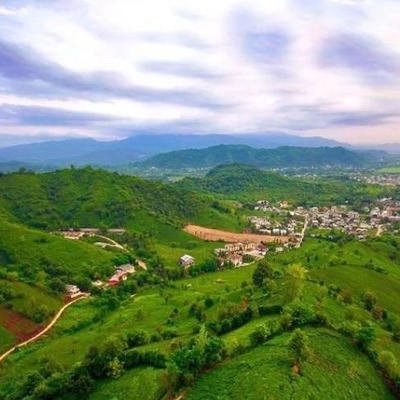
Behvard: The Behvard tourist area is located 32 kilometers northwest of Eyvanki, between the plain and the mountains.