SAEDNEWS: The seizure of Greenland may offer the United States short-term strategic advantages—but it also carries severe boomerang consequences.
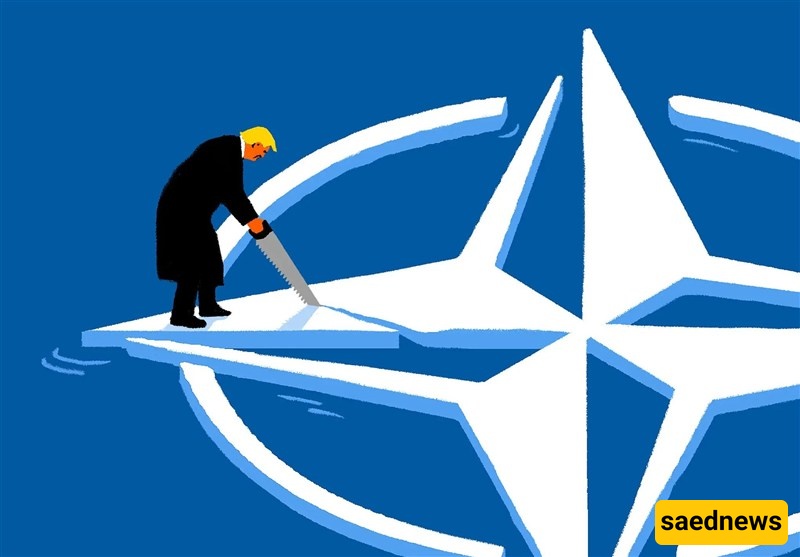
According to SAEDNEWS, For decades, the world has lived under a structure known as the “liberal international order”—a system in which the United States, as the dominant power, guaranteed maritime security, free trade, and stable borders.
But America’s new national security strategy in the current era has effectively declared the official end of that period. This shift is partly driven by the rise of new global power centers and by Washington’s inability to preserve the old order.
As a result, the United States no longer seems willing to play its once-unmatched role as the world’s “security provider.” A power that spent eight decades building this system now appears prepared to spend its strength tearing it down.
Americans—and many nations around the world—are entering the most dangerous era since World War II without the necessary psychological or material readiness. Eight decades of stability created the illusion that today’s conditions are the “natural state” of history.
In 1989, Francis Fukuyama argued in his “End of History” theory that liberalism had become humanity’s inevitable destiny. But today it has become clear that this period was not the end of history—it was a historical exception.
The post-1945 global order was built on an unprecedented bargain:
Countries devastated by war—such as Germany, Japan, the United Kingdom, and France—abandoned military expansion and territorial ambition, placing their security in the hands of a distant superpower. In return, the United States promised to use its power not to exploit them, but to support their economic growth.
Today, that deal is effectively broken.

Washington no longer views its allies as partners, but increasingly as “competitors” or “customers.” Threats of heavy trade tariffs, pressure on Asian and European allies to pay more for defense, and even threats against the territorial integrity of NATO allies—such as in the case of Greenland and Denmark—signal a transformation in U.S. behavior. According to this view, America is openly embracing imperial-style coercion and bullying.
The newest arena reflecting Washington’s new policies is Greenland.
The Trump administration has openly stated that it intends—by any means necessary, including military action—to seize and occupy the autonomous territory.
European countries have widely condemned this coercion, describing it as “economic blackmail.”
Denmark, as the direct holder of sovereignty over Greenland, has led the opposition. Danish Prime Minister Mette Frederiksen has emphasized that “Europe will not submit to blackmail,” calling the move a violation of allied relations.
France has also responded strongly. President Emmanuel Macron, in a social media post, compared the threat to Russia’s actions in Ukraine, saying:
“No threat or intimidation will change us—not in Ukraine, not in Greenland, and not anywhere else in the world.”
He also suggested that Europe should deploy its own “trade bazooka” against Washington.
This so-called trade bazooka—officially known as the Anti-Coercion Instrument—is a powerful mechanism approved in 2023, allowing the European Union to take retaliatory measures against “economic blackmail.” These steps include restricting trade permits and blocking access to the EU single market.
The United Kingdom, despite leaving the European Union, joined a joint statement with other countries. UK Prime Minister Keir Starmer called the move “completely wrong” and stressed that Greenland’s future must be determined by the Danish and Greenlandic people.
Germany, Sweden, Norway, the Netherlands, and Finland also issued a joint warning that such threats “weaken transatlantic relations and carry many risks.”
European Commission President Ursula von der Leyen and other EU officials also reaffirmed solidarity with Denmark and spoke of sanction tools to respond.
These condemnations reflect a unified European front—one that could ultimately isolate the United States.
From a strategic standpoint in the emerging global environment, the United States may no longer have any reliable friends or allies. Every relationship would become a temporary, harsh transaction.
That means America would have to spend more than ever on its military, because it would no longer benefit from stable strategic alliances that secure access to global markets and energy resources.
From this point forward, every inch of American interests overseas would have to be defended “with teeth and claws”—in direct confrontation with other major powers.
From the perspective of international relations, seizing Greenland could be interpreted as a violation of the principle of national sovereignty guaranteed by the UN Charter. Such a move would not only damage relations with Denmark—a key NATO ally—but could also trigger a chain reaction that harms U.S. interests.
For example, such an action could destroy European allies’ trust and lead to reduced cooperation in security matters. NATO—led by the United States—is founded on the principle of collective defense (Article 5). But if the U.S., as a hegemonic power, violates the sovereignty of its allies, the alliance could weaken—and even lead some members to withdraw or reduce their financial commitments.
This boomerang effect could threaten U.S. national security in the Arctic and beyond, because without Europe’s support, Washington may become more vulnerable to rivals such as Russia and China.
The foundation of global stability after 1945 rested on an unwritten arrangement: major powers such as Germany, Japan, Britain, and France accepted the loss of military ambition and spheres of influence in exchange for American protection. In return, the U.S. pledged not to use its absolute power to plunder them.
Today, the United States has “flipped the table.”
Washington has not only abandoned its allies, but has entered tariff wars against them and even threatened their territorial integrity.
In this new U.S. strategy, Russia and China are viewed not as enemies, but as “partners” to sit with at the table and divide the world like a cake.
This signals a return to a “spheres of influence” system—one in which each major power is free to do whatever it wants in its own region, as long as it does not cross into another power’s zone.
The result is that the United States has trapped itself in a strategic dead end.
On one hand, Washington wants to reduce its global costs. But on the other hand, by destroying the existing order, it may turn its former allies into hostile forces—possibly armed with nuclear capabilities—driven by resentment and distrust toward the United States.
America may save money in the short term with this strategy, but in the long term it could lose a level of security that no amount of wealth can buy back.