SAEDNEWS: The Persian Gulf Cooperation Council (PGCC) has once again issued a statement repeating its long-standing and unfounded claims regarding Iran’s three islands and the Arash gas field.
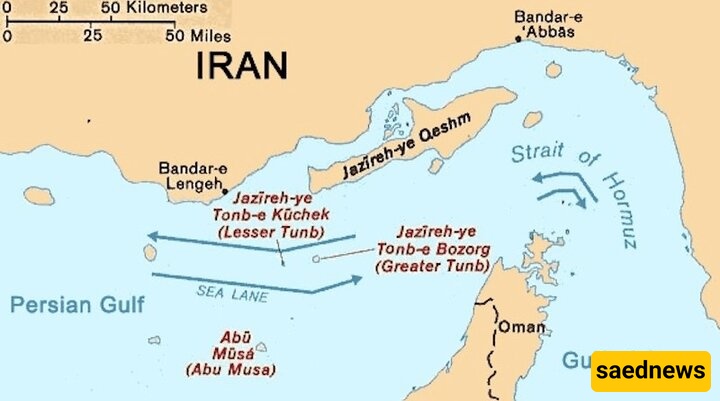
The Persian Gulf Cooperation Council (PGCC) has once again reiterated its long-standing allegations concerning Iran’s three islands and the Arash gas field, issuing a statement at the conclusion of its 46th summit in Bahrain on Wednesday night.
According to the PGCC Secretariat’s website and reports by Mehr News Agency, the council’s leaders released a statement reviving their recurring claims over the three Iranian islands and the Arash oil and gas field.
Despite the fact that Greater Tunb, Lesser Tunb, and Abu Musa islands are an integral part of Iranian territory, the PGCC claimed—without evidence—that they belong to the United Arab Emirates.
In its final communiqué, the council repeated its usual assertions, insisting that it maintains its fixed position and past resolutions condemning what it described as Iran’s continued occupation of the three Emirati islands.
Interfering in Iran’s territorial sovereignty, the PGCC further alleged that the UAE holds sovereignty over the islands, their territorial waters, airspace, and exclusive economic zone, framing them as part of Emirati territory.
Even though historical maps consistently confirm Iran’s longstanding sovereignty over the three islands, the PGCC continued its unfounded claims, asserting that any Iranian actions, decisions, or activities on the islands are “null and void” and do not alter what it called the UAE’s historic and legal rights over them.
The council also criticized Iran’s decision to designate the “National Day of the Three Islands of the Persian Gulf” (observed on 9 Azar / 30 November) in its official calendar—a move firmly grounded in Iran’s sovereign rights.
Although the islands are an inseparable part of Iran, the PGCC urged Tehran to respond to what it described as UAE efforts to resolve the dispute through direct negotiation or referral to the International Court of Justice.
The statement went further, condemning Iranian residential construction projects on the islands as “provocative actions” and expressing concern over what it labeled “tension-raising measures” by Iranian officials.
The PGCC also objected to Iranian military exercises and visits by senior Iranian officials, describing them as condemnable actions, while portraying statements by Iranian authorities about the islands as hostile and escalating, in violation of what it called the UAE’s sovereignty.
The council called on Iran to refrain from “provocative actions” and adopt positions that, in its view, could build trust toward a so-called fair resolution of the islands’ status.
On the Arash (Al-Durra) gas field, the PGCC claimed it lies entirely within Kuwaiti waters, asserting that the rights to natural resources in the shared neutral zone—including the Al-Durra (Arash) field—belong exclusively to Saudi Arabia and Kuwait, the only parties authorized to exploit them.
The council rejected any claims from other parties over the field or the adjoining neutral zone near the Saudi-Kuwaiti maritime boundary.
These statements come despite Iran’s repeated affirmations of its historical and legal sovereignty over the three islands and its rights to the Arash gas field.