SAEDNEWS: When starting music education, the first step is learning musical notes and their positions on the staff, which can be difficult at first. Musical notes are like the alphabet of a language; without them, learning music is not possible. Music is like a language, and you must first learn its notes to understand it.
According to SAEDNEWS, The santoor is one of the traditional Iranian musical instruments that is widely used today for both performance and education. If you have ever heard its sound, you know it produces a very pleasant and melodious tone. In this article, we will provide a simple introduction to learning how to read santoor sheet music.
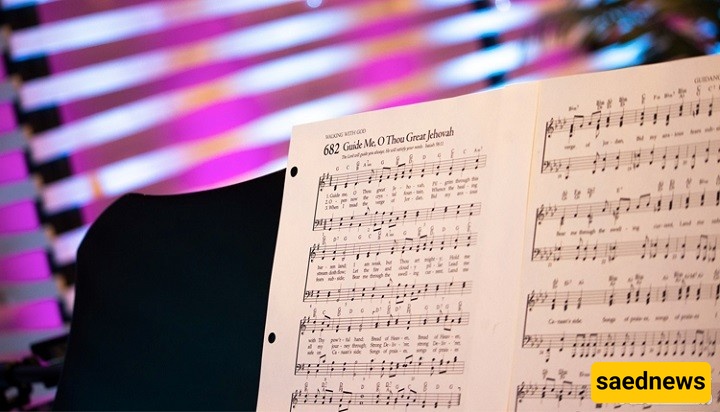
Music, like any other science, can be written on paper and shared among students. Therefore, to read musical symbols for the santoor, you need to learn musical notation. These symbols are called notes.
In general, notes are written on five parallel lines called a staff. The lines are counted from bottom to top, and notes are placed between or on these lines from left to right.
There are seven basic musical notes:
Do, Re, Mi, Fa, Sol, La, Si
These seven notes are repeated across the instrument’s range, forming multiple octaves. In total, depending on how they are counted, the santoor covers a wide range of repeated notes.
To understand all notes on the staff, you must first recognize the treble clef (G clef). This clef determines the position of notes on the staff; for example, the note on the second line is Sol, and other notes are identified relative to it. Practicing by copying notes repeatedly on paper is a useful learning method.
Each note has a specific duration or “beat value”:
A quarter note represents one beat.
A half note lasts two beats and is written as an open circle.
A whole note lasts four beats and is also an open circle without a stem.
Smaller rhythmic values include:
Eighth notes (two notes per beat)
Sixteenth notes (four notes per beat)
And even faster subdivisions for advanced rhythms
Silence in music is also represented by symbols:
Whole rest, half rest, quarter rest, eighth rest, and so on
Each indicates a different duration of silence corresponding to its note value.
A dot placed next to a note increases its duration by half of its value.
There are also symbols that change pitch:
Sharp (#): raises the pitch by a semitone
Flat (♭): lowers the pitch by a semitone
Natural (♮): cancels previous sharps or flats
Quarter-tone sharp (Sori): slightly raises the pitch
Quarter-tone flat (Koron): slightly lowers the pitch
These microtonal changes are especially important in traditional Iranian music.
A helpful method for learning notes is repeated writing and practice. You should write each note along with its name many times in a notebook.
Flashcards are also very effective for memorization. By reviewing them daily, you can gradually recognize notes on both treble and bass clefs. Mobile apps and spaced repetition systems can also help improve memory.
Music is not just a sequence of notes; it must carry feeling and expression. Listening carefully to your own playing, recording it, and practicing repeatedly can help improve musical expression.
After memorizing note names, you should train yourself to recognize notes visually. With enough practice, you should be able to identify each note instantly without mentally translating it into words. This skill is essential for fast playing.
Many pieces are based on musical scales. Recognizing these patterns helps you read music more quickly because you can identify groups of notes as a unit rather than reading them individually.
There are many mobile applications that help with note reading, such as:
Music Tutor
Vivace
Complete Music Reading Trainer
These tools are useful for daily practice.
A good method for beginners is practicing simple pieces that involve all fingers. In this method, only the first note or finger position is given, and the student must identify the rest.
Other useful strategies include:
Reading ahead while playing (anticipating upcoming notes)
Preparing the other hand in advance
Continuing even after making mistakes
Practicing slowly at first and gradually increasing speed
Chords are the foundation of harmony in music. You should first learn basic major and minor chords (such as C, D, E, F, G, A, B). Then move on to inversions and seventh chords.
With practice, you will begin to recognize chords as a single shape rather than individual notes, which greatly improves reading speed.
Understanding chords deeply is essential for efficient sight-reading and faster musical performance.