SAEDNEWS: Blue whales are the largest creatures that have ever lived on Earth. With a maximum length of nearly 30 meters and a weight approaching 200 tons, they are the undisputed heavyweight champions of the animal kingdom.
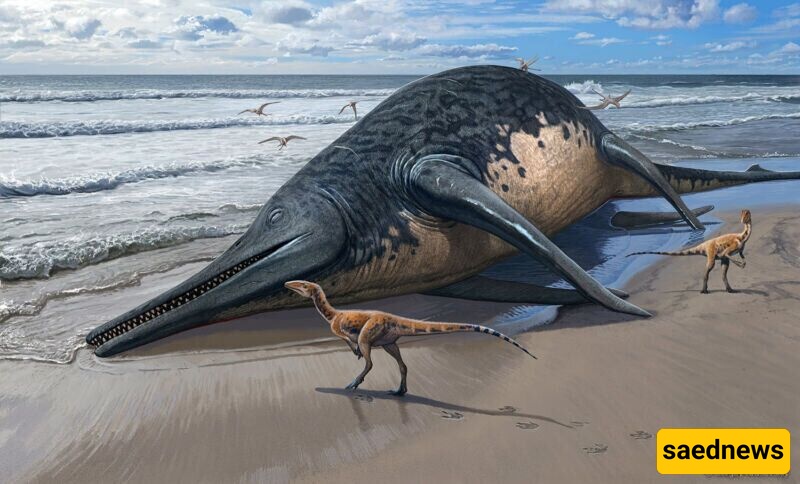
According to a report cited by Hamshahri, a team of British paleontologists has discovered the remains of a marine reptile during excavations on a beach in Somerset that could rival modern whales in size. Dean Lomax, a paleontologist at the University of Manchester who led the study, said:
“We can be fairly confident that giant ichthyosaurs as large as blue whales were swimming in the oceans around Britain during the Triassic period.”
Ichthyosaurs lived in the seas for much of the Mesozoic Era and first appeared about 250 million years ago. They had four paddle-like limbs, vertical tail fins that in most species bent downward, and generally resembled large reptilian dolphins with long, narrow, toothed jaws. Some of them were truly enormous.
The largest complete ichthyosaur skeleton discovered so far was found in British Columbia, Canada. It measured about 21 meters and belonged to a massive species called Shonisaurus sikanniensis. However, the new discovery suggests that some ichthyosaurs may have grown even larger.
What Lomax’s team found in Somerset was a thick, long, curved bone called the surangular — a bone located at the top of the lower jaw behind the teeth in reptiles. This bone measured 2.3 meters, making it about 25 percent larger than the corresponding bone in the skeleton of Shonisaurus sikanniensis.
Using simple scaling and assuming similar body proportions, the researchers estimated the total length of this newly discovered ichthyosaur to be between 22 and 26 meters, potentially making it the largest marine reptile ever identified.
But there was another important clue.
When the team examined the surangular, they found no signs of an external fundamental system (EFS), a band of tissue that forms in the outermost layer of bone and indicates a slowdown in growth — a marker of skeletal maturity. Its absence suggests that this giant ichthyosaur was probably still young and had not yet reached its full adult size.
In other words, this already enormous animal may have been even bigger when fully grown.