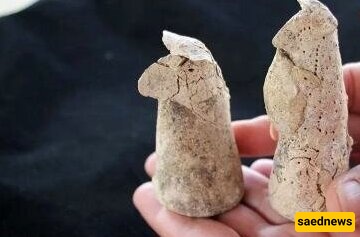
SAEDNEWS: Statues recently uncovered at the 9,000-year-old Ulucak Höyük site depict a man and a woman wearing unusual hats—head coverings that have never before been seen in any ancient finds from the region.
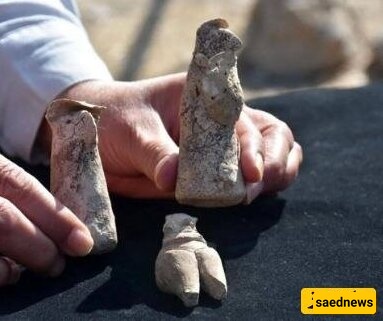
According to Saed News’ Social Affairs desk, the latest archaeological remnants discovered on a hill at the Ululak border, east of the Belkahve pass between the İzmir-Kemalpaşa plains, continue to shed light on the ancient culture of western Anatolia.
Excavations, supported by the Ministry of Culture and Tourism, have been ongoing since 2009 under the leadership of the Faculty of Literature and Pre-Asian Archaeology.
Professor Özlem Çuvik, who leads the excavation team in northwestern Turkey, reports that recently in İzmir Province along Turkey’s Aegean coast, figurines dating back to approximately 5700 BCE have been uncovered. These figures are believed to represent a pair of a man and woman, along with a child.
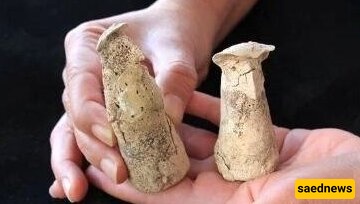
Çuvik explains that this year’s dig revealed intriguing finds. “The figurines were discovered in what we had assumed was a storage area and date back to around 5700 BCE. They appear to depict a man and a woman, with the woman holding an infant in her lap.”
She adds, “The hat-like coverings on these figurines are completely different from any discovered so far at Ululak and have no known equivalent in Anatolia.” For those who remember the Ululak hill female figurine from 2022, this distinction is striking. Çuvik notes that these figurines were crafted from baked mud and ceramic materials.
Systematic excavations at Ululak Hill, first identified by British researcher David French in 1960, resumed in 1995 under Professor Altan Çilingiroğlu, as a joint effort of the Ege University Prehistory Department and the İzmir Archaeology Museum.
Three cultural layers have been identified: a late Roman settlement at the top, early Bronze Age layers beneath early Byzantine settlements, and a late Neolithic settlement at the base.
In the late Neolithic layer—the oldest on the hill—researchers have uncovered kilns and ovens, daily-use spaces, and areas with specialized functions. Excavations have yielded numerous ceramic pots, tools made from gneiss, stone weapons, mother goddess figurines, and anthropomorphic vessels.