SAEDNEWS: Newly Unveiled Documents Reveal Unusual Experiment by the Doctor Who Autopsied President William McKinley
![The Doctor Who Injected the U.S. President’s Blood into a Dog [Photo]](https://en.saednews.com/storage/files/post/10dc7382-0ee4-409f-98c0-31cbfa469b11-yPOHS5aG0kMs6a2h/image.jpg)
Documents related to the autopsy of William McKinley, the assassinated U.S. president, reveal that after his death, a physician conducted unusual experiments on him. The doctor extracted bacterial samples from McKinley’s wounds and injected them into several rabbits and a dog. These documents are now being offered for sale for the first time.
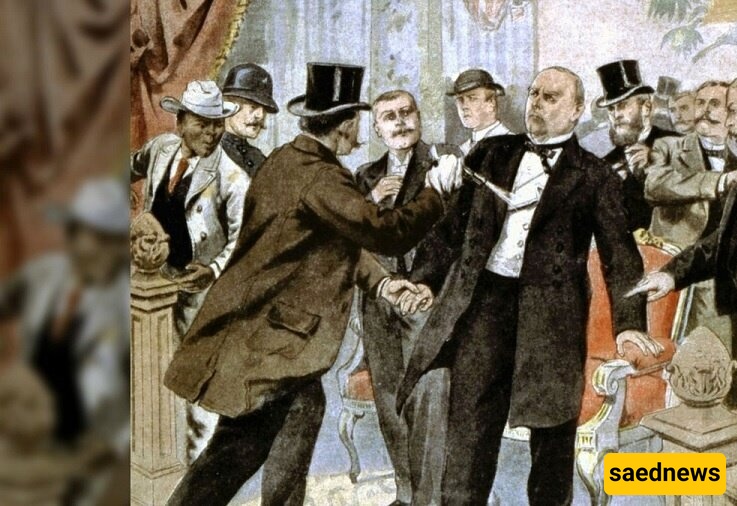
On September 6, 1901, Leon Czolgosz, pretending to shake McKinley’s hand at the Pan-American Exposition in Buffalo, New York, fired two shots at the president. The first bullet glanced off the buttons of McKinley’s coat, but the second struck his abdomen, piercing both the front and back walls.
McKinley was quickly taken to a nearby hospital, where gynecologist Dr. Matthew Mann operated on him. After showing initial signs of recovery, McKinley’s condition suddenly worsened, and he died on September 14. (Czolgosz was later executed in the electric chair.)
Doctors cited pancreatic necrosis as the cause of death—a condition in which part of the pancreas dies due to chronic infection, injury, or lack of blood flow.
Later, many criticized Mann for the surgery, reporting that he left the bullet inside McKinley’s body and failed to properly clean or close the wound. This negligence likely led to the infection that caused necrosis.
The fact that McKinley survived for days after the shooting sparked widespread speculation, including theories that Czolgosz had used bullets contaminated with poison or bacteria. Some conspiracy theorists still believe he was not acting alone.
To quell such rumors, a bacteriological examination was performed alongside the standard autopsy. Dr. Hermann Matzinger, a leading blood analysis expert of the time, conducted these additional tests and concluded that no poison was involved, and the necrosis was likely a result of the initial gunshot rather than surgical failure.
On January 9 of this year, the Rob Collection, a historical documents auction site, revealed a set of Matzinger’s personal papers related to the secondary examination, recently discovered by the physician’s descendants. The collection includes a notebook, letters, sample receipts, telegrams, a detailed copy of his original report, and an invitation to McKinley’s memorial service. These items are being offered for $80,000.
Matzinger’s documents detail how he reached his conclusions, including unexpected experiments on household animals. He recorded growing white bacteria from McKinley’s wound samples and injecting them into rabbits and a dog. It remains unclear whether the animals were his pets or lab specimens, or how he expected the experiment to confirm whether the bullets were contaminated.
The records do not report what happened to the rabbits, but Matzinger monitored the dog for several days, noting its body temperature at roughly 104°F (40°C)—higher than average for a dog according to the American Kennel Club—but apparently in good overall condition.
The documents also detail how Matzinger examined the weapons and bullets used by the assassin and analyzed McKinley’s blood for signs of poison. Letters between Matzinger and Dr. P. M. Rixey, who oversaw the autopsy, reveal that Rixey urged Matzinger to rush his findings. Matzinger, however, took his time, submitting the final report on October 2, 1901—18 days after McKinley’s death.
The Matzinger collection offers rare insights into how high-profile autopsies were conducted in the past. Discovering such documents is nearly impossible, highlighting their historical value.