SAEDNEWS: Donald Trump Advances Both Diplomacy and Military Pressure, Setting a 10–15 Day Deadline for Iran Nuclear Deal
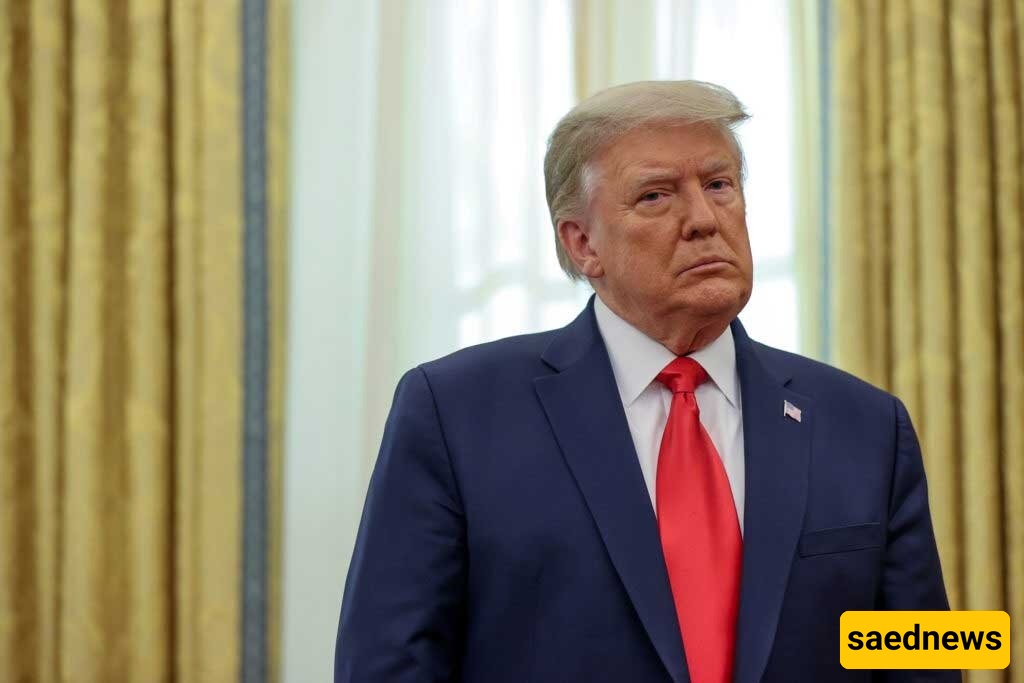
According to the political desk of Saed News, Fararu reported that in his latest remarks from the White House, President Donald Trump announced that he has given Iran a maximum of 15 days to reach an agreement over its nuclear program before Washington considers further action. The warning was delivered in blunt, threatening language, with Trump cautioning that “very bad things” could happen if diplomacy fails.
Trump made the statement during the opening of the first meeting of the “Peace Council.” In his speech, he emphasized that negotiations with Iran to resolve the escalating crisis were “going well,” but added that progress alone is not enough. He stressed that talks must result in a “serious agreement” with tangible outcomes.
Later, speaking to reporters aboard Air Force One, Trump repeated his position in even firmer terms. “Sooner or later, we will reach a deal… Either we make a deal, or it will be very unfortunate for them,” he said. When asked about a specific deadline, Trump replied: “You’ll probably know within the next ten days. I think that’s enough time… 10 or at most 15 days.” He again warned of “truly severe consequences,” insisting that “Iran has to make a deal.”
On Tuesday, Iranian and American negotiators met behind closed doors. While there were signs of progress, significant gaps remain before a final agreement can be reached.
Iran’s Foreign Minister, Abbas Araghchi, said both sides had reached an understanding on “guiding principles,” suggesting a potential foundation for broader negotiations. However, Washington struck a more cautious tone. White House Press Secretary Karoline Leavitt stated that “differences on certain issues remain and gaps have not been closed.”
Within U.S. decision-making circles, a clear divide has emerged. One faction advocates keeping the diplomatic window open, arguing that Tehran has shown flexibility that could lead to meaningful progress. Another faction warns against trusting Iranian assurances and insists that the option of a surprise military strike should remain on the table.
According to media sources, senior U.S. negotiator Steve Witkoff and presidential adviser Jared Kushner have offered assessments viewed positively by Trump. They have encouraged continued negotiations, pointing to what they describe as promising signals from Tehran that could advance talks without resorting to military action. Sources indicate that Trump places considerable trust in Witkoff’s evaluation and has granted additional time for diplomatic efforts to avoid losing a political path to agreement.
However, a more hardline group close to Trump remains skeptical. They argue that Iran is attempting to buy time to strengthen its bargaining position and ease U.S. pressure. In their view, Tehran is maintaining formal commitment to negotiations while avoiding major strategic concessions and continuing deterrent messaging — including joint naval drills with Russia in the Persian Gulf.
According to The Washington Post, U.S. military positioning in the region has been gradually reinforced in recent weeks. The aircraft carrier USS Gerald R. Ford is expected to join the operational formation after its deployment was extended and redirected from the Caribbean toward the Middle East to bolster deterrence.
Former U.S. Ambassador to Israel Daniel Shapiro warned that a joint U.S.-Israeli strike could inflict significant damage on Iran. However, he cautioned that such a conflict would not end quickly or without cost, emphasizing that Iran retains the capacity to impose reciprocal damage.
Reporting by The Wall Street Journal suggests that any potential strike plan would initially target specific military and government sites to gauge Iran’s reaction, while preserving the option of escalation if Tehran refuses to comply.
Analysts say such a limited strike would aim to demonstrate U.S. military strength and pressure Iranian decision-makers before activating broader options, including a comprehensive campaign against nuclear facilities and critical infrastructure. Washington appears to be attempting a calibrated strategy — combining military pressure and diplomatic threats — to compel Tehran to accept its terms without triggering a full-scale war.
The deployment of six Boeing E-3 Sentry aircraft to the region has raised eyebrows. The U.S. possesses only 16 of these airborne early warning and control aircraft, meaning nearly 40 percent of the fleet is now concentrated in the Middle East.
The E-3 functions as a high-altitude electronic command center. Its powerful rotating radar can detect targets more than 400 kilometers away, providing commanders with a comprehensive battlefield picture. Equipped with advanced pulse-Doppler radar technology, it can identify low-flying aircraft and track complex movements across challenging terrain.
Beyond surveillance, the E-3 coordinates operations by transmitting real-time data directly to ships, Patriot missile batteries, and aircraft, creating an integrated operational network. Even after a strike, it remains in the air to monitor potential retaliation and secure the safe return of friendly forces.
Despite its aging airframes, the Sentry remains a cornerstone of large-scale air operations. The simultaneous deployment of six aircraft signals heightened readiness and preparation for difficult scenarios.
Oil prices have surged to their highest level since last summer, reflecting fears of military confrontation between the United States and Iran. According to Axios, markets now face a dual threat: potential disruption of Iranian oil exports and broader instability in regional supply routes — particularly the Strait of Hormuz, through which roughly a quarter of global seaborne oil trade passes.
Brent crude recently surpassed $71 per barrel, while West Texas Intermediate traded near $66, with prices jumping more than 4 percent in a single day. Analysts warn that concerns extend beyond Iranian exports; any broader conflict could destabilize energy flows across the region.
Energy analyst Ben Cahill of the University of Texas at Austin noted that geopolitical factors, particularly Iran, are currently the primary driver behind rising prices. Meanwhile, Clayton Seigle of the Center for Strategic and International Studies outlined possible scenarios: a temporary blockade of Iranian exports could push prices up by $10–$12 per barrel, while direct attacks on oil infrastructure could cause a far larger spike. Disruption of shipping in the Strait of Hormuz could drive oil above $90 per barrel and significantly raise U.S. gasoline prices.
Ultimately, U.S. domestic politics may determine the scope of any confrontation. Given President Trump’s sensitivity to rising gasoline prices and their political impact, any military or diplomatic decision regarding Iran represents a delicate balancing act between economic considerations and foreign policy objectives.
For now, Washington appears to be walking a tightrope — projecting strength while seeking to avoid a broad conflict that could endanger U.S. forces, regional allies, and the stability of global energy markets. Oil prices may be the first barometer of how this high-stakes equation unfolds.