SAEDNEWS: The last garment that all Muslims wear is the shroud—a piece of cloth in white that covers the entire body. But have you ever wondered why the shroud is white?
According to Saed News, citing Neshan, in Islam, shrouding the deceased holds as much importance as clothing the living. Islamic teachings prescribe hygienic, social, and economic principles for burial. The practices of washing (ghusl), shrouding (kafan), and burying the dead are forms of respect for human dignity and carry no superstitious meaning. In Islam, death is not the end of life but a gateway to another realm and to divine mercy. Therefore, the deceased should be buried clean and in simple, pure clothing.
A common question arises: why is white used for the shroud, and what makes it preferable over other colors?
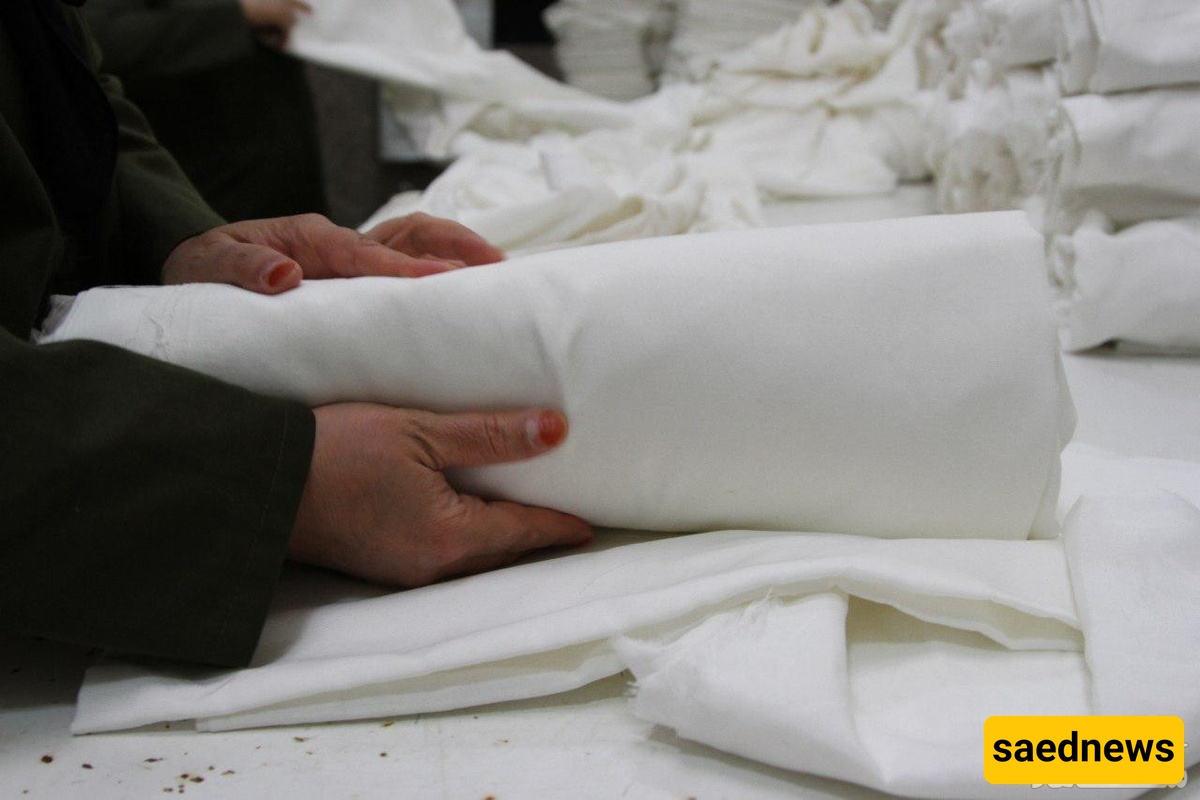
The shroud consists of three parts: one wraps around the waist, the second covers from the shoulders to the feet, and the third envelops the entire body, ensuring it is fully enclosed. The fabric is white because white naturally repels microbes, preventing germs leaving the body from returning.
It is recommended (mustahabb) that the shroud be clean and white, reflecting hygiene and respect for the Muslim body. Additionally, it is preferred that the shroud be made of cotton, while pure silk is prohibited.
Another reason for the uniform white color is to signify equality in death: all people are equal regardless of social status. White is recommended in religious sources, though not obligatory. Customarily, however, white symbolizes purity and cleanliness.
In a narration from Prophet Muhammad (peace be upon him), he said:
“There is no better color for clothing than white; wear white garments and shroud your dead in them.”
(Makarem al-Akhlaq, Vol. 1, p. 196)
Therefore, covering the deceased with white cloth is considered commendable (mustahabb) (Tahrir al-Wasilah, Vol. 1, p. 135). One of the reasons for this is the hygienic properties of white, as it repels microbes and prevents their spread from the body (The Welfare Principles of Islam, Vol. 2, p. 146).
The body may be contaminated with microbes due to illness, poisoning, or weakened immunity. Washing with pure water or water mixed with sidr (lotus) and camphor disinfects and cleanses the body, ensuring safety for a period after the ritual washing.
Beyond religious guidance, the color white is psychologically uplifting. Its brightness can reduce grief for the bereaved, making it a meaningful choice for the deceased.
Shrouding in impure materials, pure silk, or fabrics made from prohibited animal hair is not permissible by choice, and caution dictates avoiding gold-woven cloth except in necessity. Cotton white shrouds remain preferred (Risalah Tawdih al-Masa’il of Imam Khomeini, Issues 570–584).
In Wasa’il al-Shi‘ah, there are chapters on the recommendation for white shrouds and the discouragement of black shrouds (Vol. 2, Chapters 19 & 21). While black shrouds are allowed, they are disliked (makruh), similar to wearing black garments in daily life. The recommendation for white reflects cleanliness, uniformity, and the positive impact of light colors.
The clothing of the afterlife is chosen for simplicity, modesty, and accessibility.
All human beings wear similar garments in death, unaffected by social, political, or worldly status.
Individuals must leave behind worldly adornments and possessions, departing the world without material display.