Saed News: Scientists have discovered that as soon as a bee fully emerges from its pupa stage, it changes its sound and produces a loud trumpet-like call to inform worker bees that a new, fertile queen is ready to take over the hive.
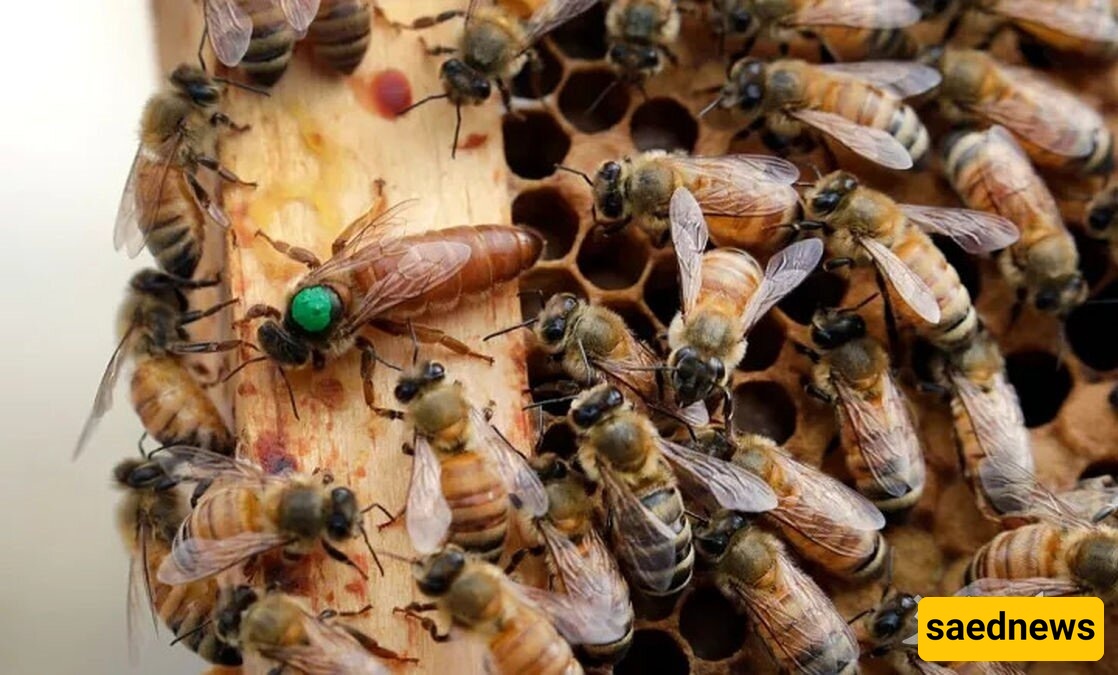
According to SAEDNEWS, researchers at the University of Nottingham in the United Kingdom have been able to record and interpret the communication sounds of queen honeybees using ultra-sensitive sensors.
The recent study, published in the scientific journal Scientific Reports, focuses on the process of how a hive queen is selected from among multiple pupae.
Worker bees place several eggs into pupal form inside special hexagonal cells in the hive and feed them exclusively with royal jelly. When these potential queens are ready to emerge, they begin making sounds similar to those of a duck.
Scientists have found that as soon as a bee fully emerges from its pupa, it changes its sound and emits a loud trumpet-like signal to inform worker bees that a new queen is ready to take control of the hive.
In fact, the trumpet-like sound is specific to a queen that has successfully emerged from her hexagonal cell, while the duck-like sound belongs to queen bees that are still inside their pupal stage and are signaling readiness to the worker bees.
If two queen bees emerge at the same time, they fight each other to the death until one of them wins.
Martin Benczik from the University of Nottingham, who led the study, said:
“Previously it was believed that these queens communicate with each other to show which one is stronger through loudness, but now we have evidence for an alternative explanation.”
He says that contrary to previous assumptions, the audience of the queen bees’ sounds is not other queens, but worker bees. Worker bees, whose job is to finally release the queen, ignore the duck-like sounds but respond immediately to the trumpet-like call and collectively prevent other queens from emerging from their hexagonal cells.
Researchers say that decisions regarding the queen are made collectively by worker bees, and they determine whether a new queen is needed or not.