SAEDNEWS: Russian Company Turns Pigeons Into Living Drones by Implanting Brain Chips for Surveillance Missions
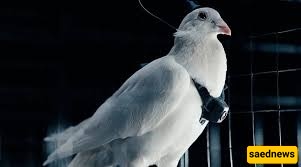
According to the Science and Technology Desk of SaedNews, Russian company Neiry has conducted a groundbreaking experiment in Moscow, transforming a group of pigeons into drone-like creatures by implanting neural interfaces and equipping them with small electronic devices.
Neiry reports that the first batch of pigeons fitted with neural implants successfully completed a test round-trip flight from the laboratory. The company is now studying the “flight characteristics” of dozens of chip-equipped birds. Some are being prepared for journeys spanning thousands of kilometers, while others remain in Moscow for ongoing experiments.
The system relies on electrodes implanted in specific regions of the bird’s brain. These electrodes connect to a neural stimulator and a controller housed in a small panel, which includes solar-powered electronics.
The controller receives a pre-programmed route similar to a conventional drone mission. The neural stimulator sends pulses that adjust the bird’s motivation to turn left or right. The bird’s location is tracked using GPS and other navigation methods.
Neiry claims that unlike trained animals, no behavioral conditioning is required: “Any animal gains remote-control capabilities after surgery.” Surgeons use stereotactic tools to precisely position electrodes in the brain, aiming for a 100% survival rate post-operation.
Some birds carry cameras functioning like surveillance systems for infrastructure or transport robots. Neiry says AI blurs people’s faces, and personal data is removed in compliance with the host country’s regulations.
The company envisions using these birds to monitor power lines, gas distribution centers, critical infrastructure, environmental assessments, industrial inspections, search-and-rescue missions, and security operations. According to Neiry, the cost of each bird is comparable to conventional drones—but their range and endurance are hundreds of times greater.
Alexander Panov, Neiry’s founder, notes that while the system is currently tested on pigeons, it could be adapted for other species: “Right now, it works with pigeons, but any bird could carry the equipment. For heavier payloads, we plan to use crows, and for monitoring coastal areas, seagulls.”
Neiry points out that similar research on controlling birds with neural interfaces has been conducted in China, South Korea, the U.S., and India. However, the company claims its team has moved past the experimental stage and is on the path to commercialization, with international markets in sight.