SAEDNEWS: Ardashir I of the Sasanian dynasty, commonly known as Ardashir Babakan, was the founder of the Sasanian Empire, ruling from 224 to 242 CE.
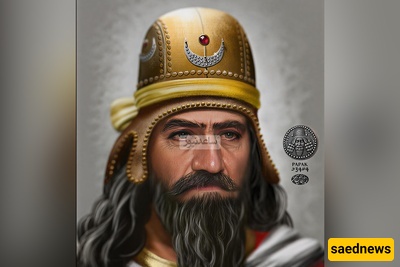
According to the History and Culture Service of Saed News, Artaxerxes I (Old Persian: 𐎠𐎼𐎫𐎧𐏁𐏂𐎠, pronounced Artaḵšatra), son of Xerxes I and Amestris, was the sixth king of the Achaemenid Empire, ruling from 424 to 465 BCE. He had several consorts, and because his children were born to multiple wives, rivalries arose among them.
After the deaths of his father Xerxes and his brother Darius, Artaxerxes, as the first legitimate heir, ascended the throne with the support of Artabanus, commander of the royal guard, despite having an older brother, Vishtaspa, satrap of Bactria. Artabanus initially placed Artaxerxes on the throne with plans to eliminate him later, but Artaxerxes learned of the plot and preemptively killed Artabanus and his sons, claiming the throne for himself and ruling for eight years.
Sources on Artaxerxes I
Historical records concerning Artaxerxes I are primarily found in two regions: Babylon, through the Murashu archives related to the reigns of Artaxerxes I and his son Darius II, and Egypt, through Aramaic documents, mostly from Elephantine. Among these are letters by Arsham, governor of Egypt, written on parchment. References to legal proceedings in eastern Iran appear for the first time after the early years of Darius the Great’s reign. Although recent excavations have prompted reevaluation of Artaxerxes’ role as a founder, interpreting these sources remains challenging.
The surviving documents are fragmentary and often unreliable, and dating them is difficult. Many Babylonian or Aramaic documents are dated according to the regnal years of Artaxerxes, but the long reigns of both Artaxerxes I and II complicate precise chronology. Sometimes, examining proper names offers clues, since neither scripts nor familiarity with ancient scripts alone suffice. Greek and Aramaic inscriptions in Asia Minor mentioning Artaxerxes’ reign, although historically significant, also pose difficulties. For example, the Greek inscription at Sardis records a statue dedication by a high-ranking official, while an Aramaic inscription in Cilicia indicates a Persian power center in that region. Greek historians occasionally confused different kings named Artaxerxes, contributing to ongoing debates over the timing of Ezra and Nehemiah’s missions in Jerusalem.
Name, Lineage, and Family
Artaxerxes’ name in Old Persian is Artaḵšatra, in Aramaic ʾrtḥšsš, in Biblical Aramaic and Hebrew ʾrtḥšśtʾ / ʾrtḥšstʾ, in Egyptian ʾrṭḫšsš / ʾrṭḫššs, in Greek Artaxéssēs (attested once in the Tralles inscription), in Latin Artaxerxes, and in Lydian Artakśassa. Greek forms such as Artaxerxes or Artoxérxēs are also found. He was given the epithet “Long-Handed” (Greek Makrocheir, Latin Macrochir, Longimanus), either reflecting the symbolic idea of “extended power” or, according to Plutarch, a literal long right hand—though the latter is likely figurative, as kings would conceal physical imperfections. Another interpretation is that the epithet reflects his political skill or his precedence in ascending the throne. Scholars such as Zarrinkoub suggest the epithet symbolized capability, not literal anatomy, and Ahmad Tafazzoli links it to the Old Iranian concept of dast (power).
Islamic sources record his name in various forms: Ardashir, Key-Ardashir, Artahshast al-Awwal, Ardashir son of Arkhshir, with epithets such as Tawil al-Yadayn (al-Biruni), Bahman son of Esfandiar son of Khosrow (Hamza), and Artahshasht (Ibn Ebri).
Artaxerxes’ wife, Damaspia, bore him Xerxes II, his heir. He had 17 sons from other wives, including Alogune the Babylonian, mother of Sogdianus; Cosmartidene, mother of Artistes; and Andia (Andrea), mother of Bagapaeus and Prince Parisatis. Darius II was also a son of one of his wives. His daughter, Parisatis (Paroushat), wielded considerable influence at the courts of Darius II and Artaxerxes II.
Succession
Accounts of the court plot that led to Xerxes’ death and Artaxerxes’ accession in 464 BCE differ in motive and execution. Artabanus, commander of the royal guards, allegedly conspired with other high-ranking officials, including Bagabish (Greek Megabyzos), Xerxes’ son-in-law, and Mehrdad (Ctesias: Spemters), the court chamberlain, to kill Xerxes and frame his eldest son Darius, thereby manipulating Artaxerxes into eliminating Darius. Artaxerxes may have killed Artabanus to prevent his own demise and seized power immediately. Subsequently, all conspirators were executed on his orders. According to Ctesias, Bagabish had warned Artaxerxes of Artabanus’ plot. After eliminating Artabanus, Artaxerxes defeated his brother Vishtaspa, who had rebelled with support from Bactrian nobles, solidifying his rule in 463 BCE. Xerxes, aged 55, was interred in a preconstructed tomb at Naqsh-e Rustam. Babylonian records and astronomical texts describe the plot, interpreted as divine punishment by Marduk, whose temple Xerxes had destroyed. Later Egyptian texts similarly portray Xerxes’ death alongside his eldest son as divine retribution for confiscating temple lands at Buto. According to Aelian, Xerxes was killed in his sleep by his son, though he does not specify whether Darius or Artaxerxes was responsible. Diodorus reports that conspirators misled Artaxerxes to believe Darius orchestrated the murder, leading him to kill Darius and his sons. Hystaspes (Vishtaspa), Xerxes’ second son and satrap of Bactria, was uninvolved in these events.
Beginning of the Reign
In 465 BCE, following the deaths of Xerxes and Darius, Artaxerxes I ascended the throne with Artabanus’ support.
One of his first acts was to change his name, which means “Power established through Arta (justice),” reflecting his commitment to political and religious legitimacy and the values of truth and order.
In 464 BCE, Artaxerxes reorganized the empire, appointing loyal followers as satraps. His brother Vishtaspa, satrap of Bactria, attempted to seize the throne with local nobility but was defeated and killed in two battles.
Fearing further court intrigues, Artaxerxes ordered the elimination of all remaining brothers. From that point onward, secret plotting became increasingly significant in the imperial court, tied closely to the stability of the monarchy.
Artaxerxes introduced himself in royal inscriptions as:
"I am Artaxerxes, great king, king of kings, son of King Xerxes, grandson of Darius the Achaemenid."