SAEDNEWS: Analysis of remains in deep, rimmed bowls found in Mesopotamia reveals that more than 5,000 years ago, people used these vessels to eat bone broths.
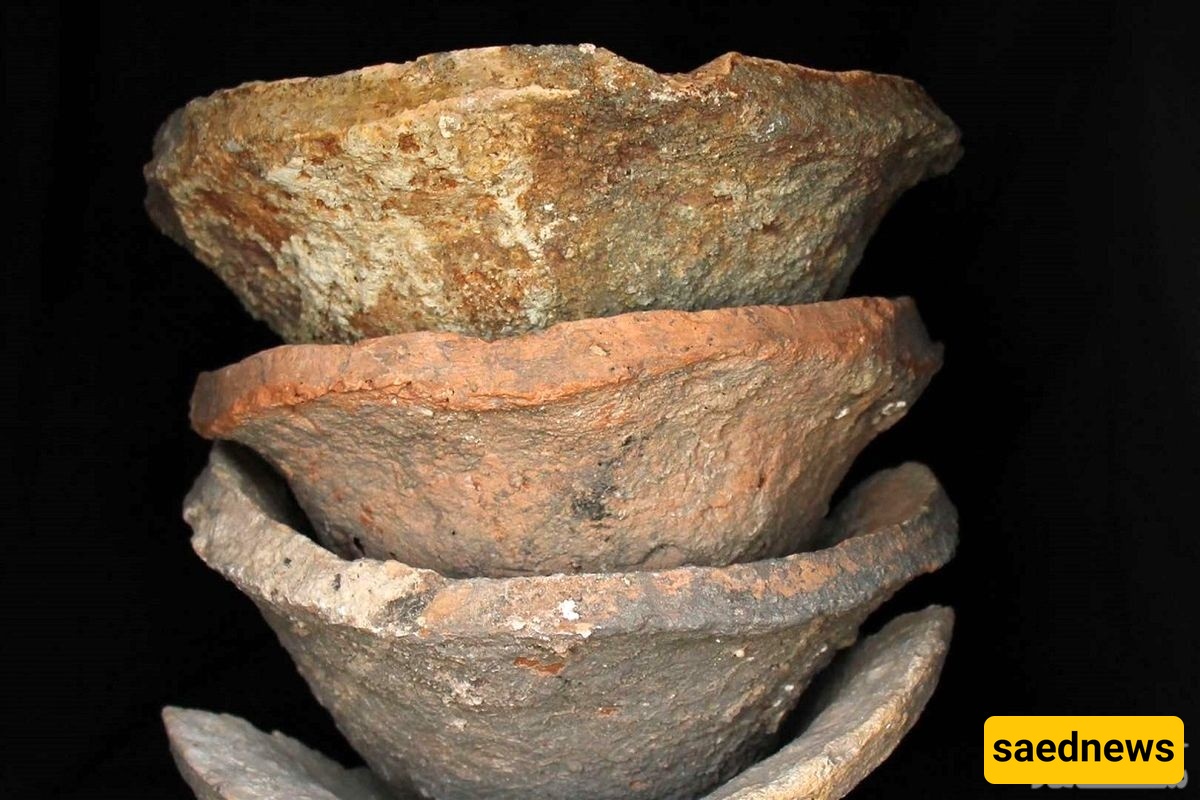
According to Saed News, citing Bartarinha, the world’s first urban communities emerged around 5,500 years ago in Mesopotamia—modern-day Iraq. Nothing symbolizes this era more vividly than the so-called “rimmed deep bowls,” the first mass-produced ceramic bowls dating back to the fourth millennium BCE. For more than a century, researchers and archaeologists have debated their function and the foods they once contained.
Reports indicate that these rimmed deep bowls held a variety of foods, but the exact dishes they served remained a mystery—until recently. Advanced archaeological studies have revealed that these bowls contained meat, particularly stews or broths flavored with bone marrow.

Chemical compounds and stable isotope signatures of animal fats were discovered in the rimmed deep bowls at the late Chalcolithic site of Shakhi Kora, located in the northern Diyala/Siirwan River Valley in northeastern Iraq. An international team led by Professor Claudia Glatz of the University of Glasgow has been excavating Shakhi Kora since 2019 as part of the regional Siirwan project.
Known as BRB bowls, these rimmed deep bowls were mass-produced, featuring thick walls and conical interiors. They appear to have spread from southern lowland regions, such as Uruk, across northern Mesopotamia, the Zagros foothills, and beyond. Over millennia, they have been found in late Chalcolithic sites, often near monumental structures.

Early written records and cuneiform tablets mention these bowls, typically as rationing containers used to distribute grain or grain-based foods among workers or state-affiliated personnel. Grains such as wheat, emmer (wild wheat), and barley—both taxable and storable—were long considered the backbone of wealth and power for early state institutions and elites.
However, a recent paper titled “Invisible Stews: New Results from the Analysis of Organic Residues in Rimmed Deep Bowls from the Late Chalcolithic Shakhi Kora, Kurdistan Region, Iraq” challenges this traditional interpretation. It notes: “Our results challenge conventional views that these bowls were primarily grain rations or bread molds. The presence of meat, and potentially dairy-based foods, in Shakhi Kora vessels confirms their multipurpose nature and highlights local culinary practices and uses.”
Dr. Elsa Procini of the National Patrimony Institute explains: “To identify the source(s) of lipids extracted from ceramic fragments, we used a combined chemical and isotopic analysis approach, aiming to gain new data on the function of BRBs.”

Professor Claudia Glatz, head of the Shakhi Kora excavation team, adds: “Our findings mark a significant advance in understanding early urbanism and the emergence of state institutions. They show that BRB use and the foods they held varied considerably across Mesopotamia, reflecting strong local agency in adopting and reinterpreting the social and functional role of these objects. This opens new avenues for studying the role of food and culinary practices in the development, trade, and eventual decline of early states at both regional and local scales.”
Professor Jimmy Tony, an environmental and climate science expert, remarks: “We collaborated closely with Claudia and her team for several years to minimize contamination during bowl collection. Seeing these results is exciting: residue fossil analysis and isotopic studies clearly demonstrate that these vessels once contained animal fats.”
The Siirwan regional project continues to reveal Mesopotamia’s archaeological landscapes along the river known in Kurdish as Siirwan and in Arabic as Diyala, in the Kurdistan region of Iraq.