SAEDNEWS: What may appear at first glance as a minor regional dispute—the Greenland crisis—has evolved into a revealing test of the Western security order, exposing NATO’s deep dependence on the US.
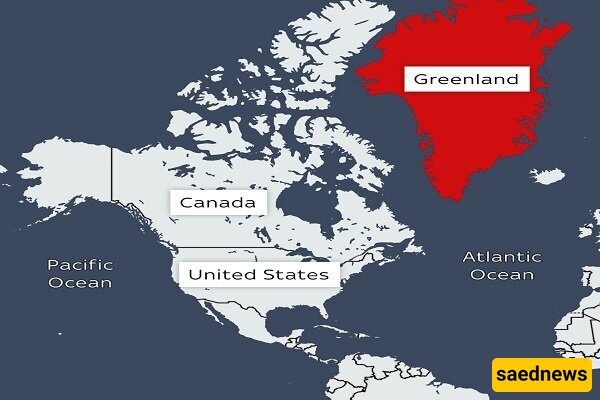
According to SAEDNEWS Quoting CNN, Trump’s recent threats have pushed NATO into an unprecedented crisis. By warning of new tariffs against European allies who oppose his efforts to assert control over Greenland, the US president has placed the world’s largest military alliance under extraordinary strain. These actions risk not only escalating tensions within NATO but also destabilizing Europe’s political and security balance—and potentially the global order itself.
Background of the Crisis
Trump has recently declared his intention to bring Greenland, a semi-autonomous territory of Denmark, under US control “by any means necessary.” He has threatened to impose a 10 percent tariff on imports from NATO member states starting February 1, followed by a 25 percent tariff from June 1, should they resist his plans.
According to Trump, the move is aimed at safeguarding US security interests, expanding defense capabilities, and countering potential Chinese and Russian influence in the Arctic. However, experts warn that such policies could undermine NATO’s foundational principle of collective defense under Article 5, placing the alliance itself at risk.
In both Europe and Washington, there is growing concern that the crisis could fracture NATO in ways that may prove irreversible. Such an outcome would represent a historic strategic victory for Russia and China and could stand as one of the most destabilizing legacies of Trump’s presidency.
Rising Alarm in the US Congress
Members of the US Congress—both Republicans and Democrats—have expressed mounting concern over Trump’s actions. Senators Rand Paul of Kentucky and Tim Kaine of Virginia are among those seeking to impose legal constraints on the president’s authority.
They aim to advance new resolutions to limit Trump’s war powers and to exert greater congressional oversight over trade tariffs and any potential withdrawal from NATO. Despite these efforts, conservative Republicans loyal to Trump continue to back him, and many lawmakers remain wary of confronting the president directly. Even as cracks appear in his political base, fear of his influence continues to deter open opposition.
European Allies Push Back
European leaders have responded to Trump’s threats with unusual unity and clarity.
UK Prime Minister Keir Starmer and Italian Prime Minister Giorgia Meloni have contacted Trump directly to voice their opposition to the tariff threats. However, analysts caution that diplomatic engagement and rhetorical pushback alone may be insufficient. Concrete measures to limit Trump’s authority, they argue, may be necessary.
NATO’s Structural Challenge
Since its founding, NATO has weathered numerous crises. In past decades, some members criticized Washington for its reluctance to intervene in global conflicts, including the wars in Yugoslavia and Iraq. Trump’s posture, however, marks a new threshold.
For the first time, NATO’s most powerful member—the United States—has effectively assumed the role of a direct threat to its own allies. While Trump’s interest in Greenland can be partially understood in the context of Arctic competition and access to natural resources, his justification for direct territorial control remains unclear.
The United States already maintains defense agreements with Denmark that allow military presence in Greenland. A push for territorial acquisition, experts warn, would fundamentally challenge NATO’s collective defense clause and could push the alliance toward collapse.
Economic and Political Fallout
Trump’s tariff threats could delay trade agreements between the US and Europe and negatively impact American financial markets. A weakened or fractured NATO would also affect US military deployments across Europe, the Middle East, and Africa, potentially shifting the entire burden of Arctic defense onto the US military alone.
At the same time, strained relations with European allies could complicate cooperation on broader security initiatives, including efforts to stabilize Gaza or resolve the Ukraine conflict.
Internal Challenges Among Allies
European leaders have increasingly called for greater strategic autonomy. However, building sufficient independent defense capabilities and effective security structures would require decades of sustained investment. Convincing governments and publics—long accustomed to reduced defense spending—to bear these costs remains a significant challenge.
Conclusion
Ultimately, NATO appears deeply vulnerable in its confrontation with Trump. A president who treats US military power as a personal asset and employs economic and military threats to advance individual objectives risks undermining a 77-year-old alliance.
The Greenland crisis, while seemingly regional in scope, has become a symbol of the fragility of the Western security order and NATO’s heavy reliance on US leadership. Preserving the alliance will require both congressional lawmakers and European leaders to demonstrate that unilateral presidential actions carry consequences—and that collective commitments remain the foundation of global security.