SAEDNEWS: Gold sheets, flat and as thin as paper, feature motifs of the god Frey and a goddess and date back to the Merovingian period in Norway. This era began around 550 AD and continued into the Viking Age. These gold sheets were likely used as votive offerings or sacrifices.

Archaeologists in Norway have unearthed 35 gold sheets depicting Norse gods at the remains of a temple once used by local sorcerers, according to Saed News’ society desk. The delicate sheets, as thin as paper, feature motifs of the god Freyr and the goddess Gerðr and date back to the Merovingian period, which began around 550 CE and continued through the Viking Age. They were likely used as votive offerings or sacrificial gifts.
Because the sheets lack any holes, it is unlikely they were worn as decorative jewelry. The first such gold sheets were discovered in Scandinavia in 1725 and eventually became known as gullgubber, meaning “ancient golden men.”
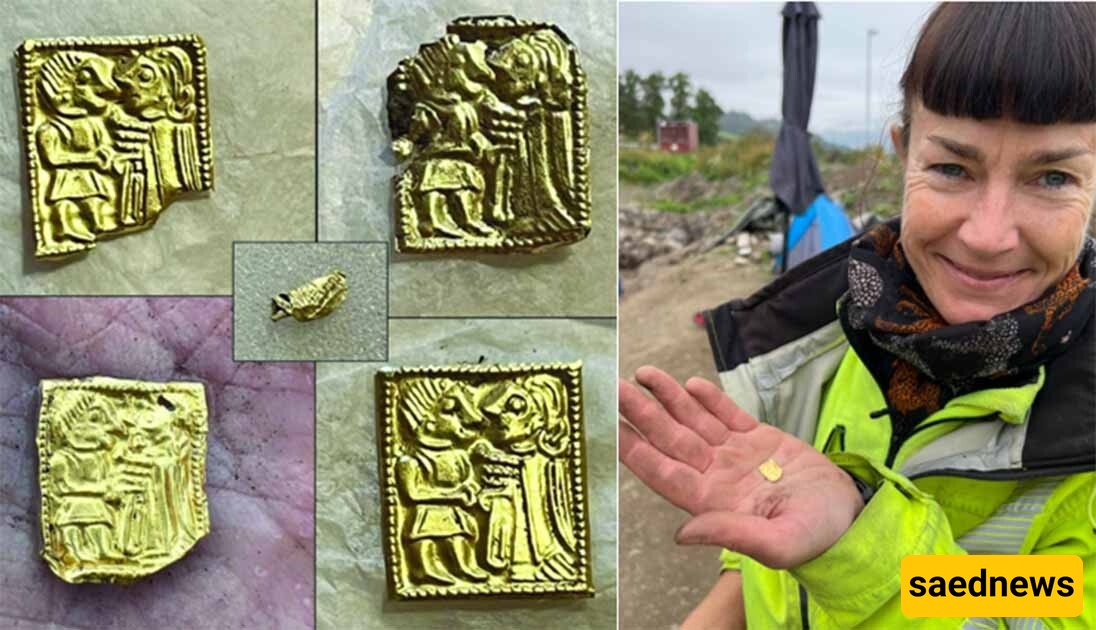
Catherine Steen, the archaeologist who led the summer excavations, described the find as “exceptional. Each gold sheet is relatively small, about the size of a fingernail.”
Some of the nearly three dozen sheets were found inside post holes that once held protective beams for the building, while others were uncovered in locations corresponding to the former walls of the structure.
The ancient building, located in the village of Hov in southern Norway, was first discovered in 1993. At that time, two gold sheets were found alongside the structure. Subsequent excavations in the 2000s uncovered 28 additional sheets.
Although similar gold sheets have been found in Norway and across Scandinavia—in Bornholm, Denmark, and Sweden—in buildings associated with sorcery, this marks the first time archaeologists discovered them in a smaller building.

Ingun Marit Rostad, an archaeologist at the Museum of Cultural History in Oslo, notes: “The number of these small gold pieces is increasing. Whether through excavations or metal detectors, they are appearing more frequently, suggesting they may turn up in a variety of locations across Norway in the future.”
In separate excavations, archaeologists discovered 30 more gold sheets elsewhere in Hov. Steen added: “We usually find these sheets in buildings used for religious purposes. Discovering them in a smaller building was a remarkable surprise.”

By examining post holes, researchers estimated the building’s length, noting that many homes from this period were 20 to 30 meters long.
Scholars have speculated about how the gold sheets ended up in the building. Some suggest the pieces may have served as entry tokens, but Steen believes it is more likely they were placed in post holes during construction. “Based on where we found them—inside areas that were once walls and beam sockets—it is unlikely these sheets were used as access tokens,” she explained.
Instead, the sheets were probably votive offerings intended to bless and protect the building.