SAEDNEWS: Colombia Plans to Raise a 300-Year-Old Sunken Ship Believed to Hold a $20 Billion Treasure
According to Saed News’ society desk, citing Sarpoosh, Gustavo Petro, the President of Colombia, has ordered the government to recover the remains of the famed sailing ship, the Galleon San José, from the Caribbean seabed as soon as possible.
On Wednesday, Colombia’s Minister of Culture, Juan David Correa, said, “President Petro wants this ship, which carries 62 cannons and has three masts, to be raised before the end of his presidential term in 2026. He has also requested the formation of a public-private partnership for this mission. It is one of the administration’s priorities, and the president has instructed us to accelerate the process.”
The Galleon San José, manned by 600 crew members, sank on June 8, 1708, during a battle with Britain in the midst of the War of Spanish Succession. Built in 1698, the ship was the crown jewel of the Spanish Navy’s treasure fleet.
In the early 18th century, such ships transported wealth and local resources from the newly “discovered” lands of the so-called New World to Spain. During wartime, the San José frequently traveled between Peru and Spain, carrying precious metals and jewels.
Reports vary on exactly what happened during its final voyage, but it is widely believed that the ship’s cargo included at least 200 tons of gold, silver, and emeralds mined in Bolivia.
After anchoring overnight near Barú Island off the coast of Cartagena, the ship encountered four British warships. In a fierce naval battle, cannon fire from the English ships critically damaged the San José, causing it to sink. All but 11 of the crew perished.
For nearly 300 years, the ship and its sinking remained shrouded in legend, as its exact location was unknown. In 1981, an American company named Glocca Mora claimed to have found the lost treasure and provided its coordinates to Colombia in exchange for a promise to receive half of the recovered wealth.
However, it was not until 2015 that former Colombian President Juan Manuel Santos announced that the Colombian Navy had located the shipwreck at a different site on the seabed. Colombia has never disclosed the exact coordinates, though the American company maintains that the wreck is in the same area it identified 34 years prior.
The ship, renowned for its immense treasure, has been dubbed the “Holy Grail of Sunken Ships.” While it remains underwater, its precise ownership is still disputed, and a legal battle over its treasure has been ongoing for decades.
Colombia asserts exclusive rights to exploit the ship’s contents, claiming the wreck lies in its territorial waters. Meanwhile, the American company Glocca Mora—now renamed—argues that it first discovered the ship’s coordinates in 1981 and deserves a significant share of the treasure. It has filed a lawsuit seeking $10 billion under a U.S.-Colombia trade promotion agreement.
Spain also claims a stake in the ship, while the indigenous Qara Qara people of Bolivia contend that their ancestors originally mined the metals and thus deserve a share.
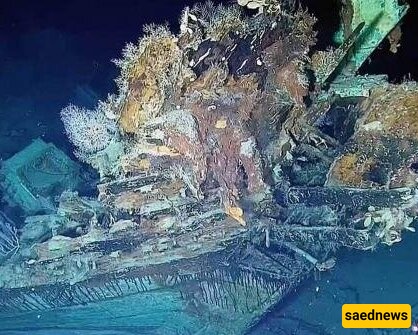
Last year, the Colombian military released footage from an exploratory mission to document the wreck. The images show war cannons, porcelain and clay vessels, glass bottles, and gold coins. Part of the ship’s bow, covered in silt and marine algae, is also visible.
According to the Colombian military, the mission confirmed that the San José has not been disturbed or altered by human activity.