SAEDNEWS: The Chinese willow, also known as Salix matsudana, is a species of the willow genus and family, native to northeastern China. This plant species was named in honor of the Japanese botanist Sadahisa Matsuda.

The red willow is a small tree that grows near wetlands and lakes, thriving in areas with moist soil.
The corkscrew willow, or Chinese willow, is a deciduous tree native to northeastern China. It has an upright growth habit and grows quickly. It is a dioecious plant, with male and female flowers forming in clusters on separate trees.
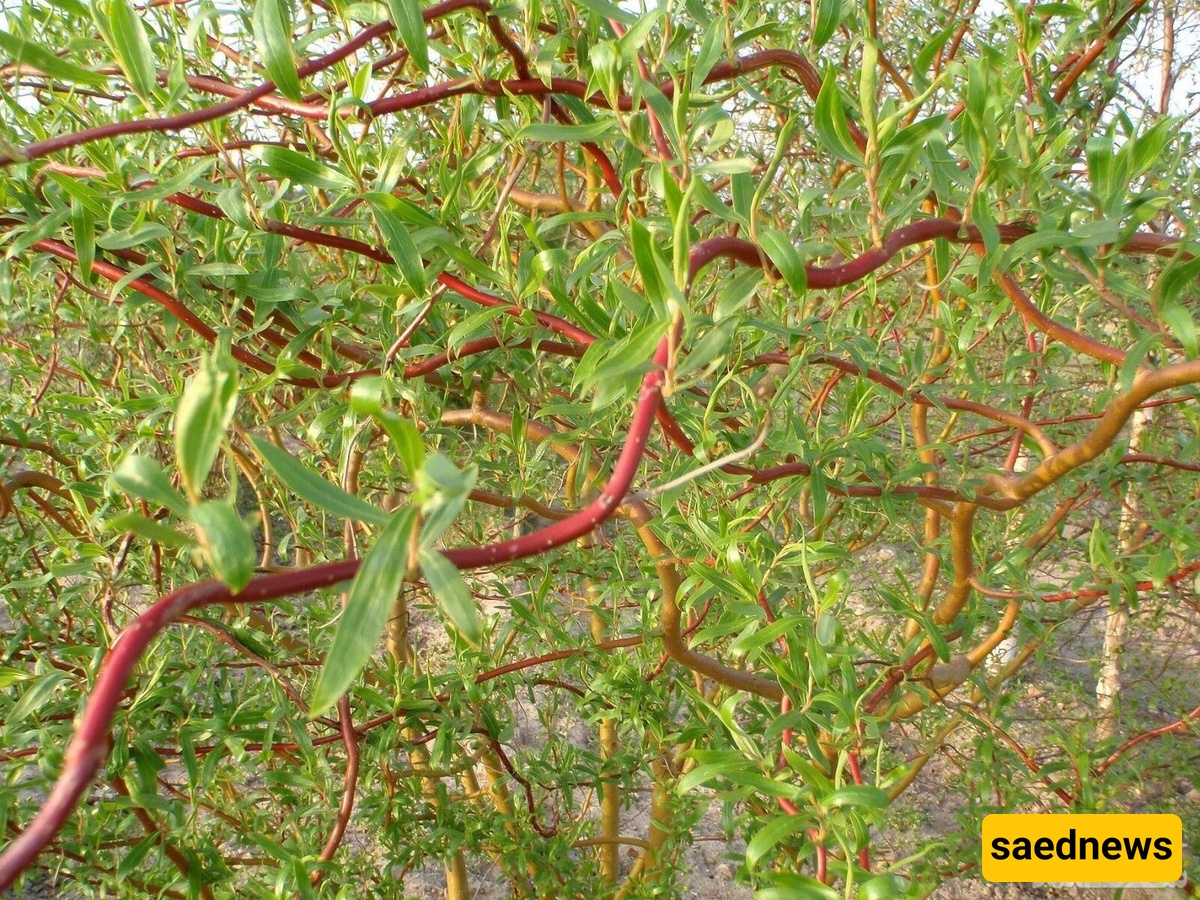
The leaves of this plant are long and narrow, light green in color, measuring 4 to 10 cm in length and 1 to 2 cm in width. Flowers appear in clusters in early spring. Its twisted branches give the tree a distinctive and attractive appearance. Some varieties of this species also have red-colored branches. The tree can reach up to 13 meters in height with a spread of 7.5 meters, though its growth depends on conditions. Red willow trees can grow between 3 to 9 meters tall. Multiple branches emerge from the main trunk, and the tree’s width usually expands along with its height, ranging from 3 to 13 meters.
The corkscrew willow has a unique appearance, characterized by its twisted and curled branches, which is why it is called “corkscrew.” Its leaves are long, narrow, and light green, measuring 4 to 10 cm in length and up to 2 cm in width. The bark of mature trees is brown.
Ideal Temperature: 20–24 °C
Minimum Winter Temperature Tolerance: –29 °C
Light Requirements: Full sun
Soil: Fertile, moist soil with good drainage
Watering: Young plants require regular watering until roots are established (especially when the soil surface dries). Mature trees need less frequent watering.
Fertilization: Apply slow-release complete fertilizer annually in early spring.
All types of willow cuttings root easily in water. Once roots are well developed, cuttings can be planted in pots or in their permanent location. Propagation is possible with 30 cm cuttings from spring to August. Seeds, which ripen in late spring, can also be used, though this method is rarely employed. The most effective method is by cuttings, which can be performed whenever water and temperatures of at least 13 °C are available.
Corkscrew willows are often grafted onto ordinary willow trees for display purposes, producing a visually striking tree with spiral branches.
Common issues include powdery mildew, fungal infections, canker, root rot, and crown gall.