SAEDNEWS: Archaeologists Discover 1,000-Year-Old Altar Built with Four Human Skulls in Mexico
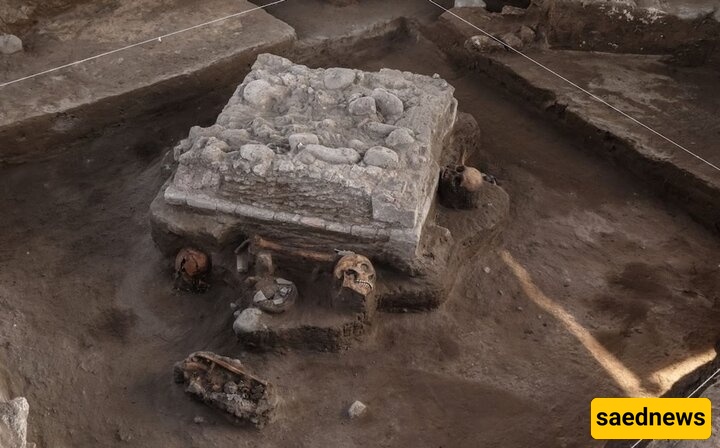
According to Saed News Social Desk, Mexico’s National Institute of Anthropology and History (INAH) has recently announced the discovery of a pre-Hispanic stone altar. The remarkably well-preserved find, which includes offerings and human remains, was uncovered near a Toltec cultural site known as “Tula Chico” in central Mexico during rescue archaeology efforts ahead of the construction of a new passenger railway line.
Construction of the Mexico City–Querétaro train began in April 2025, and official reports indicate that progress is currently around 10%. The recent discovery is part of ongoing archaeological investigations led by INAH. Victor Francisco Ordia Guillen, coordinator of the INAH project, said: “In the initial field surveys, we identified 12 archaeologically significant zones containing artifacts and structures of various scales.”
In October, the discovery of rock carvings at a nearby archaeological site forced an 8-kilometer rerouting of the railway line. The newly uncovered altar, a one-square-meter structure made of various types of stone, contained human remains, ceramic objects, and obsidian artifacts. Four human skulls and what appear to be leg bones were arranged around the base of the altar, suggesting a ritual function.
The altar was located approximately 300 meters from the main ceremonial center of the Toltec civilization. It dates back to around 900–1150 AD, the height of the Toltec period, and is believed to have been part of a larger complex that likely served as a residential area for local elites.
The artifacts and human remains recovered from the site are currently under analysis, and the area has been covered for preservation. However, the future of the site remains uncertain, as the railway route—only 600 meters away from the discovery—may still be subject to changes.
In recent years, railway construction projects in the region, particularly the Maya Train project, have sparked ongoing debates over cultural heritage protection and environmental concerns.