SAEDNEWS: A fossil hunter in Mississippi uncovered a massive fossil after spotting a strange curved object jutting out from a creek bank.
![Mysterious Object by the River Turns Out to Be a 10,000-Year-Old Ivory Artifact [Photos]](https://en.saednews.com/storage/files/post/9720f0b9-07f2-43f9-8e33-3a6099940511-JL9YZPkmnVOvritZ/image.jpg)
A fossil hunter in Mississippi has made a remarkable discovery after spotting a strange curved object protruding from the bank of a small stream: a massive fossilized tusk. Careful excavation of the site revealed a complete mammoth tusk dating back to the Ice Age.
The find occurred on Saturday, August 3, in Madison, by fossil collector Eddy Templeton. The Mississippi Department of Wildlife, Fisheries, and Parks reported: “When Eddy and the state paleontology team arrived at the site, they found the fossilized tusk in an astonishing condition—partially exposed above the water, beneath a small clay overhang in a minor drainage area.”
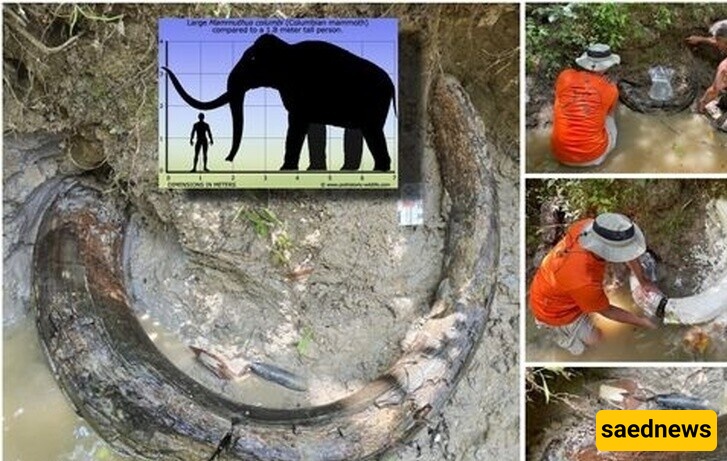
Because of the tusk’s pronounced curvature, experts believe Eddy and the team are dealing with a Columbian mammoth, rather than the more common mastodon. If confirmed, this would be the first discovery of its kind in the region.
The team spent a full day carefully removing clay and found that, despite being at least 10,000 to 13,000 years old, the fossil was remarkably intact. Such finds are extremely rare in Mississippi, where most fossil tusks are fragmented and generally attributed to mastodons.
Male Columbian mammoths could weigh up to 22,000 pounds, and both males and females possessed long, curved tusks. The tallest of these mammoths stood around 3.9 meters (12.8 feet) at the shoulder, weighing nearly 9,979 kilograms (22,000 pounds). Unlike the woolly mammoth, Columbian mammoths lacked thick fur.

To preserve the fossil, it was carefully wrapped in plaster and foil before removal. Sediment samples were also collected to study the environment in which the fossil had been buried.
Based on the tusk’s position in the stream, researchers believe the mammoth likely died nearby, and its remains were gradually moved along the waterway. The carcass was eventually buried in mud and clay, possibly following a flash flood.
After being encased in plaster, the fossil weighed approximately 272 kilograms (600 pounds). It is now housed at the Mississippi Museum of Natural Science, where it will undergo further study and preservation.