SAEDNEWS: Archaeologists in Denmark have discovered two iron spears decorated with gold—spears that were likely offered as ritual votives nearly three thousand years ago beside a sacred spring in Boslund.
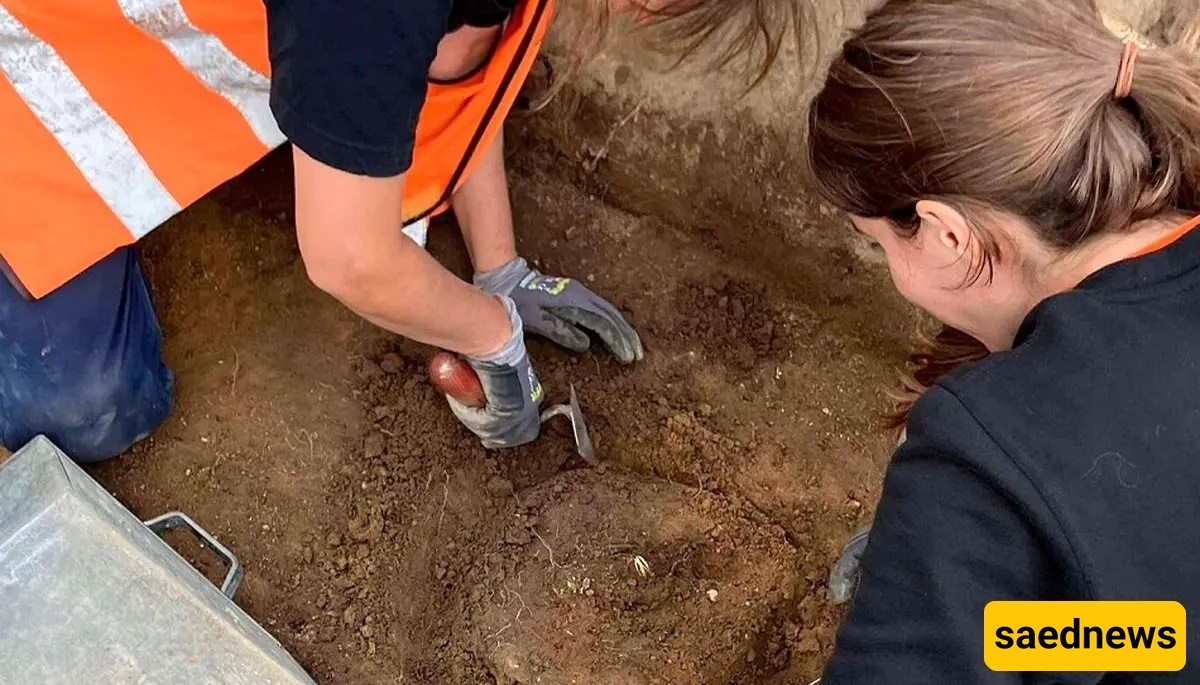
According to Saed News’ society desk, when archaeologists at the West Zealand Museum began excavating a new trench in Boslunde in August 2025, their goal was simple: to understand why, over nearly a decade, a variety of finds—from golden oath rings to thousands of delicate spirals—kept emerging from the same small plot of farmland in southwestern Zealand. They did not expect to rewrite the history of metalworking in Northern Europe. Yet, just days later, a gleam in the soil revealed that the site held another secret.
As reported by Faradid, the discovered object was tall, heavy, and clearly unusual: a corroded yet gleaming spearhead adorned with gold. Archaeologist Lone Claudi-Hansen could hardly believe what she was holding. She later recalled instinctively placing it back in the soil and stepping away in shock. In Bronze Age digs, iron weapons are not expected—let alone a ceremonial iron weapon covered in gold.
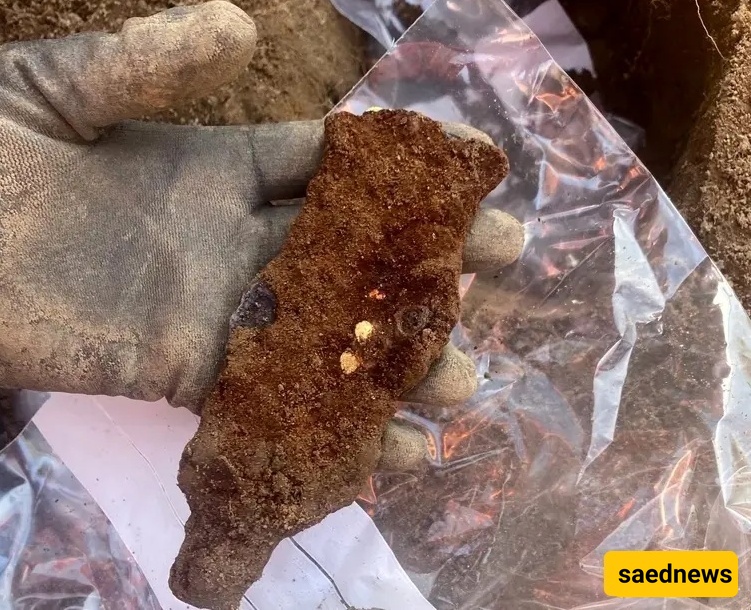
One of the gilded components at the moment of discovery
This moment of disbelief marked the beginning of one of Denmark’s most significant archaeological finds in decades. By the end of the same day, the team had uncovered a second spearhead, nearly identical to the first in shape and decoration. Laboratory analysis soon confirmed an astonishing fact: the weapons date to roughly 900–830 BCE, making them the oldest known iron artifacts found in Denmark.
A Sacred Spring Beneath the Gold
The 2025 excavation initially focused on a question that had puzzled researchers for years: why were so many valuable objects—including ten heavy golden oath rings and nearly 2,200 tiny spirals—buried here? The answer emerged when archaeologists uncovered a buried spring directly beneath the previous gold finds. The waterlogged environment had preserved organic materials exceptionally well, allowing precise dating through analysis of birch resin in the spear sheaths.
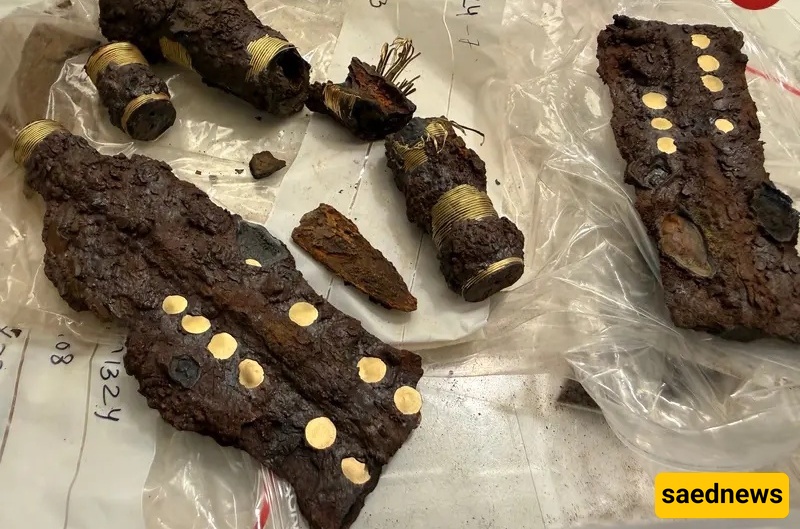
The gilded spear fragments after discovery
The spring changed everything. The discovery shows that the scattered wealth was not the result of accidental loss, random accumulation, or remnants of a raided settlement. This was a ritual site. The golden objects had been deliberately placed near and above flowing water, reflecting a tradition recorded across Europe, in which springs served as powerful gateways for offerings to the gods. In Boslunde, this practice continued throughout the Late Bronze Age, with nearby cooking pits indicating repeated gatherings, celebrations, and ceremonies.
The newly discovered spears fit perfectly within this ritual landscape. Their gold decorations, revealed through detailed X-ray imaging, demonstrate artistry at the highest level. The best-preserved spear measures 47 centimeters in length and is estimated to have originally been about 60 centimeters. No comparable examples have been found either in Denmark or across the Nordic region.
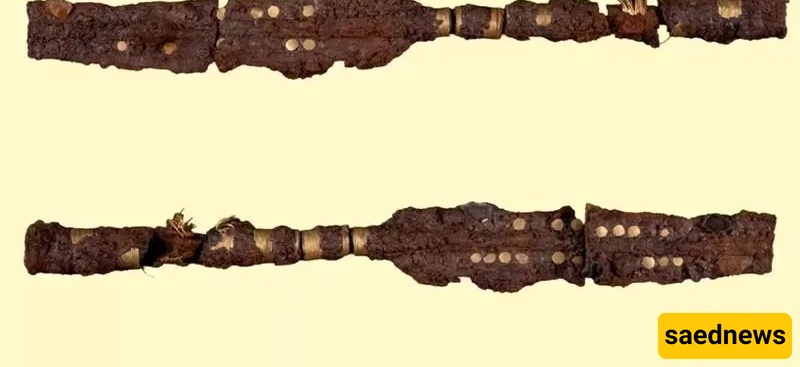
Reconstructing the complete spear from its fragments
Iron Before the Iron Age
Perhaps the most remarkable aspect of the find is its timing. Denmark’s Iron Age traditionally begins several centuries after the production of these spears. Their discovery shows that iron was not yet a local industry but a rare and valuable material brought into the region through long-distance exchange networks—centuries before large-scale local iron production became common.
Comparable early iron weapons exist in Greece and parts of Central Europe, but none bear gold decoration. The Boslunde spears thus represent an unexpected moment of technological and social fusion: a privileged Bronze Age Danish community possessed imported iron adorned with local gold artistry.
This raises fascinating questions about the people who lived here. Claudi-Hansen believes that the surrounding landscape, already notable for six rare gold bowls and concentrated collections of valuables, was likely the domain of an influential dynasty engaged in long-distance trade and ritual exchange. Their wealth was not simply accumulated; it was periodically deposited in the spring, transforming personal assets into sacred offerings.
Deliberately placing these objects in the spring reveals how rituals shaped the relationship between humans, metal, and the landscape. Water held profound symbolic meaning. The newly identified Bronze Age spring in Boslunde elevates the site from a mere farmland with unusual finds to a coherent ritual complex, where cooking, gatherings, and offerings were intertwined over generations.