SAEDNEWS: Decorating Cypress and Pine at Christmas: Inspired by Ancient Iran, Where These Trees Symbolized Resilience Against Darkness and Cold

According to Saed News’ social affairs section, citing Mehr News, in ancient Iran, during Yalda Night, a tree called the “Yalda tree” was decorated, usually using cypress or pine. It is said that the custom of decorating cypress and pine at Christmas was inspired by ancient Iran, as Iranians regarded these trees—especially cypress—as symbols of resilience against darkness and cold. On the first day of the month of Dey, they would stand before the cypress tree and vow to remain strong and steadfast until the next year, planting another cypress sapling in its place.
Additionally, according to Iranian beliefs, greenery at the start of the year symbolizes blessings for the entire year. This belief gradually gave rise to the tradition of planting sprouts (sabzeh) during Nowruz, replacing the Yalda tree as the symbol of renewal.
In Europe, however, the widespread use of Christmas trees began around the 16th century—though some accounts suggest the 14th century—first in Germany, then Poland, and eventually across the continent. The tradition in 16th-century Germany began when Christians brought decorated trees into their homes. At that time, some people created wooden pyramids adorned with evergreen branches and candles. Over time, the practice spread to other parts of Europe.
Early Christmas tree decorations included small fairies or bells at the top of the tree instead of angel figurines, meant to represent benevolent spirits or ward off evil. In Poland, trees were adorned with small angel figurines, peacocks, other birds, and numerous stars. In Sweden, wooden decorations painted in bright colors and shaped like children and animals made of straw and hay were popular. Danes used small national flags and ornaments shaped like bells, stars, hearts, and snowflakes. Japanese Christians favored fans and tiny lanterns.
Ukrainian tree decoration is particularly fascinating: spiders and webs are considered auspicious. According to an old legend, a poor woman who had no means to decorate her tree fell asleep saddened. By sunrise, she discovered that the Christmas tree was covered in spider webs, which the sun’s rays had turned into silver threads.
Today, Christmas trees come in countless forms worldwide, sometimes extremely expensive, with some even breaking records in size or cost.
For example, in early December this year, the world’s tallest floating Christmas tree was illuminated in Rio de Janeiro. Weighing approximately 542 tons and standing 85 meters tall, it features 3.1 million lights—setting a world record.
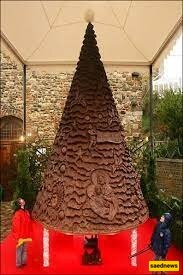
In France, known for its exceptional chocolate, a chocolate Christmas tree about 10 meters tall was created using over 400 kilograms of chocolate, with pieces to be sold for the benefit of orphaned children.
Recently, a Dubai hotel unveiled the world’s most expensive Christmas tree, mounted on a gold base and adorned entirely with gold and 180 diamonds, valued at around $11 million. A Japanese jeweler also showcased a 2.4-meter solid gold Christmas tree made with Disney Japan, containing nearly 20 kilograms of gold and priced at $4.2 million, on display until late 2012.
In early 2012, Legoland constructed the tallest LEGO Christmas tree, nearly 9 meters high, made of over 400,000 LEGO pieces, weighing 6 tons, and taking 10 weeks to complete. It was displayed until the end of 2012 before potential dismantling.
Eight years earlier, an oak tree—about 400 years old—was recognized as the largest Christmas tree. Decorated annually with over 5,000 lights, research indicates it was first used as a Christmas tree in 1928, standing 22 meters tall and 35 meters wide.
Ultimately, one enduring legacy of this festive tradition is that Christian communities, in exchange for the decorative trees used in their celebrations, plant modest saplings. This ensures a lasting memory of the holiday and aligns Christmas celebrations with the symbolic renewal and blessings of greenery, much like the Iranian tradition of Nowruz.