SAEDNEWS: China has unveiled Qingzhou, a next-generation cargo spacecraft designed to enhance resupply operations for the Tiangong Space Station, according to a recent report by CCTV.
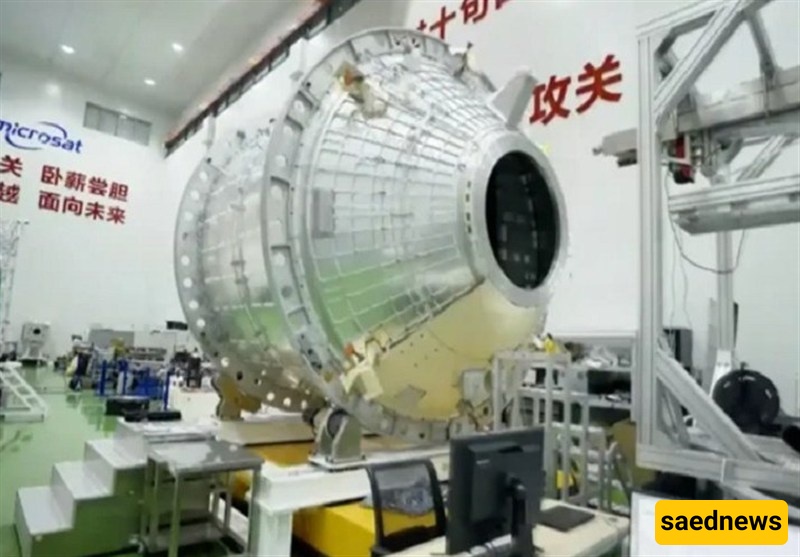
China’s Qingzhou spacecraft represents a significant advance in efficiency, automation, and mission capacity, reflecting the country’s expanding ambitions in orbital logistics.
Qingzhou is being developed as the successor to the Tianzhou cargo spacecraft, which has supported China’s Tiangong space station since 2017. The new vehicle is designed to carry heavier payloads, operate more flexibly in orbit, and provide improved long-term logistical support for the permanently crewed station.
Compared with Tianzhou, Qingzhou incorporates higher levels of automation, experimental reusability features, and more advanced docking systems. Engineers have focused on reducing the need for human intervention during critical phases of flight by integrating upgraded onboard control and monitoring technologies.
“We have now conducted large-scale experiments and are currently loading and verifying the status of the remaining individual systems, as well as carrying out final testing. The overall test results are quite good,” said Wu Huiying, deputy chief designer of the Qingzhou cargo spacecraft, in an interview with China Central Television (CCTV).
Wu’s comments indicate that the project is approaching the final stages of pre-launch preparation, which typically involve comprehensive system validation and environmental endurance testing. These procedures are essential to ensuring reliable performance, particularly given the spacecraft’s increased technical complexity.
In addition to servicing the Tiangong station, Qingzhou is viewed as a technological stepping stone toward future lunar-orbit and deep-space logistics missions. Its modular architecture could eventually support cargo transport linked to China’s planned lunar base or its crewed lunar exploration program targeted for the 2030s.
CCTV reports that Qingzhou’s propulsion efficiency, docking interfaces, and cargo handling systems have been redesigned to support heavier loads with reduced fuel consumption. This makes the spacecraft suitable for both low Earth orbit operations and longer-range missions beyond Earth’s immediate vicinity.
Although no official date has been announced for its first launch, analysts estimate that Qingzhou could fly within the next two years, potentially aboard a Long March 7 rocket from the Wenchang Space Launch Site on Hainan Island. Such a mission would mark an important milestone in China’s space logistics capability, placing it alongside established cargo systems such as NASA’s Cygnus and SpaceX’s Dragon.
The Qingzhou program reflects China’s broader shift toward modernized orbital operations emphasizing efficiency, autonomy, and sustainability. Each generation of Chinese cargo spacecraft has introduced improvements aimed at reducing turnaround time and increasing delivery precision.
If the spacecraft performs as intended, it could enable more frequent resupply missions, improved support for long-duration crewed stays, and new possibilities for in-orbit servicing. This would further enhance Tiangong’s ability to function as a largely self-sustaining space station.
Overall, Qingzhou illustrates the global trend toward replacing disposable spacecraft with reusable, scalable systems designed for long-term space infrastructure. As the spacecraft enters its final testing phase, it highlights how closely China’s space logistics development is tied to its long-term goals in human spaceflight and lunar exploration.