SAEDNEWS: A rare gold pendant from the 9th century has been discovered in Norfolk, England, providing an unusual glimpse into the religious and cultural landscape of early medieval Europe. The piece, which depicts John the Baptist, has been described as “unique and mysterious,” raising significant questions about its origin and cultural context.
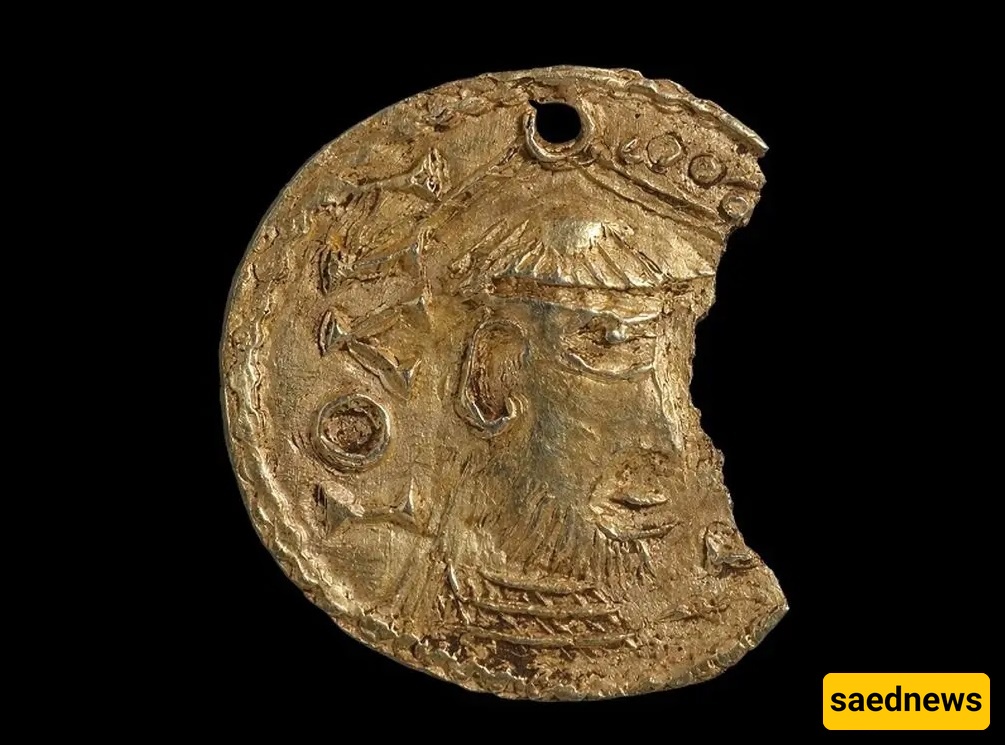
According to the Saed News , citing Faradid, in an interview with the BBC, Simon Copeland, a numismatics expert, A rare and unusual gold pendant discovered near Danton is challenging historians’ understanding of early medieval Europe. According to Simon Copeland, a numismatics expert speaking with the BBC, the artifact is unprecedented among known examples from this period.
The pendant, crafted from gold and modeled on a solidus coin—a type commonly used in late Roman and Byzantine times—was found by a metal detectorist. Although the piece is incomplete, the surviving details reveal distinctive features.
On one side, a bearded man in profile is identified in Latin inscriptions as John the Baptist. The reverse retains partial Latin text interpreted as “Baptizer and Herald,” making this coin an exceptionally rare find.
In the 9th century, coins minted in Western Europe, particularly during the Carolingian dynasty, typically depicted kings or emperors rather than religious figures. Depictions of saints or Christ were more common in the Byzantine Empire.
What makes this discovery extraordinary is its divergence from established historical patterns. Copeland notes that no other Carolingian coins featuring John the Baptist are known, suggesting this pendant may be unique.
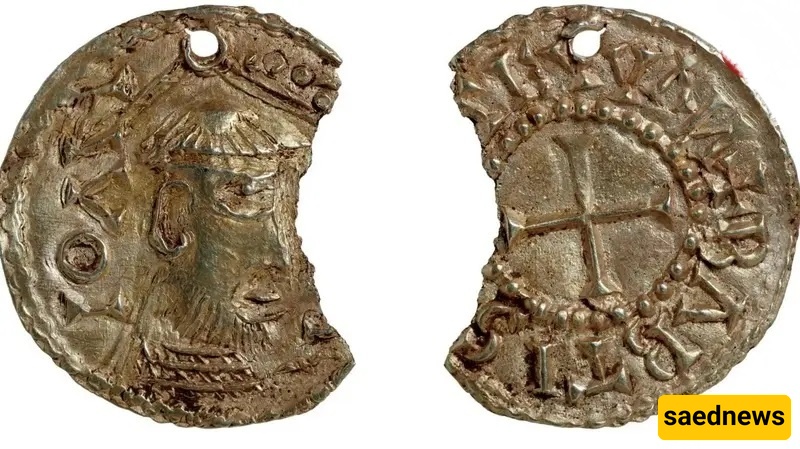
The lettering style dates the piece to the late 9th century, likely the 860s or 870s. Yet the imagery and symbolism do not conform to norms of the time. Historical context adds to the mystery: around 870, the kingdom of East Anglia had fallen to Viking invaders, who were still largely pagan. Why such a strongly Christian icon would be produced or used in that environment remains unclear.
This discrepancy has led researchers to speculate about unknown cultural exchanges or influences between Viking and Christian communities. Copeland described the pendant as “like trying to fit a hexagon into a square hole,” emphasizing its resistance to conventional historical classification.
The presence of John the Baptist is especially significant. In Christian tradition, he validated Jesus’ mission through his baptism in the River Jordan—a role rarely commemorated on Western European coins of the era.
Currently, the pendant is undergoing formal treasure evaluation in the UK. A judicial authority will determine whether it qualifies legally as a “treasure.” If confirmed, it may join the collection of Norwich Castle Museum, which has expressed strong interest.
Despite its incomplete state, the pendant offers a rare window into a period of cultural transformation. It raises fresh questions about religious symbolism, artistic expression, and cross-cultural interaction in early medieval Europe.
With its unusual design and distinctive iconography, the mysterious pendant may ultimately reshape historians’ understanding of Viking-Christian interactions, revealing a 9th-century European cultural landscape more complex than previously thought.