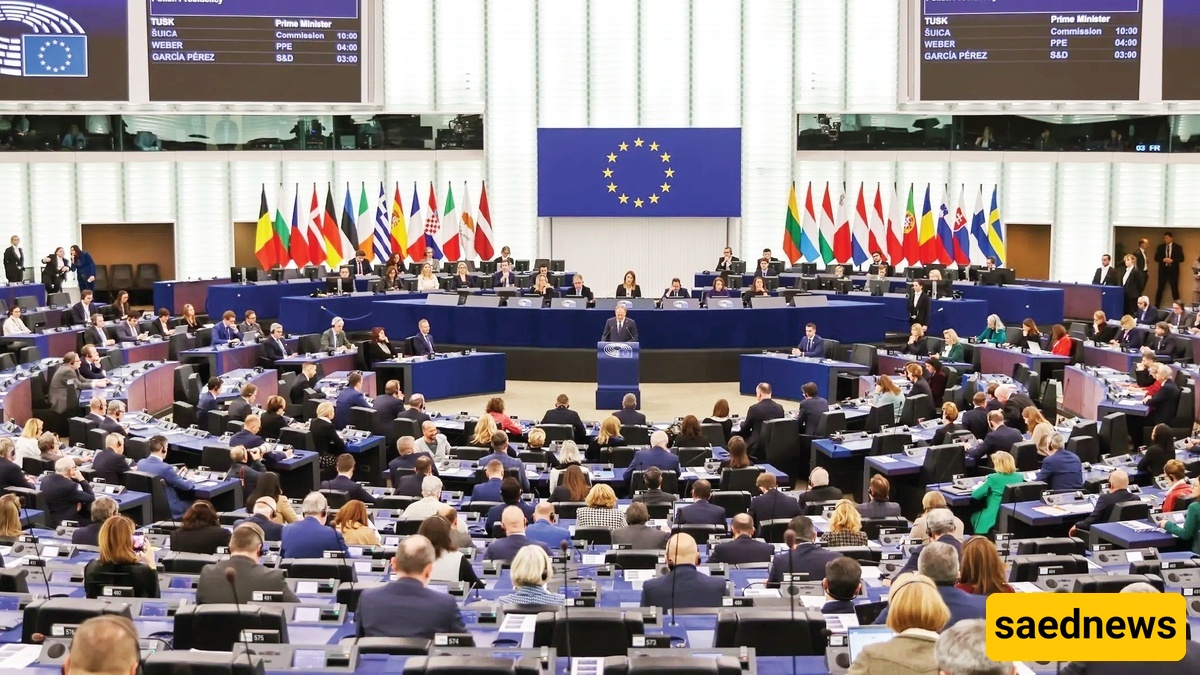
SAEDNEWS: On Thursday, the Council of the European Union illegally and unjustifiably designated the Islamic Revolutionary Guard Corps as a so-called terrorist organization.
According to the political desk of Saed News, Javan newspaper reported:
On Thursday, the European Union, in what has been described as an illegal, unlawful, and unjustified move, classified Iran’s Islamic Revolutionary Guard Corps (IRGC) as a so-called “terrorist organization.” This political decision comes at a time when Europe is perceived as weak, and every recent action reflects this fragility. Bloomberg also described Europe as a symbol of weakness: “Poor Europe! In the turbulent period following the Cold War, it has become a symbol of weakness. Europe’s situation is largely the result of its own choices and failures.”
Why, according to the report, is Europe “ungenerous”? Because it was the IRGC that confronted ISIS across West Asia, preventing the extremist group from turning toward its creators. And why is Europe said to be in decline? Because even if the U.S. military were to deploy in Greenland—or in Paris or London—Europe lacks the capacity to label that army as a terrorist force or an enemy, and can only passively observe such aggression.
A Bloomberg columnist recently criticized European countries for their inaction in the face of U.S. intimidation under former President Donald Trump, writing that the EU has become a symbol of weakness. The column notes: “Poor Europe! In this turbulent era following the Cold War, it has become a symbol of weakness. Europe’s position is largely the result of its own choices and failures.”
The article continues: “By the 2010s, Europe depended on Russia for energy, on the U.S. for security, and on China for economic growth. Now it must pay the price for these dependencies.”
The piece questions whether European governments could ever label the U.S. military’s real-world deployment in Greenland—or even in Paris or London—as “occupation,” “aggression,” or “terrorism.” The answer is clear: no. This inability to define an adversary and defend sovereignty reflects Europe’s structural dependence, which Bloomberg identifies as a key weakness.
The EU’s decision to label the IRGC as a “terrorist organization” has drawn widespread domestic criticism in Iran and serious legal and political objections. The measure lacks any basis in international law or independent expert assessment and is widely regarded as biased, provocative, and costly in terms of international relations.
From the perspective of Iranian public opinion, the move is seen as a direct affront to national sovereignty, collective dignity, and the historical will of the Iranian people. The IRGC is a legally established institution, enshrined in Iran’s constitution, and recognized as a key pillar of national defense, protecting the country’s security, territorial integrity, and strategic interests. Labeling it “terrorist”—despite its recognized global counterterrorism role—sets a dangerous precedent in international law and violates fundamental principles such as state sovereignty and non-intervention.
Evidence suggests that this decision, particularly driven by countries like Germany and the UK, reflects alignment with U.S. and Israeli political agendas rather than independent European judgment. In recent years, the EU has demonstrated a lack of strategic autonomy in international affairs, from the Ukraine conflict to developments in West Asia, rendering it a secondary and less effective actor in global politics.
Criminalizing a sovereign institution is unprecedented and inconsistent with international law. This selective, instrumental approach to defining terrorism undermines the legitimacy of the international anti-terrorism regime and challenges Europe’s moral authority in defending human rights—especially given NATO’s controversial military interventions in Iraq, Afghanistan, and parts of Africa.
The IRGC played a decisive role in combating organized terrorism, particularly ISIS—a reality that, if ignored, overlooks the fact that Europe’s security would have faced far greater threats without this intervention. Denying this role reflects a political, double-standard approach rather than an objective assessment.
A similar U.S. designation in 2019 demonstrated that labeling the IRGC as terrorist did not alter Iran’s behavior but increased the costs of returning to dialogue. By repeating this strategic mistake, the EU risks undermining diplomatic engagement and strengthening Iran’s ties with non-Western blocs, ultimately weakening Europe’s regional and global influence.
Following the EU’s decision, Iranian officials voiced strong opposition:
Mohammad Bagher Ghalibaf, Speaker of the Iranian Parliament, wrote on X: “The IRGC is one of the strongest and most effective anti-terrorist forces in the world. Only those aligned with terrorists could deny the IRGC’s record against ISIS. Supporting terrorism will bring regret to European countries.”
Judiciary Chief Hojjatoleslam Mohseni Ejei stated: “The IRGC has proven itself at the forefront of global and regional counterterrorism. Europeans, by labeling the IRGC terrorist under U.S. and Israeli influence, should recall the fear they felt a decade ago facing U.S.-backed ISIS, when it was the IRGC, under General Qasem Soleimani and his comrades, that dismantled the terrorist group. Europe will face consequences for this hostile act.”
Ali Larijani, Secretary of the Supreme National Security Council, emphasized that countries involved in the EU decision may be considered terrorist under Iranian law, warning that the consequences will fall on European states.
The Iranian Armed Forces called the EU move illogical, irresponsible, and compliant with U.S. and Israeli domination policies, stressing that labeling the IRGC as terrorist violates the UN Charter and international law.
The Ministry of Defense described the action as spiteful and desperate, reaffirming that the IRGC is an inseparable part of Iran’s sovereignty and that criminalizing it contradicts the principle of non-intervention.
The Coordinating Council of Islamic Propaganda and Iran’s National Security and Foreign Policy Commission condemned the EU decision as baseless, asserting that it strengthens, rather than undermines, national cohesion.
The World Assembly of Islamic Awakening also strongly condemned the EU’s designation, highlighting the IRGC’s role in regional security and counterterrorism, including against ISIS, and described the EU move as a reflection of Europe’s moral and legal collapse.
The EU’s designation of the IRGC as “terrorist” reflects strategic confusion and an attempt to deflect deep domestic crises, rather than strength or responsibility. It undermines international law, distorts the global counterterrorism framework, and challenges the EU’s credibility. Meanwhile, strong domestic reactions in Iran demonstrate that such political actions do not divide national cohesion but reinforce public support for institutions safeguarding security and sovereignty.