SAEDNEWS: The Espiyeh Mazgat Fire Temple, or “White Mosque,” nestled in the forests of Rezvanshahr, Gilan, with over a thousand years of history, is a unique symbol of civilizational transition and the peaceful coexistence of Zoroastrianism and Islam in Iran.
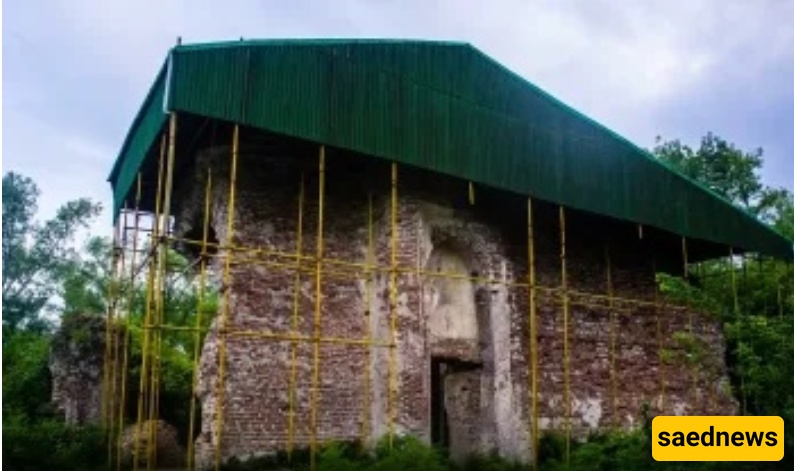
According to the Tourism Service of SaedNews, the Espeh Mazgat Fire Temple is one of the oldest historical buildings in Gilan and a symbol of the coexistence of Zoroastrianism and Islam in Iran. This remarkable structure, whose name in the Talysh language means “White Mosque,” is located in the heart of the forests of Rezvanshahr. With a history of over a thousand years, the Espeh Mazgat Fire Temple was in use from the Seljuk period to the Safavid era.
Hidden among the lush forests and roaring rivers of Gilan Province lies an ancient structure that represents the civilizational and religious transitions of ancient Iran: the Espeh Mazgat Fire Temple. Known in the Talysh dialect as the “White Mosque,” it is one of Gilan’s oldest and most astonishing historical monuments. Espeh Mazgat is not only a relic of pre-Islamic Zoroastrian times but was also used as a mosque during Islamic periods, containing multiple layers of Iranian history within its structure.
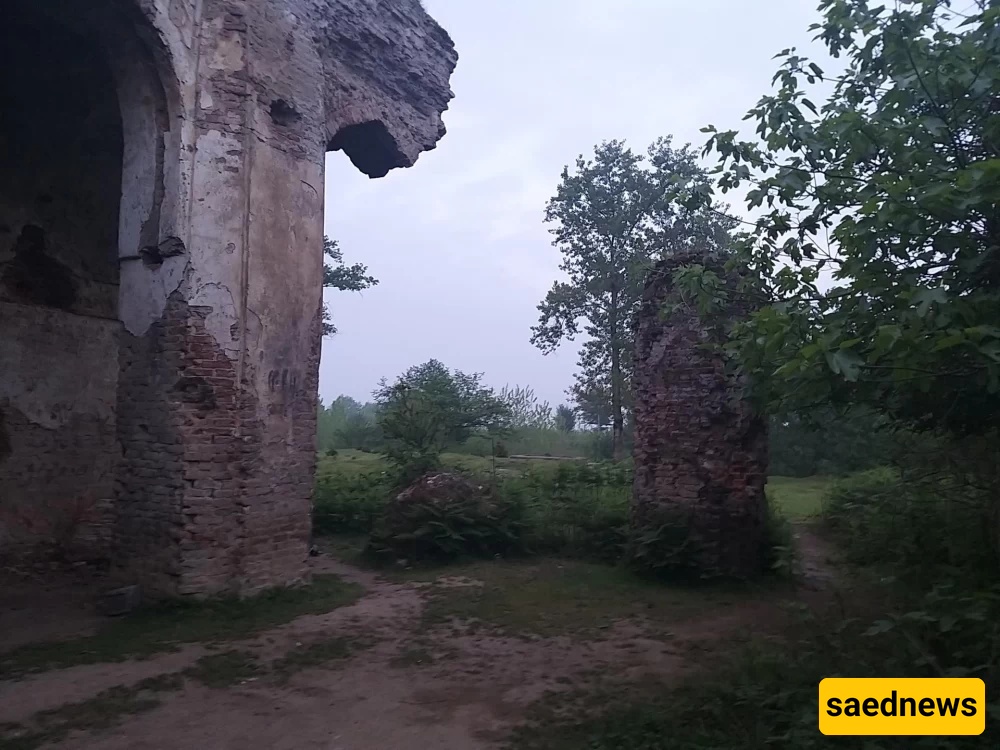
Geographical Location of the Espeh Mazgat Fire Temple
The Espeh Mazgat Fire Temple is located in Rezvanshahr County (Talysh), Gilan Province, in the Pareh Sar District and Dinachal Rural District. The temple sits on the western bank of the Dinachal River, in the village of Kish Khaleh (or Dinachal), approximately 80 kilometers west of Rasht, 22 kilometers south of Talesh, and 60 meters west of the Dinachal River. Its geographic coordinates are 37°39′08″N and 49°03′20″E.
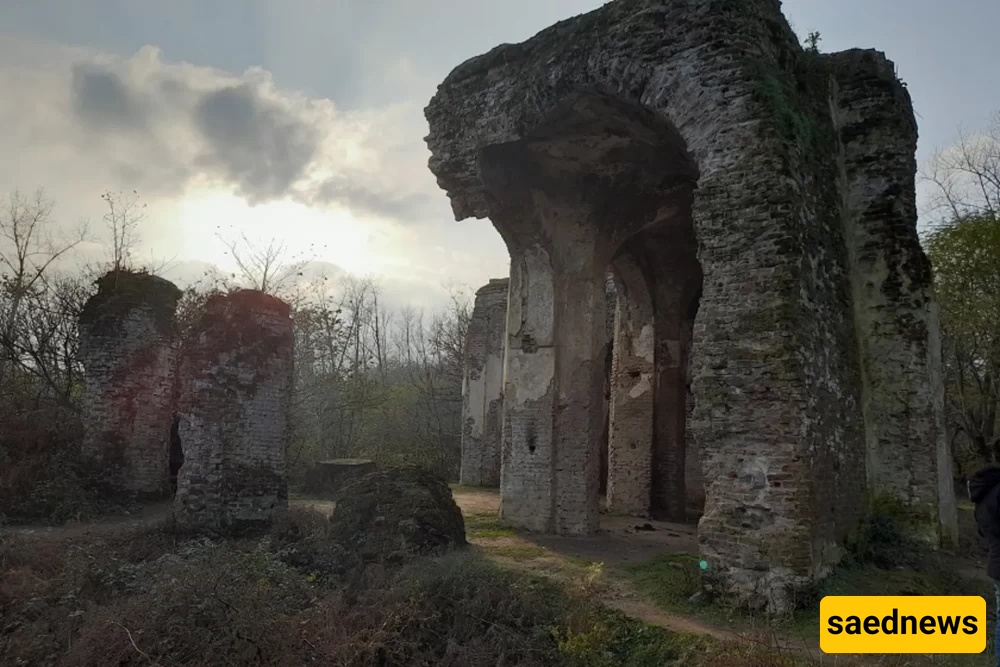
Access to Espeh Mazgat is possible via the Rezvanshahr–Talesh road; after crossing the Dinachal River bridge, a 1,600-meter route on a northern side road leads to a 1,300-meter paved forest road that ends directly at the temple. This site is surrounded by dense forests at the southeastern end of Gisum Forest Park (one of Gilan’s popular tourist attractions) and lies about 2 kilometers east of the Talesh–Anzali road.
Its remote and natural setting makes Espeh Mazgat an ideal destination for nature and history enthusiasts, although the lack of signage can sometimes confuse visitors. South of the Dinachal River, a large recreational area hosts local gatherings every year on Farvardin 13 (March 31/April 1), featuring handicrafts, traditional foods, and local games.
Historical Background
Espeh Mazgat dates back to pre-Islamic times as a Zoroastrian fire temple. Archaeological excavations indicate that its original construction belongs to the 11th–12th centuries CE (Seljuk period), when it was built as an Islamic mosque and place of worship, with surrounding grounds covering approximately six hectares, including an adjacent cemetery. Discovered inscriptions date it to the 10th–11th centuries AH, while pottery fragments belong to the 14th century AH (Ilkhanid period). After the advent of Islam, probably in the 9th century AH, the fire temple was converted into a mosque without major structural changes and remained in use until the Safavid period (10th–11th centuries AH), during which it underwent restoration.
Archaeological excavations in 2000, 2002, and 2006 by Gilan Cultural Heritage experts, including Yousef Fallahian, confirmed the two main periods of use (Seljuk and Safavid). Despite claims linking the building to the Sassanid era, no architectural remains or pottery from that period have been found. The name “Espeh Mazgat” combines “Espeh” (white in Talysh) and “Mazgat” (mosque in Avestan and Kurdish), meaning “White Mosque” or “Abdollahi Mosque,” reflecting the ancient Iranian roots of the word “mosque.” The site was registered as a national heritage monument of Iran on October 8, 2000 (registration number 2796), under the ownership of the Ministry of Cultural Heritage, Tourism, and Handicrafts. Interestingly, there is no mention of Espeh Mazgat in classical historical books or travelogues, which remains a historical mystery.
Architecture of Espeh Mazgat
Espeh Mazgat’s architecture blends Zoroastrian and Islamic elements, closely resembling pre-Islamic fire temples. The plan includes a central square hall (iwan) for the sacred fire, surrounded by four corridors where worshippers stood. The main entrance is on the north side, approximately 1.5 meters wide. Each corridor measures 3.5–4.3 meters in width and 5.5–7.5 meters in height. Octagonal pillars at the four corners have a circumference of 5.5 meters, with projections spaced 2.5–3.2 meters apart. Broken-arch vaults above the pillars support the roof.
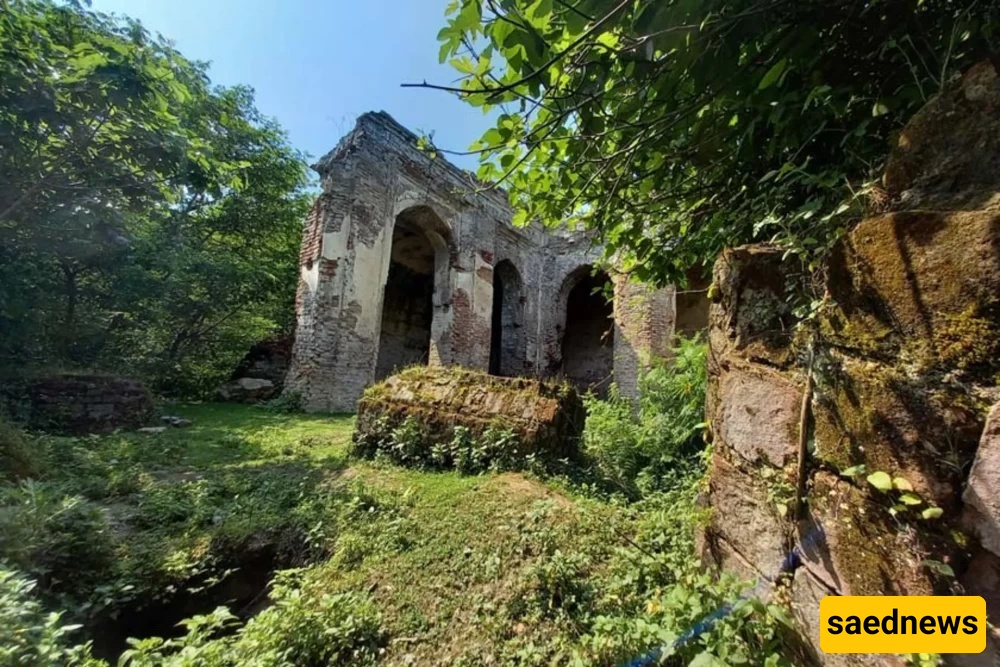
The main construction materials are bricks measuring 6×23×23 cm, and the walls are 175 cm thick, made from clay, adobe, and lime mortar. The roof is covered with 36×50 cm tiles bonded with mortar—unlike modern sloping tile roofs in Gilan, which are generally unbonded. Decorations include a 5–6 meter high Kufic inscription on the north corridor wall, featuring verses from Surah At-Tawbah and floral motifs at the base. Beautiful plasterwork up to 1 meter high is also visible. One surviving wall measures 17 meters, and the Seljuk-style main entrance arch remains the most prominent intact feature. This structure, largely unchanged after the Islamic conversion, demonstrates respect for its pre-Islamic heritage.
Historical and Cultural Significance
As the oldest mosque in Gilan (over a thousand years old) and one of the province’s seven wonders, Espeh Mazgat symbolizes religious coexistence and cultural transition from Zoroastrianism to Islam. Its remote location raises the possibility of an ancient city or large religious center buried nearby, potentially an important archaeological site. The building incorporates Seljuk, Ilkhanid, and Safavid historical layers, and its hybrid architecture with local Gilan elements is highly valuable.
Dr. Manouchehr Sotoudeh, in his book From Astara to Estara, describes it as one of Gilan’s marvels. Culturally, Espeh Mazgat recalls the Iranian roots of words and religious traditions and could be restored as a religious or tourist site. Its national registration emphasizes the importance of preserving this heritage.
Current Condition and Preservation Challenges
Today, only the main entrance, half of the northern and western halls, a few adjacent walls, and the octagonal pillars remain intact, with the rest of the building damaged. Factors contributing to its deterioration include human activities (graffiti, illegal digging, livestock grazing, fire), natural factors (Dinachal River flooding destroying the southern part, tree roots causing deep cracks, earthquakes, erosion, and rainfall moisture), and lack of proper maintenance. Large trees on the roof have taken root, putting the ceiling at risk of complete collapse. Despite its tourism potential (proximity to Gisum), visitor numbers are limited, and immediate conservation is needed. Recent excavations underline the need for restoration, though local and natural threats remain significant.