Saed News: Charging cables are among the most frequently used technologies in our daily lives, and we only notice them when they break and leave us with a dead phone. The bitter truth is that we are often the main cause of their damage. However, by changing a few simple habits, you can save money and also help the environment.
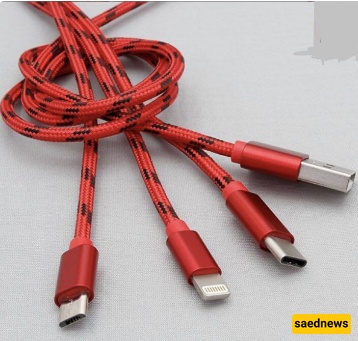
According to SAEDNEWS, citing Hamshahri Online, this article—based on opinions of materials engineering experts—explains how to properly take care of charging cables. Many of us believe that tightly or irregularly coiling a cable can break its internal wires. However, Michael Puckett, founder of the Advanced Life Cycle Engineering Center at the University of Maryland, disagrees. His team has tested USB cables under extreme conditions, from crushing and pulling to X-ray imaging.
Puckett says: “We have done research for the world’s largest computer companies, and we have never seen a cable fail just because it was poorly coiled.” So, there is no need to worry too much about how you wrap thin charging cables. The real problem lies elsewhere.
Most damage happens exactly at the point where the wire connects to the connector (plug). When your phone is charging and you hold or use it at a sharp angle, this area is under heavy stress.
Robert Hyers, a materials engineering expert, compares this to a paperclip. If you repeatedly bend it from one point, atomic bonds break, the metal hardens, and eventually it cracks. The copper wires inside charging cables behave in a similar way.
Experts identify three common behaviors as the main causes of early cable failure:
Pulling the cable instead of the plug: Never pull the cable itself to unplug it. Always grip the connector.
Using short cables: If your cable is stretched tightly to reach the outlet, it puts stress on the internal wires and damages them.
Phone placement during charging: Placing your phone upright in a cup holder or on a surface while charging puts the full weight of the phone on the cable connection. This is literally deadly for the cable.
Instead of buying cheap, low-quality cables that last only a few weeks, choose braided (nylon or fabric-covered) cables. Even Apple has moved toward such cables in newer models. These coatings act like armor, protecting the internal wires and preventing sharp, damaging bends.
Charging cables may not be the most exciting technology, but without them our digital lives would be disrupted. By following these simple tips, you can not only extend the life of your cables but also reduce electronic waste.