SAEDNEWS: Assassination Attempts on Ali Larijani and Kamal Kharrazi Seen as Effort to Disrupt Backchannel Negotiations and Sowing Division Among Surviving Officials
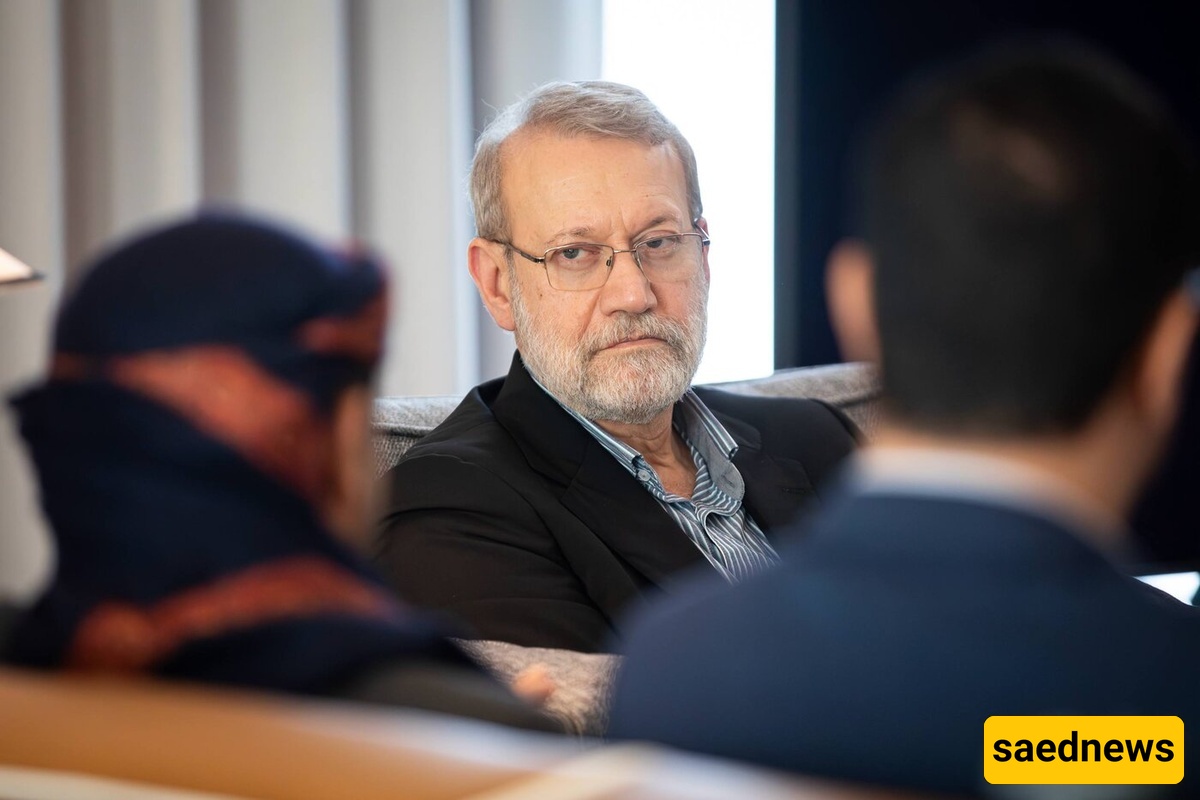
According to the political desk of Saed News, Mehrdad Khodir wrote in Asr-e Iran: the subject of this piece is someone who is not, of course, the only martyr of the 40-day war between the United States and Israel against Iran. A war whose flames broke out on 9 Esfand 1404 (late February 2026) and—provisionally, not definitively—subsided on 19 Farvardin 1405 (early April 2026), because 3,752 others were also victims of this war, and he is not even the most famous or highest-ranking among them. The first of these 3,753 people is Ayatollah Seyyed Ali Khamenei, the second leader of the Islamic Republic of Iran. In the thousands of years of this land’s history, how many heads of state have met such a fate in wartime?
Even so, after the Supreme Leader and military commanders, and among the assassinations carried out by Israel, none caused the same shock as the news of Ali Larijani being targeted—and a similar feeling followed the assassination of Kamal Kharrazi.
My own position regarding Kamal Kharrazi was clear: because of his eight years as Foreign Minister in Mohammad Khatami’s government and his previous media management experience, and also his constant praise in the words of Hajj Ahmad Borqani. But what about Larijani? He was known both for 12 years as Speaker of Parliament and 10 years as head of state broadcasting in confrontation with reformists.
Over time, things changed. Although he never became a reformist, when Mahmoud Ahmadinejad criticized him alongside figures such as Hashemi Rafsanjani, Natiq Nouri, and Hassan Rouhani, he was unintentionally placed in opposition to radical principlists. From Parliament he tried to contain that radicalism, and this is where he found common ground with reformists and moderates. This peaked during the approval of the JCPOA in a parliament opposed to it, although it was expected that he would at least hand over one year of the next parliamentary term to Mohammad Reza Aref, who had entered parliament with over a million more votes than him.
This text, however, does not want to dwell on those issues, especially regarding a man who, had he not accepted the position of Secretary of the Supreme National Security Council, would still be alive today—not, as his brother said, someone whose body was later found after a massive explosion and enemy attack, only his hand remaining, headless and bodiless.
If he had not been threatened in the 12-day war, accepting the SNSC role would not have required particular courage. But despite all the injustices, he came to the field to serve as a link between different factions, and to find a way to prevent another war—or, if it did occur, to ensure Iran would not be caught off guard. Although he failed in the first aim, he succeeded in the second.
But this text is not about that story. Rather, it is written because his death deprived the Guardian Council of the chance to make amends. The Council, which had disqualified thousands of people on various grounds, had presented reasons for Larijani’s disqualification that—even by its own standards—were inconsistent and highly surprising. If their main hidden reason in 2021 was that he might defeat Ebrahim Raisi, it was unclear why the same approach was repeated in 2024.
Now the story should be clearer. On the fortieth day after Ali Larijani’s martyrdom, I do not intend to review his record in 10 years as head of state broadcasting, 12 years as Speaker of Parliament, or his two terms as Secretary of the Supreme National Security Council—once appointed by Mahmoud Ahmadinejad and once by Masoud Pezeshkian, both with the Supreme Leader’s approval. My aim is different.
Perhaps it is also worth recalling that in Khordad 1403 (mid-2024), when Larijani once again ran for office, reformists feared what would happen if he were approved: if they did not support him and power shifted elsewhere, what then? And if they did support him, how could they convince their base after the experience of unconditional support for Hassan Rouhani?
From this perspective, the final list without Larijani’s name—and with Masoud Pezeshkian approved—reduced internal fragmentation but increased the moral burden on the Guardian Council: how could someone like Larijani, with such a record, be deemed unqualified while others were approved?
One of his most important political acts was forcing the Guardian Council to disclose the reasons for his disqualification—reasons so weak and at times absurd that some suspected they might not even be real. Claims included: supporting disqualified individuals, defending their performance, employing them in his offices, frequent foreign travel by family members to Europe and the U.S., and the residence of one child in America. He denied all claims of frequent travel.
An accusation made against a man on the verge of 100, who had repeatedly advised piety in Friday prayers, was made not by Mehdi Karroubi, but by the heads of three parliamentary terms.
From Ayatollah Jannati’s perspective, Larijani’s “fault” was that his son had gone abroad for studies with his spouse. Later, on 26 Esfand 1404, it was reported that this same son had been killed alongside his father in the attack. One was criminalized by Jannati; the other was apparently not even acknowledged as a virtue.
In his letter, Larijani had written: “One of my sons is a PhD student in mechanical engineering and has recently graduated; the other is a cleric.” The first (Mostafa) was the one killed alongside his father; the second is the one who later reported the incident.
Most amusing in the disqualification reasoning was the claim: “perceived involvement in parts of the current government’s poor performance.” He responded: “Legally, what does government performance have to do with me? Does the government not have a president and officials? By this logic, why is the head of the judiciary not considered responsible? And why was the same president approved twice if the government was supposedly flawed?”
The 21-page letter was never answered by the Guardian Council’s secretary.
Later, when he became SNSC secretary again, the question arose: how could someone previously unqualified for presidency now be deemed qualified for such a sensitive post after war—or on the brink of another war or negotiation?
The assassination of Ali Larijani, like that of Kamal Kharrazi, carried the message that Israel seeks to disrupt backchannel negotiations and remove consensus figures to deepen divisions among remaining officials. After their removal, this narrative became even more frequently repeated.
At this point I recall an issue of Shahrvand-e Emrooz magazine from 6 Aban 1386 (October 2007), with Larijani’s photo on the cover under the headline: “Farewell to Larijani / A file on the former Secretary of the Supreme National Security Council.” None of the writers imagined that 18 years later, the words “farewell” and “former secretary” would again apply—this time with a deeper meaning beyond politics, extending into life itself.
In that issue, Serge Barseghian ended his report with the question: where is his next home? Has he, now middle-aged, a rational philosophy of life like Kant’s “exact sciences in philosophy”—a course he once taught at university?
Larijani was neither my ideal nor my preferred candidate in the 2021 and 2024 elections, so the dilemma of whether to vote for him never arose. Yet he could have played an effective role as SNSC secretary, even if in a short time he did not meet all initial expectations. But none of this justifies assassination by Israel with U.S. complicity, nor his disqualification in those elections. In this sense, one could ironically call his assassination a kind of “approval,” in contrast to his previous disqualifications.
The revolutionary poet Seyyed Hossein Hosseini, a favorite of Ayatollah Khamenei, once wrote:
“Winter does not relent
On the first morning of Nowruz, snow falls
Perhaps spring’s qualification has been rejected!”
When news of Larijani’s assassination in the final days of winter 1404 spread, I remembered this poem. And in a reversed reading, I thought: perhaps his qualification has now been approved. And now, on the fortieth day of that event—while state media, where he once served as director for ten years, pays little attention to him—we might speak of “the fortieth day of approval,” in a spring that recalls his two disqualifications, in 1400 and 1403.