SAEDNEWS: The Minister of Science condemned the insult to the national flag, describing the unrest caused by a group of individuals on the university campus as disruptive to academic activities. He emphasized that disciplinary committees will take serious action against those responsible for the disturbances.
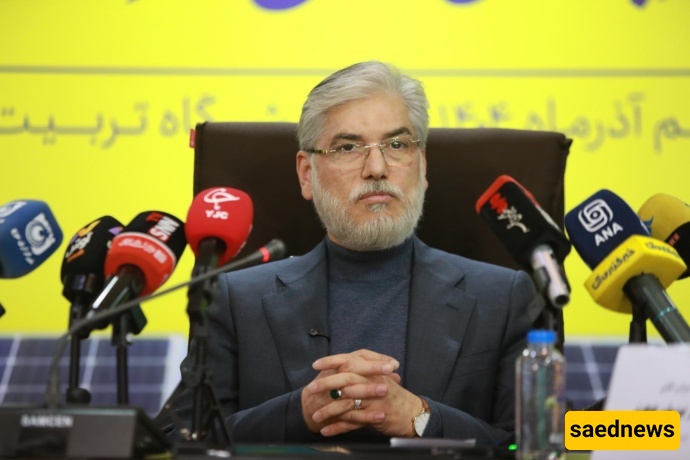
On the fourth day of the new academic term, Iran’s universities appeared to be gradually regaining balance. Monitoring of the country’s academic environment suggests that while campuses have not fully returned to calm—and sporadic radical and norm-breaking slogans can still be heard in some areas—the intensity of unrest has declined compared to the beginning of the week. Universities today witnessed a different atmosphere: not entirely free of protest, but with more visible management of gatherings.
After several days of public anticipation, Hossein Simayi-Sarraf, Iran’s Minister of Science, Research and Technology, issued a video message condemning insults to the Iranian flag as a clear red line.
“National symbols belong to all the people of Iran,” he said. “No Iranian citizen accepts insults to national symbols such as our beloved flag.”
He emphasized that universities exist for education, research, and innovation, and that disorder disrupts the academic process. “We will not tolerate unrest,” he stated, adding that disciplinary councils would address violations and that judicial authorities would intervene if necessary.
In remarks to Parliament’s news outlet, he noted that thousands of undergraduate classes are currently being held across the country and that many professors and students have voiced concern that disruptive actions are interfering with academic activities.
At Sharif University of Technology, which has faced both on-campus tensions and online rumors—including claims of its website being hacked—administrators sought to emphasize continuity.
University president Masoud Tajrishi announced that more than 1,500 classes were held over three days, with 99 percent of scheduled programs proceeding as planned.
He acknowledged that some provocative behavior in the early days of the week led to verbal and physical confrontations that caused concern among students and families. While noting that the overall climate of gatherings has shifted toward calmer dialogue, he warned against isolated but “unacceptable” incidents that could create serious risks. Tajrishi stressed that maintaining campus safety is a non-negotiable priority and apologized to the Iranian public and families of martyrs for inappropriate actions that occurred.
Amirkabir University of Technology—also known as Tehran Polytechnic—issued a firm statement condemning stone-throwing, vandalism, and disrespect toward national symbols. The university said such actions not only fail to advance legitimate demands but also damage the credibility of authentic student movements and divert institutions from their core mission of knowledge production.
The statement underscored unconditional support for the pillars of the Islamic Republic and warned that inaction could normalize disorder. It concluded with a clear message: disciplinary proceedings against offending students would begin immediately, with no leniency.
At University of Tehran—often regarded as the symbolic heart of Iran’s higher education system—officials adopted a more nuanced approach.
In a detailed statement, the university affirmed students’ right to express their views within legal frameworks and without fear of repercussions. Notably, it announced the allocation of a designated space for student protest—described as a first in the country—aimed at institutionalizing lawful expression and ensuring safe dialogue.
However, the university strongly condemned reported insults to the national flag during recent demonstrations. It described the flag as a symbol of collective identity and unity, calling disrespect toward it both illegal and inconsistent with the dignity of student movements.
The Secretariat of the Supreme Council of the Cultural Revolution issued a statement asserting that disrespect toward national symbols—particularly during the holy month of Ramadan—falls outside acceptable bounds. It urged the Ministry of Science and university presidents to take decisive action against those who violate regulations while also promoting constructive dialogue through academic forums.
Meanwhile, at a parliamentary session attended by the science minister, Ebrahim Azizi, head of the National Security and Foreign Policy Commission, called on students to remain vigilant against what he described as hostile foreign agendas. He expressed confidence that universities and student bodies would continue to uphold the values of Islam and the Islamic Revolution.
As the week progresses, Iran’s universities appear to be navigating a delicate path: recognizing students’ right to protest while drawing firm boundaries around national symbols and public order. Though tensions have not fully subsided, officials report a downward trend in unrest and a renewed emphasis on restoring academic normalcy.