SAEDNEWS: Iran's Foreign Minister Abbas Araqchi declared on Friday that Tehran is fully prepared for both fair nuclear negotiations and war, but will never accept dictated conditions amid ongoing US military threats.
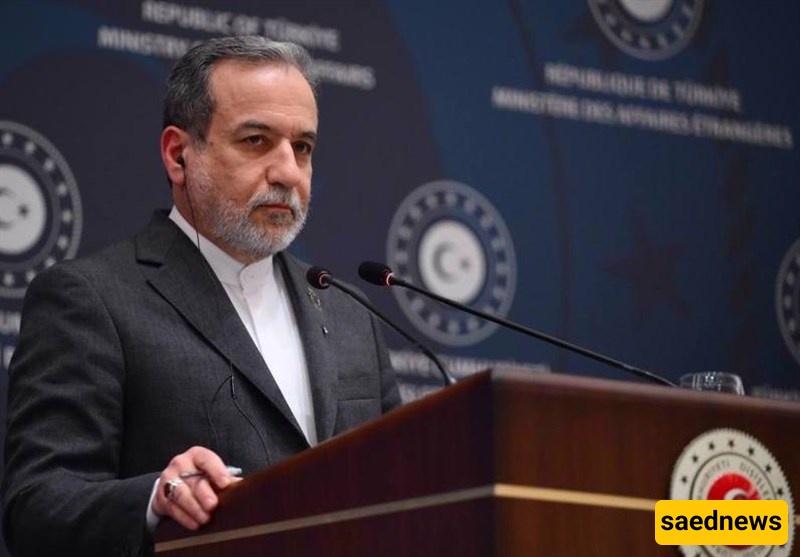
According to SAEDNEWS, Iran is prepared to enter nuclear negotiations provided they are conducted on the basis of equality, mutual interests, and mutual respect, Iranian Foreign Minister Abbas Araqchi said during a joint press conference with his Turkish counterpart, Hakan Fidan, in Ankara.
“If the negotiations are fair and just, Iran is ready to participate,” Araqchi stated, stressing that Tehran will “by no means accept dictation and imposition.”
Araqchi described his talks with Fidan as “good and useful,” highlighting the strong neighborly relationship between Iran and Turkey. He noted that the two countries have supported one another “in both easy and difficult days.”
He reaffirmed Tehran’s support for any regional initiative aimed at promoting peace, reducing tensions, and countering what he described as “the sinister plots of Israel.” Araqchi also confirmed Iran’s readiness to participate in dialogue among regional countries to achieve de-escalation and long-term stability.
Addressing contacts with the United States, Araqchi acknowledged that Washington has repeatedly sought negotiations through intermediaries. “Iran has no problem with negotiation,” he said, adding that talks cannot take place “under the shadow of threats.”
“They must abandon threats and be ready for fair negotiations,” he emphasized, underscoring that “Iran has never abandoned diplomacy and will never abandon it.”
Asked about the possibility of an imminent meeting with U.S. officials, Araqchi said no such plan has yet been arranged. He stressed that key preliminary issues, including the format, venue, and agenda, must first be agreed upon for any meaningful negotiations to occur.
“We will continue consultations with friends in the region,” he said, expressing hope that a clear framework ensuring “honorable negotiations” can soon be achieved.
Araqchi also issued a stern warning regarding U.S. threats. “Iran, just as it is ready for negotiations, is also ready for war,” he said, adding that the country is “more prepared than before the 12-day war,” referring to U.S.-Israeli attacks on Iran in June, which occurred amid indirect nuclear talks mediated by Oman.
He warned that any new conflict, particularly one involving direct U.S. participation, would be fundamentally different and could expand beyond a bilateral confrontation. “I hope rationality prevails and those who seek to drag the region into an all-out war fail,” he said.
Araqchi categorically ruled out any discussion of Iran’s defensive capabilities. “Iran’s defensive capability and missiles will never be the subject of any negotiation,” he said, stressing that Iran will preserve and expand its defenses as necessary to protect national security.
He also pointed to shared concerns between Iran and Turkey over destabilizing regional trends caused by what he called “illegitimate interventions by some extra-regional powers,” accusing Israel of seeking to provoke war, weaken regional states, and pursue expansionist objectives.
For his part, Turkish Foreign Minister Hakan Fidan firmly opposed any military action against Iran. “We have conveyed our opposition to a military intervention against Iran at every opportunity,” he said, adding that Iran’s internal affairs should be resolved peacefully by Iranians without outside interference.
Fidan warned that Israel is actively encouraging the United States to attack Iran, cautioning that such efforts could severely damage the region’s already fragile stability. He expressed hope that Washington would exercise “common sense” and avoid escalation.
Describing the resumption of nuclear talks between Tehran and Washington as “vital,” Fidan said dialogue is essential to reducing regional tensions.
The remarks come amid heightened U.S. rhetoric, including recent statements by President Donald Trump about deploying “another beautiful armada” of warships toward Iran. Trump said the naval buildup is intended to force negotiations, warning that failure to reach an agreement could result in an attack “far worse” than the June 2025 U.S. strike on Iranian nuclear facilities.
A U.S. naval strike group has been stationed in Middle Eastern waters since Monday, with Trump describing it as “ready, willing and able” to act against Iran “if necessary.”
Tehran has repeatedly rejected negotiations conducted under threat or coercion, insisting that diplomacy must be based on mutual respect and equality, and has warned it would respond forcefully to any attack.