SAEDNEWS: Iran’s Minister of Science, Research and Technology, Hossein Simayi‑Sarraf, has stated that the country’s adversaries are not only attempting to weaken the Islamic Republic but are also seeking to divide Iran and undermine its national unity.
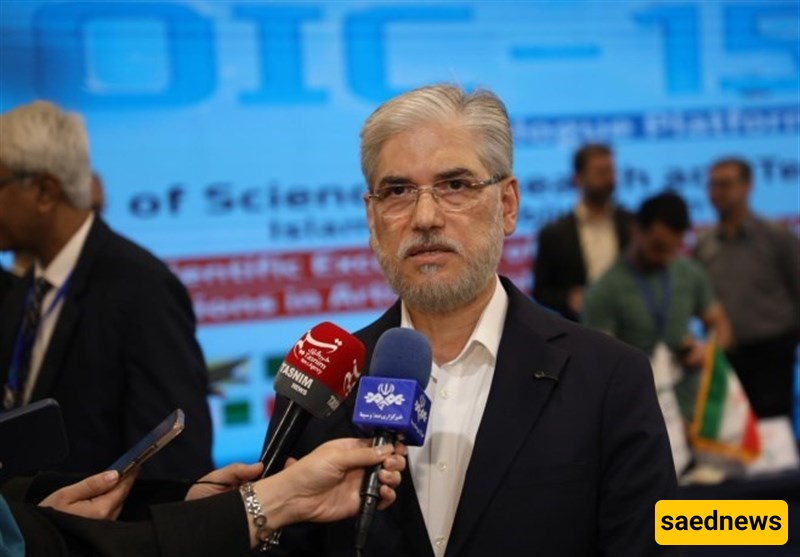
According to SAEDNEWS, Speaking in a televised interview, the minister said the primary objective of Iran’s enemies is “not merely to strike the Islamic Republic, but to fragment Iran and destroy national cohesion.”
During the interview, Simayi‑Sarraf also addressed the current situation in the country’s academic sector. He confirmed that the 2025 recruitment process for university faculty members will proceed as scheduled. He also noted that university counseling centers have expanded their activities, and their services are now available not only to students but also to the broader public.
The minister pointed to recent international actions taken by the Ministry of Science, saying that its international affairs department contacted UNESCO immediately after the Minab school incident. According to him, UNESCO issued several statements condemning the event, while UNICEF remained silent. He added that Iranian professors and students have published more than 200 statements that could potentially carry legal weight in international forums.
Simayi‑Sarraf said scientific associations across the country have remained active, producing more than 100 academic and cultural podcasts during the recent period. He emphasized that, contrary to what he described as the enemy’s expectations, the country’s academic environment remains highly motivated.
Highlighting what he called Iran’s strengths in the current situation, the minister stated that the country’s scientific capabilities support its defensive power. He praised what he referred to as the legacy of the late leader of the Islamic Revolution, saying the leader had strongly emphasized scientific development and technological advancement.
According to Simayi‑Sarraf, the late leader had promoted key scientific priorities over the past two decades, including nanotechnology, biotechnology, the knowledge‑based economy, artificial intelligence, and the pursuit of scientific leadership. He also stressed the importance of transforming Iran from a consumer of technology into a producer of knowledge and innovation, while expressing concern about the long‑term emigration of talented scholars.
The minister also accused foreign media outlets of attempting to create divisions between the Iranian government and the public. He argued that historical precedents show that external powers have often used various pretexts to attack Iran, and claimed that current calls for “regime change” are in fact attacks on Iranian culture and civilization rather than solely on the political system.
Simayi‑Sarraf further alleged that recent military actions have violated fundamental principles of the laws of war, claiming that several research institutes, laboratories, and university facilities have been damaged. He cited the destruction of a 600‑bed student dormitory at Persian Gulf University and damage to an arts building at Isfahan University of Art.
Despite the tensions, the minister stated that Iran’s national academic calendar will continue as planned. Major exams—including the national university entrance exam and graduate entrance tests—are expected to be held according to schedule. However, the announcement of doctoral exam results has been temporarily delayed due to internet disruptions and to allow additional time for candidate appeals.
Concluding his remarks, Simayi‑Sarraf said Iran will continue its path of scientific development and insisted that external pressures will not weaken the unity and determination of the Iranian people.