SAEDNEWS: The plant known as “Bid Fari” or “Chinese willow” is a species belonging to the willow genus and family. It is native to northeastern China. This plant species is named in honor of the Japanese botanist Mr. Sadahisa Matsuda and is scientifically classified as Salix matsudana.
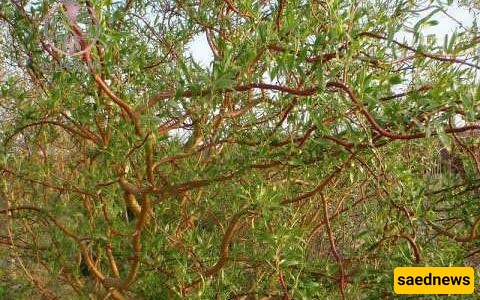
The red willow is a small tree that grows near wetlands, ponds, and lakes. It thrives in moist soil conditions.
The curly willow, also known as Chinese willow, is a deciduous tree native to northeastern China. It has an upright growth habit and a fast growth rate. It is a dioecious plant, meaning male and female flowers form separately in clusters on different trees.
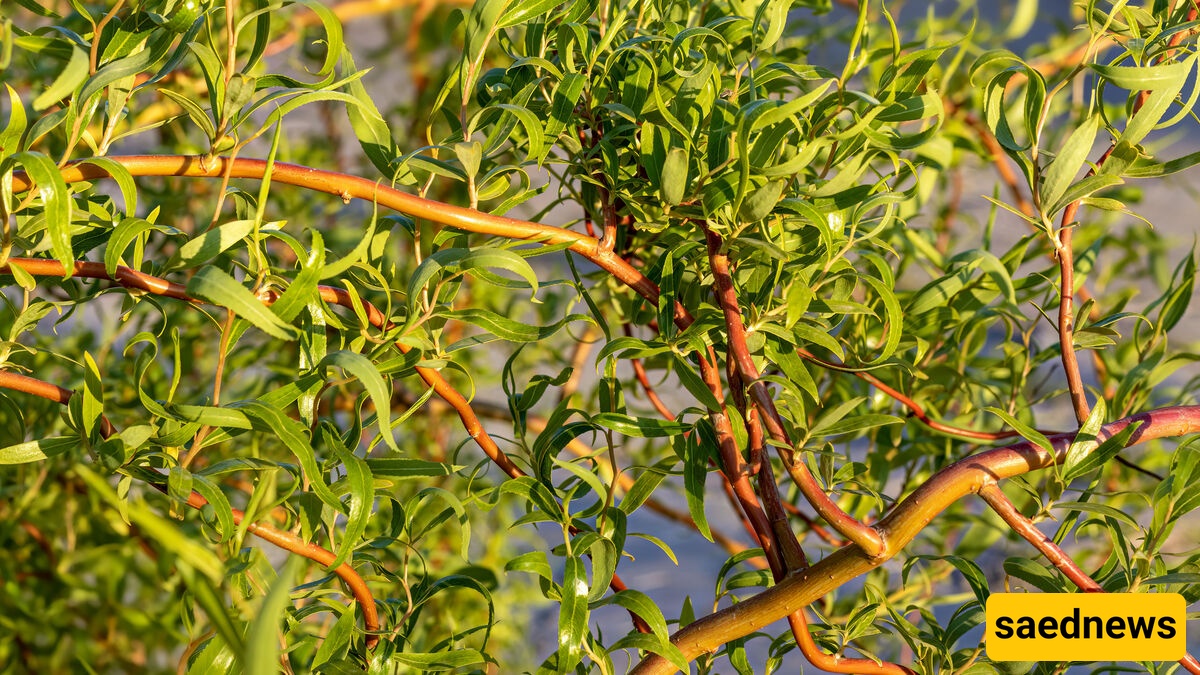
Its leaves are long, narrow, pale green, measuring 4–10 cm in length and 1–2 cm in width. The flowers appear in clusters in early spring. The tree’s twisted, spiral branches give it a distinctive ornamental appearance. Some varieties also have reddish branches.
This tree can grow up to 13 meters in height and spread up to 7.5 meters, depending on conditions. Red willow growth may range between 3 to 9 meters in height. Its canopy expands as it grows, often reaching 3 to 13 meters in width. Many branches grow from the main trunk.
The bark of mature trees is brown.
The most distinctive feature of the curly willow is its twisted and curled branches, which give the tree its name. Its leaves are slender, elongated, and pale green. In mature trees, the bark becomes brown.
Factor | Requirement |
|---|---|
Temperature (optimal growth) | 20–24°C |
Minimum winter tolerance | Down to −29°C |
Light requirement | Full direct sunlight |
Soil | Fertile, moist soil with good drainage |
Watering (young plants) | Regular watering until roots are established; maintain when topsoil dries |
Watering (mature plants) | Low water requirement |
Fertilization | Slow-release complete fertilizer applied annually in early spring |
Chinese willow is easy to propagate:
Cuttings root easily in water; once roots develop, they can be planted in pots or directly in the ground.
Semi-hardwood cuttings (about 30 cm long) can be planted from spring to late summer.
Seeds can be used in late spring, though this method is rarely used.
The most common method is propagation through cuttings.
Propagation is possible whenever water is available and temperatures are above 13°C.
Often, curly willow is grafted onto common willow trees to enhance ornamental appearance.
Common issues include:
Powdery mildew
Fungal infections
Resin (tar-like) disease
Root rot
Crown gall disease
The Chinese willow is a fast-growing ornamental tree valued for its unique twisted branches, adaptability to moist environments, and ease of propagation through cuttings.