Saed News: The James Webb Space Telescope, in a revolutionary mission, has succeeded in capturing images of the birth of a new planetary system located 1,300 light-years from Earth. This unprecedented discovery has opened a new window into understanding how the solar system and planet Earth were formed.
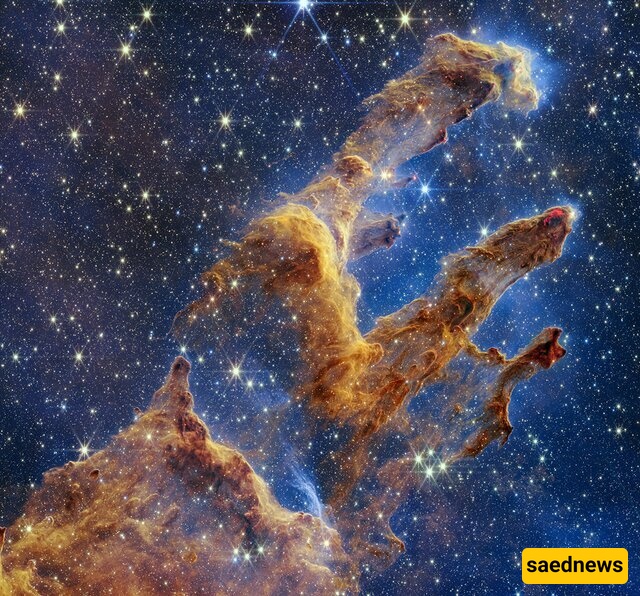
According to SAEDNEWS, at a moment that scientists call a “turning point in the history of astronomy,” the James Webb Space Telescope has managed to go beyond the boundaries of the universe and witness the birth of a new stellar system. This astonishing discovery, occurring 1,300 light-years away from us, presents a living image of the process that created the Sun and its surrounding planets 4.6 billion years ago.
Repetition of History in the Heart of the Cosmos
The transmitted images show that within a dense, dusty cloud, a young star is forming. What makes this discovery unique is the observation of the first solid materials that form the seeds of planets. These materials, which are in fact the “building blocks of the universe,” accumulate amid chaotic gas turbulence and gradually form planets and asteroids.
From Dust to Civilization
According to researchers, what we see today through the James Webb telescope contains a distant future within it. Millions of years later, this system could host rocky planets similar to Earth, which might one day become the cradle of a new civilization.
This observation confirmed that our solar system also went through exactly the same stages in its early history—a complex physical process that began with the accumulation of remnants from the formation of the Sun and ultimately led to the creation of the world we live in today.
This achievement not only demonstrates the technological power of humanity in the 21st century but also answers one of humanity’s most fundamental questions: “Where do we come from?”