SAEDNEWS: While Anthropic and the Pentagon disagreed on how the military should use artificial intelligence, a new reality was emerging thousands of miles from the battlefield: data centers were becoming military targets.
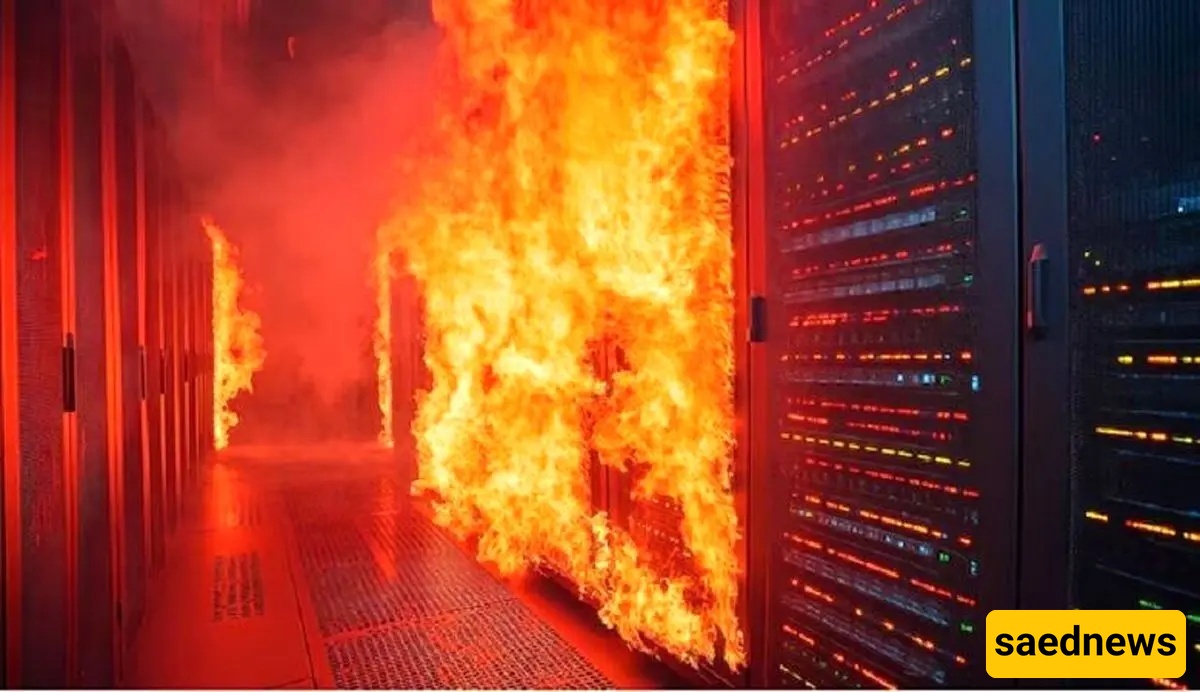
According to the Science and Technology Service of SaedNews, citing ISNA, Amazon announced this week that three of its data centers in the Middle East—two in the United Arab Emirates and one in Bahrain—were damaged during drone attacks amid rising tensions between the U.S. and Iran.
Reports from Business Insider and an internal Amazon Web Services (AWS) document indicate that company staff were evacuated and access to at least one data center was blocked due to structural damage and flooding caused by Sunday’s attacks.
Amazon stated that the two UAE centers were “directly targeted,” while the Bahrain center suffered damage from a drone strike “in very close proximity.”
On Wednesday, Iran’s Islamic Revolutionary Guard Corps (IRGC) said it strategically targeted an Amazon data center in response to the company’s support for U.S. military activities, a report carried by Iranian state media.
This marks the first time that major tech companies’ data centers have been directly exposed to military attacks—a new threat for firms that have heavily invested in the region to capitalize on the artificial intelligence boom.
According to DC Byte, the Middle East currently has around 4.5 gigawatts of data center capacity, with another 1.7 gigawatts under construction. Most planned capacity is concentrated in Saudi Arabia and the UAE. For comparison, one gigawatt roughly equals the electricity consumption of a mid-sized city like San Francisco.
The IRGC also claimed that a Microsoft data center in the region was targeted. A Microsoft spokesperson responded that there were no signs of an attack and that its regional data centers were operating normally. Google and Microsoft reported no disruptions in their data centers this week.
As of Friday, services in Amazon’s affected data centers remained either offline or heavily disrupted. The company advised customers to implement “emergency recovery plans.”
These disruptions underscore the global tech sector’s heavy reliance on data centers. Modassir Sheikha, CEO of Careem in Dubai, said some of the company’s services were affected but later restored. Several banking applications also experienced temporary outages during the week.
Data centers are typically designed for resilience and redundancy, with processing distributed across regions to prevent a single point of failure. However, with the surge in AI usage and Middle Eastern tensions, billions of dollars invested in data centers now face new risks, signaling a shift in the strategic landscape of modern conflicts.
James Lewis, senior advisor at the Center for Strategic and International Studies, noted: “Data centers have become critical infrastructure for economies. In the past, railroads and steam engines were the infrastructure; today, data centers and fiber optics have taken their place.”
Recent disruptions demonstrate that data centers can become strategic targets in conflicts. Lewis referenced the Russia-Ukraine war, where data played a vital role and Ukraine sought to restrict Russia’s access to servers. “The change in the Gulf today is that we must now think about how to defend these centers,” he said.
Data centers have large thermal signatures, making them hard to conceal. “You can’t hide them,” Lewis added. “The question is whether they can be hardened and defended. Previously, there was no need.”
Meanwhile, Saudi Arabia is rapidly expanding its data center capacity to become a global AI hub. Last year, the country launched Humain, a company aimed at building a complete AI ecosystem—from data centers to AI models.
Humain is partnering with Nvidia and AMD to create centers equipped with their chips, and tech giants have pledged increased regional investment. Microsoft plans to invest about $7.9 billion in the UAE by 2029, while Amazon, through a strategic partnership with Humain, committed over $5 billion.