SAEDNEWS: Al Naslaa is a rock formation in northwestern Saudi Arabia made of two large symmetrical stone blocks split by a deep, mysterious crack. They rest on small natural bases, creating a striking desert landmark.
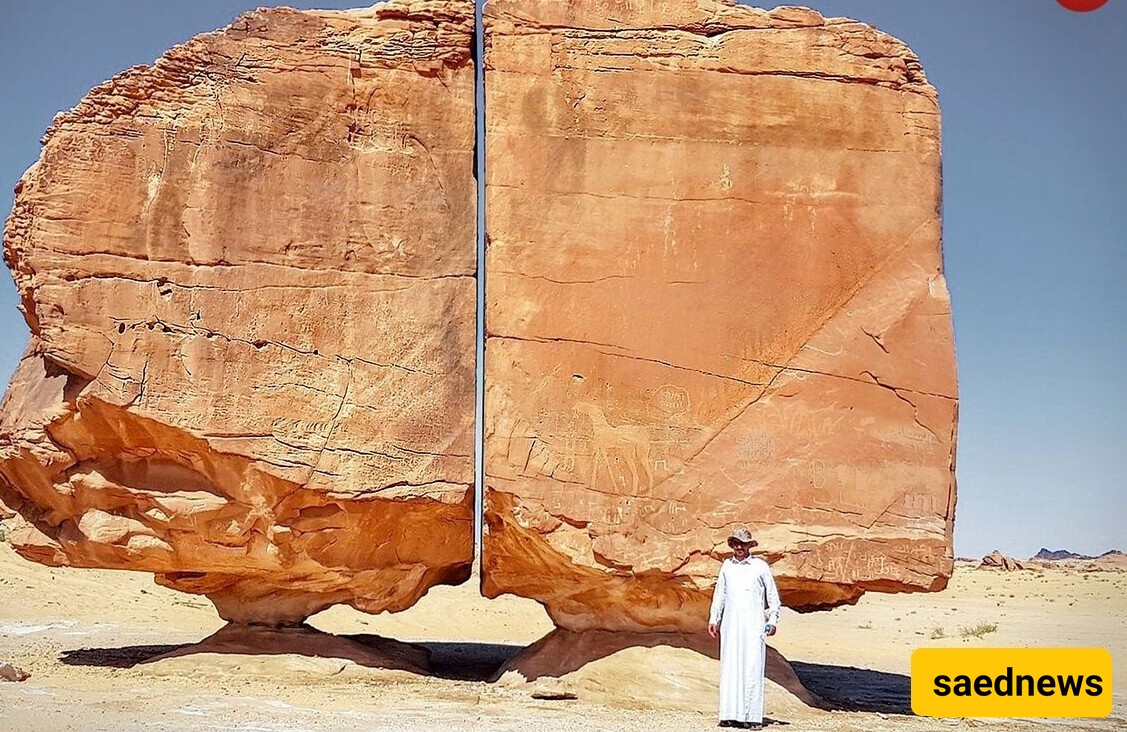
According to the historcal desk of Saednews, The Al Naslaa rock formation is a striking geological landmark in the desert of Saudi Arabia. It consists of two large sandstone blocks that are divided by a remarkably thin, pencil-like crack running almost perfectly straight down the middle. This near-perfect split has separated what was once a single massive rock into two symmetrical halves.
The Al Naslaa formation is approximately 6 meters tall and 9 meters wide. Scientists are still uncertain about how this unusual fracture formed.
However, according to Geology Science, a website that reports on geological news and trends, the crack appears to have a natural origin. Researchers have proposed several theories to explain the split between the two rock blocks, one of which suggests it was created by tectonic plate activity.
Al Naslaa is located in a remote, arid region in northwestern Saudi Arabia that occasionally experiences tectonic movements.
Researchers believe that sudden shifts in the Earth’s crust may have displaced and fractured the formation. Since Al Naslaa is made of sandstone—a layered and relatively fragile rock—some force likely created the initial break. However, the extreme smoothness of the split suggests that additional processes must have shaped it over time.
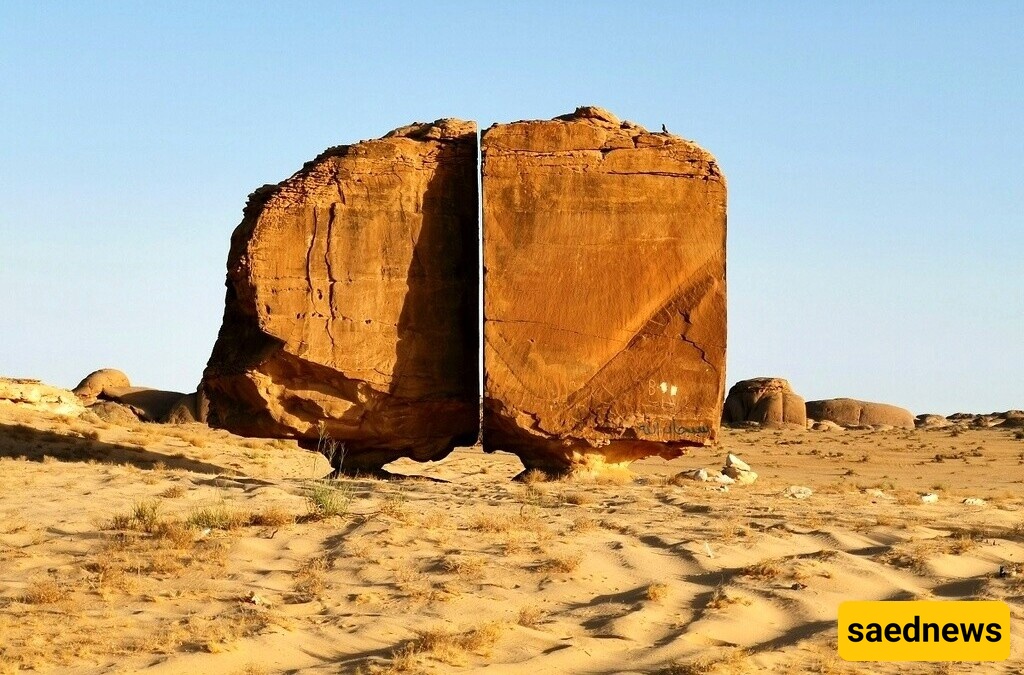
Scientists propose that thousands of years after the initial fracture, wind and water erosion acted on the formation. The newly formed crack may have channeled winds carrying sand and other abrasive particles, gradually polishing and smoothing both surfaces of the split rock.
Another theory suggests that the formation resulted from a joint—a natural fracture in rock that occurs without significant displacement. According to the Swiss Federal Institute of Technology in Zurich (ETH Zurich), joints can form due to regional tectonic stresses or the cooling and contraction of rocks.
Joints typically break rocks along straight lines, and erosion may later refine and smooth the resulting surfaces, as seen here.
A third hypothesis is that the rock split due to freeze-thaw processes, where water enters small cracks, freezes, expands, and gradually forces the rock apart. Over time, these micro-cracks may have connected, forming the clean, straight split visible today.
In this scenario, Al Naslaa became two separate rock masses after a cooler climatic period ended thousands or even millions of years ago, allowing trapped ice to melt and leaving behind the dramatic split formation.