SAEDNEWS: Polish History Enthusiast Discovers Medieval Ring with Sixteen Runic Symbols in Quadring, UK
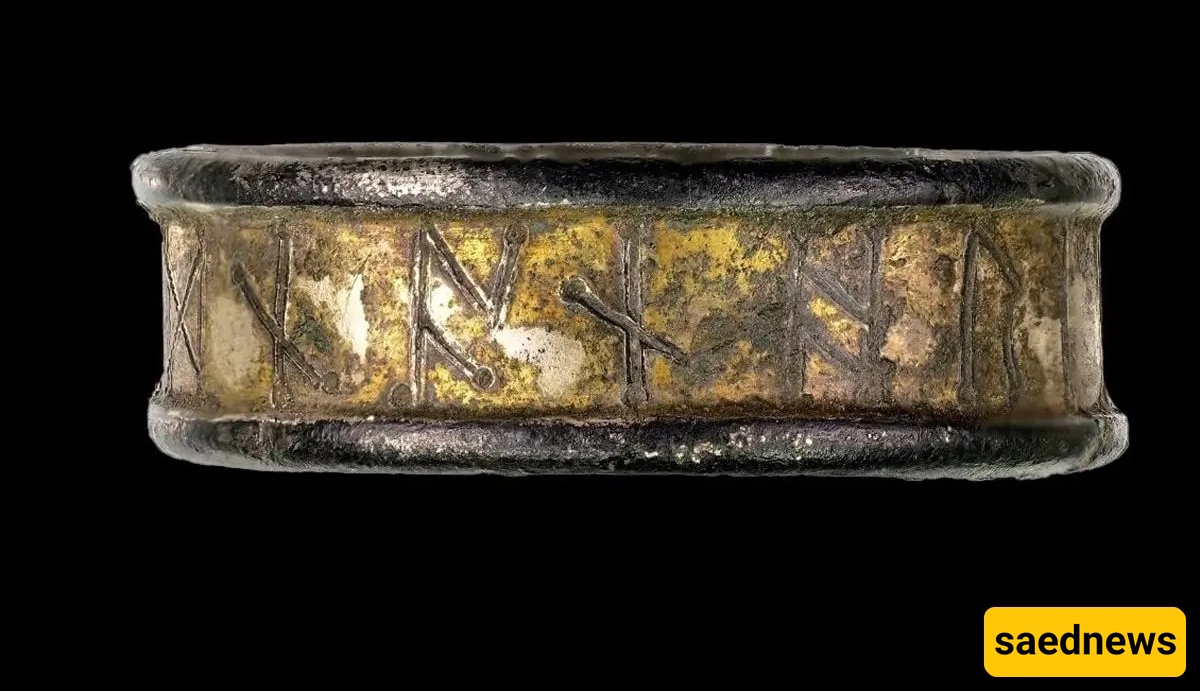
According to a report from the Saed News social affairs service, a rare ring was discovered in May 2024 by metal detectorist Rafał Wesołowski in a field in the South Holland area of Lincolnshire. In an interview with a media outlet, he said that during his search in the village, he came across a rare early medieval silver ring bearing a runic inscription. (Runic refers to an ancient writing system used in Northern Europe).
The object has now been registered in the Portable Antiquities Scheme database, a system that collects information on archaeological objects found by members of the public, including those recovered using metal detectors. This data supports academic and scientific research.
According to the database description, the object is a silver ring with a gold coating, dating to the period between the 8th and 10th centuries AD (around 700–1000 AD). The ring is just over 23 mm in diameter and slightly more than 7 mm wide. Its outer surface is decorated with sixteen runic symbols arranged from left to right, though the full meaning of the inscription remains unknown.
Research conducted by two scholars from the University of Nottingham suggests that the ring belongs to a small group of known early medieval rings bearing runic inscriptions. One comparable example is the Kingmoor ring from the same period, which is believed to have had a possible magical or protective function. Another similar artifact, the Whitley Hill ring, is housed in the British Museum and dates to the 8th century.
The Quadring ring features a carefully engraved sequence of sixteen runic characters. The lines are fine and mostly straight, with small dot-like marks at the ends that were likely made using a specialized tool. This craftsmanship closely resembles other known examples, including the Whitley Hill ring.
The inner surface of the ring contains no inscriptions or markings. In addition to the runic text, a cross symbol appears at the beginning of the inscription, along with a sign likely used as a separator or punctuation mark.
Wesołowski described the discovery by saying:
“I didn’t exactly know what it was at first, but I immediately felt it was something special. The idea that more than a thousand years ago someone wore this not just as jewelry, but as something meaningful or protective, is truly amazing.”
Archaeologist Lisa Brandel noted that other artifacts found in the same area—including a late Anglo-Saxon buckle—suggest the presence of an unknown early medieval archaeological site. She added that the findings point to a high-status community and possibly even a literate group living there.
The ring, officially recorded as a “treasure” by Lincolnshire authorities, may eventually be displayed in the Lincoln Museum, where it could contribute to a better understanding of early medieval history.