SAEDNEWS: The influence of the U.S. president is institutionalized in the country’s political structure in such a way that even after the official end of his second term, his successor will effectively govern under the shadow of a “third Trump term.”
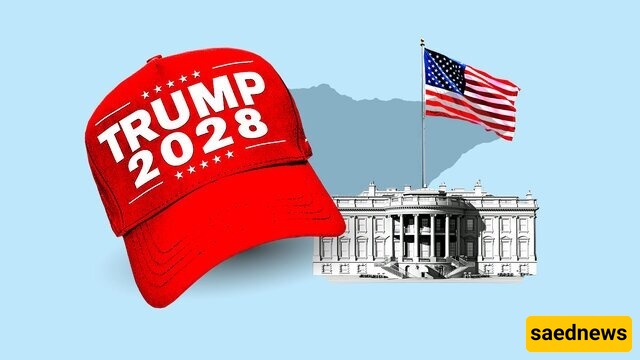
According to Saed News Political Service, the American magazine emphasizes that Donald Trump’s influence on U.S. politics will likely continue beyond the official end of his second presidential term, regardless of whether he personally wishes to remain in power.
According to ISNA, the publication Politico writes in this report that Trump’s dominance has become so structurally embedded in the U.S. political system that his successor will effectively govern under the shadow of a “third Trump term”—a third term not in legal terms, but through the policies, procedures, and political culture left behind by Trump’s second administration.
Politico notes that one way to measure Trump’s influence is through historical comparison. The article argues that if Trump completes his second term, he will be the dominant figure in 21st-century American politics for 14 years by January 2029—a period even longer than Franklin Roosevelt’s 12-year dominance in the 20th century. From this perspective, the article emphasizes that Trump has profoundly shaped the nature of U.S. governance and its relationship with the world, more than any other president in recent decades.
According to Politico, this reality will heavily overshadow intra-party Democratic debates ahead of the 2028 election. Democrats will not only compete for the presidential nomination but also see themselves as tasked with a historic mission: ending what the article calls the “Trump moment.” However, Politico writes, this mission places Democrats in a difficult dilemma: they must either continuously discuss Trump to define themselves in opposition to him, or consciously—and not very convincingly—avoid mentioning his name, an approach the article considers unlikely to succeed.
The article emphasizes that Trump’s policies and the destabilizing way they were implemented will almost inevitably dominate his successor’s campaign and first term. Politico adds that this influence may even be stronger if a Democratic president wins, compared to a Republican successor. From this perspective, the article concludes that Trump can effectively achieve a third term without violating the Constitution or attempting to stay in power.
Politico writes that some Democrats may focus on symbolic actions to restore the pre-Trump status quo—actions aimed at reversing the destructive trends of Trump’s era. However, according to the American media outlet, such an approach would trap the new president in the past during the early days, months, and even years of their administration, leaving little room to look forward. Politico warns that a “Trump legacy restoration” agenda carries the risk of being stuck in the past.
In contrast, the article notes that other Democrats may consciously avoid these symbolic battles and instead focus on forward-looking issues such as affordable housing and economic security. Nevertheless, Politico emphasizes that these symbolic disputes are only a small part of the fundamental questions Trump has introduced into the U.S. political agenda.
According to the article, immigration policy is one of the main challenges in this regard. While criticizing Trump’s hardline actions seems easy, Politico says the more difficult question is whether a Democratic president would reverse Trump-era border policies, which significantly reduced illegal crossings, or preserve them with modifications. The same uncertainty exists regarding Trump-era trade tariffs, especially in industrial states where protectionist policies enjoy strong social support.
Politico emphasizes that Trump’s approach to economic nationalism has blurred traditional party boundaries. According to the article, some elements of Trump’s economic policies—such as prioritizing central government intervention and choosing economic winners—overlap with ideas rooted in the Democratic Party’s labor wing. Therefore, the article questions whether a Democratic successor would truly want to fully abandon these approaches.
The article also states that Trump’s legacy extends to presidential power norms. Politico argues that Trump has solidified a theory of executive power according to which the president is entitled to exercise authority as much as possible, with impeachment or electoral defeat being the only real checks. The article notes that any powers remaining at the end of Trump’s term are likely to be fully preserved and utilized by his successor, regardless of party affiliation.
Politico adds that even areas typically associated with “norm restoration,” such as relations with allies, will be affected by Trump’s legacy. Although his potential successors may speak about the importance of alliances, the article stresses that it is unlikely anyone would risk domestic political costs by retreating from Trump’s insistence on increasing allies’ contributions to defense spending.
Ultimately, Politico concludes that Trump’s lasting influence stems from the fact that his rise was not a temporary deviation but represented a generational political movement. The article notes, referencing historical experience, that political movements usually end not through total rejection but by partial adoption by successors. However, Politico asserts that Trump’s incendiary tone and the surrounding political culture have made such a path difficult.
In summary, Politico emphasizes that Trump’s most enduring legacy lies not necessarily in specific policies but in redefining presidential power and political norms—a legacy that, according to the magazine, ensures debates over “Trumpism” will continue long after he leaves office and will shape U.S. politics.