SAEDNEWS: President Masoud Pezeshkian, pointing to widespread public dissatisfaction with executive bodies, emphasized the need to improve the quality of administrative services and increase responsiveness to citizens.
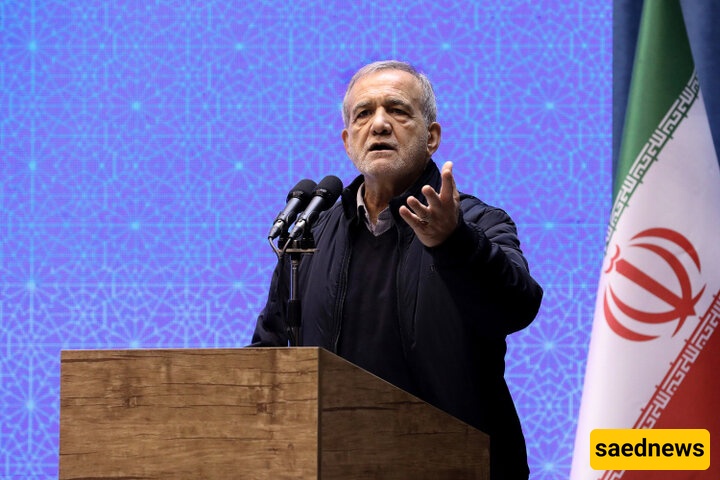
According to SAEDNEWS, Pezeshkian said on Tuesday, January 20, 2026, at the conference on performance-based planning, budgeting, and payments, that:
“We all have a duty to serve the people and those who refer to government offices. We must do our work in the best possible way and be accountable.”
The President stated:
“Today we have a broad and extensive administrative structure, yet people who come to our offices are often not satisfied with how we perform. That is why it is necessary to reform this trend, and in every possible way, we must solve people’s problems.”
Pezeshkian also stressed the importance of rewarding real work properly, noting that he had discussed the issue of salary ceilings with the heads of the Planning and Budget Organization and the Administrative and Employment Affairs Organization.
He said such a system was not scientifically acceptable, and added:
“The Qur’an says that whoever does even an atom’s weight of good will see its reward, and whoever does even an atom’s weight of wrongdoing will see its consequence. So even from a religious belief perspective, it is not acceptable that someone who works more should not receive more.”
He added that around the world today, salaries and wages are also tied to performance:
“Just holding meetings will not solve any problem. We must focus on doing the work and achieving goals. The ‘result’ is what matters and is worth paying for. Holding meetings without achieving results is not enough.”
Pezeshkian emphasized that public service is the main purpose of government responsibility:
“Our presence in positions of responsibility is for serving and fulfilling duty in a way that satisfies the citizen. If a service is provided but the citizen remains dissatisfied, then the existence of that office or organization is meaningless.”
He warned that poor service and lack of proper response will eventually harm the system itself:
“If services are not delivered correctly, with quality, and at the right time, then later we will not receive proper responses either—and we will suffer damage. It is wrong to think our actions have no consequences. One day, we ourselves may be the next person visiting that same office and facing the same poor treatment.”
The President said accountability and clear performance goals are essential:
“Responsiveness, performance, and our objectives matter. We must know what we are doing. It is not acceptable that a citizen leaves dissatisfied from a system we designed.”
He described the habit of avoiding responsibility and refusing to answer people as something that can lead to social breakdown:
“We have a large and complex administrative system, yet people are dissatisfied—why should it be like this? We spend our time and our lives; why shouldn’t we respond properly? What is wrong with sending a citizen home with a smile, kindness, and satisfaction?”
Pezeshkian said that even when a direct solution is not possible, government managers must communicate respectfully:
“Even if we cannot respond in a practical way, officials must speak to people politely. Kind words cost nothing, but they create satisfaction among those who come to seek help.”
He stressed that internal employee satisfaction matters:
“We cannot have an administrative structure where staff and employees are dissatisfied, and then expect them to treat citizens properly. You cannot manage processes with frustration and resentment.”
Pezeshkian called it necessary to give rewards to employees who work responsibly and correctly:
“Unfortunately, our administrative system is such that if an employee does their job properly, not only do they not receive a reward, but they may even be criticized. Meanwhile, someone who does not work properly may be rewarded.”
He said that in Islamic teachings, a person who does good work should receive ten times the reward.
He added:
“If we cannot reward, at least we should not punish. A person who commits a violation should be penalized only to the extent of that violation or laziness—not more. Sometimes we dismiss someone for a single mistake, while we ignore those who do their work well. That is why our administrative system has become inefficient.”
He emphasized:
“We must make a clear distinction in payment between someone who works and someone who does not.”
Pezeshkian stated:
“The Qur’an is not only for reciting—it must be acted upon. God will not accept that we ignore those who are helpless or struggling. Being Muslim is not a claim; it is performance.”
That is why, he said, the government constantly emphasizes solving people’s livelihood problems:
“We must solve people’s economic hardships.”
The President said solving livelihood issues is one of the government’s top priorities and called on managers to help achieve that goal:
“Follow up so that we can implement the performance-based payment framework. We do not expect this to happen overnight, but with training, dialogue, and cooperation, it can be done.”
He added:
“Equality does not mean that good and bad are the same, that knowledgeable and ignorant are the same, or that capable and incapable are equal. They are not equal. Human rights are equal, but in payment, our approach must be different.”
He stressed that even the smallest service should not be ignored and must be properly managed.
Addressing government managers, Pezeshkian said this approach should not be seen as an order, but as justice for both employees and citizens.
He emphasized that the term “arbaab-e rojou” (visitor/citizen in an administrative sense) should be treated with respect and responsibility:
“We must have the mindset and sense of responsibility to remove the worries and concerns of the citizen, and take pride in that. The joy of healing someone’s anxiety and sadness cannot be compared to any other good feeling, and we must institutionalize this thinking in our workplaces.”
In closing, the President said:
“I hope these discussions lead us to become true servants of the country in our short lives, and a worthy model for future generations.”