SAEDNEWS: Blood groups are identified by antigens—compounds made of sugars and proteins that alert the immune system to foreign substances in the body—and these form the basis of the ABO blood group system, introduced by Karl Landsteiner in 1901.
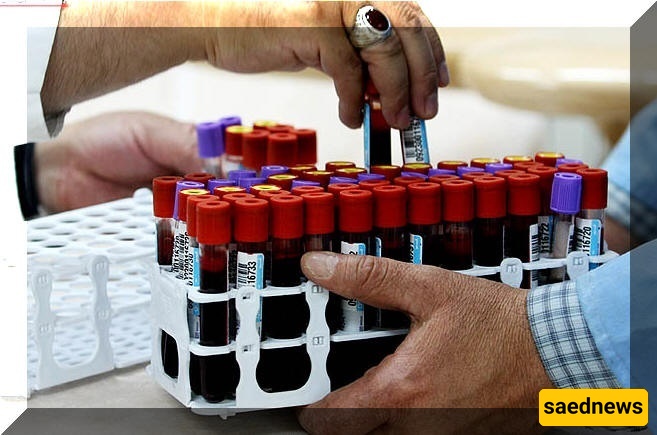
According to Saed News, citing Hamshahri, blood type A is associated with the A antigen, which has N-acetylgalactosamine as its primary sugar. Blood type B is linked to the B antigen, with D-galactose as its main sugar. Blood type AB carries both antigens, while blood type O lacks both A and B antigens. Another key antigen in blood typing is the Rh factor: being Rh-positive means a person has it, while Rh-negative means they do not. All these complexities are encoded by the ABO gene on chromosome 9.
These antigens are especially important in blood donation and transfusion. For a successful transfusion, the antigens of the donor’s and recipient’s blood must match; otherwise, the new blood is rejected by antibodies present in the plasma. This is why O-negative blood is called the “universal donor”—it lacks A, B, and Rh antigens, minimizing the risk of rejection and making it transfusable to people of all blood types.
However, even rarer blood types exist than O-negative. Only 50 people worldwide have Rh-negative blood completely free of Rh antigens, sometimes called “golden blood.” Earlier this year, a single individual with Gwada-negative blood was identified. While O-negative occurs in about 7% of the global population, researchers in Thailand recently tested the blood of patients and donors and discovered an entirely new type, present in the veins of just three known individuals (one patient and two donors). This new type, now called B(A), primarily carries B antigens but also includes A antigens.
In a study published in Transfusion and Apheresis Science, the researchers noted: “ABO differences between donors and patients were evident even within the same ethnicity. This finding highlights the influence of patient conditions and treatment on abnormal ABO types. Moreover, the B(A) individuals identified in this study shared identical genetic variations distinct from all previously known B(A) phenotypes.”
The team observed four alleles—alternative forms of the same gene at a given chromosomal location—on the B(A) type, differing from alleles associated with other blood types. Mutations like these have been seen in multiple ethnic groups, including other parts of Asia, but this is the first documented case in Thailand. B(A) adds a new variant to the 48 known human blood types.
It is likely that even more undiscovered blood types exist, along with additional individuals carrying these extremely rare types. The three known cases of B(A) may not be the only ones on the planet. Further research could uncover more, proving that blood typing is far more complex than just ABO.