SAEDNEWS: Following confirmation that Iran’s navy has deployed its North Korea–built lightweight attack submarines for operations in the Strait of Hormuz, significant questions have emerged regarding these vessels’ ability to pose a threat to high-value assets of the United States Navy.
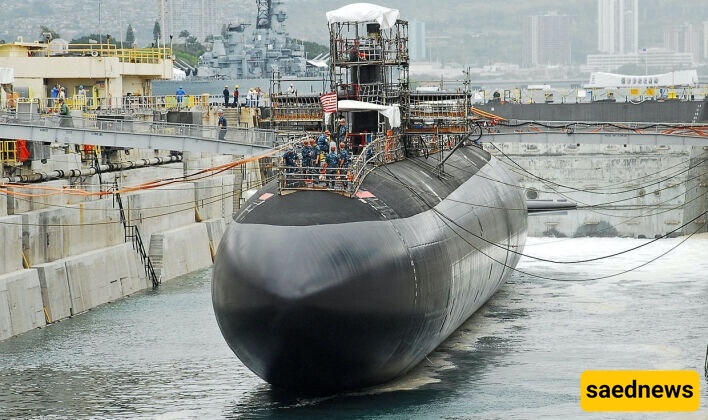
According to the political desk of Saed News, citing Ettela’at Online, assessments of the performance of Ghadir-class submarines—produced under license and based on North Korean designs and technologies—along with other diesel-electric submarines with similar capabilities, during simulated exercises against the United States Navy, provide valuable insights into the potential vulnerabilities of U.S. aircraft carriers in the event of an engagement with such vessels.
Due to the frequent joint exercises between the Royal Australian Navy and the U.S. Navy, Australia’s Collins-class diesel-electric attack submarines have been extensively tested against American warships. During the RIMPAC 2000 exercises, these submarines reportedly “sank” two nuclear submarines and approached the USS Abraham Lincoln aircraft carrier dangerously closely. Although these exercises were pre-planned and the carrier group was aware of the Australian submarine’s presence in the target area, they were still unable to detect it.
Subsequently, in 2001 during Operation Tandem Thrust, a Collins-class submarine “sank” two U.S. amphibious assault ships in waters 70 to 80 meters deep—only slightly deeper than the submarine’s own length. In October 2002, during exercises near Hawaii, Collins-class submarines “hunted and destroyed” the nuclear submarine USS Olympia. The Australian submarine commander stated that the greater speed and acceleration of the larger American vessel offered no advantage, noting: “It simply means that when you move faster, you produce more noise.”
In 2003, it was reported that Collins-class submarines had destroyed two U.S. Navy nuclear attack submarines and an aircraft carrier in simulated engagements. Defense Weekly reported on October 1, 2003, that the commander of the U.S. Pacific Fleet attempted to downplay these results. These successes were not unique; in 2004, a U.S. Navy vice admiral confirmed that in the fall of 2000, a Swedish diesel-electric submarine demonstrated remarkable capability during an exercise against one of the Navy’s top vessels, USS Annapolis.
That exercise, along with many others, highlighted the difficulty of tracking a well-built, well-crewed diesel-electric submarine. Unconfirmed reports suggest that USS Annapolis was “sunk” during these drills. In engagements with Japanese diesel-electric submarines, their inherent quietness made detection by U.S. sonar extremely difficult, allowing them to repeatedly “sink” American warships during exercises. Chilean attack submarines are also reported to have achieved similar results.
Decades of U.S. naval experience confronting diesel-electric submarines indicate that Iranian vessels acquired from North Korea, such as the Ghadir class, could pose a significant threat to U.S. carrier strike groups, including amphibious assault ships, nuclear attack submarines, and aircraft carriers. The large number of submarines deployed by Iran, combined with the challenging sonar conditions in the Strait of Hormuz, may further intensify this threat.
While it remains unclear whether Iranian crew training matches the standards of their North Korean counterparts, other branches of the country’s armed forces have demonstrated strong preparedness for potential conflict with U.S. forces—raising the possibility of highly unfavorable outcomes for U.S.-led military efforts. It is estimated that between 14 and 20 Ghadir-class submarines, along with several other North Korean-produced diesel-electric attack submarines, are currently in service with Iran, equipped with various torpedoes and cruise missiles.