SAEDNEWS: A Malaysian scholar has hailed Leader of the Islamic Revolution Ayatollah Seyed Ali Khamenei as the sole prominent and consistent voice in the world for demanding that Muslims reorganize themselves and reclaim their true Qibla.
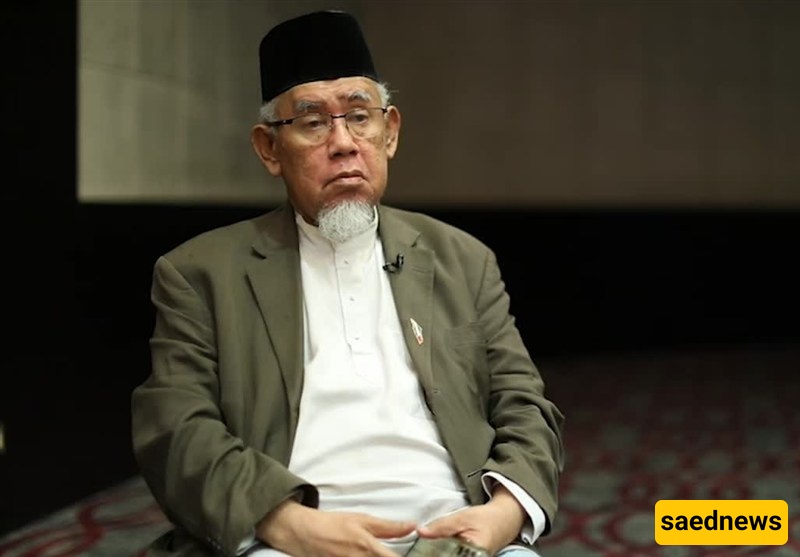
According to Saednews ,On the sidelines of the International Conference on the Rights of Nations and Legitimate Freedoms in the Intellectual System of Ayatollah Khamenei, held on Sunday, 30 November 2025 (9 Azar 1404), at the Guardian Council Research Institute in Tehran, Tasnim News Agency conducted an exclusive interview with Mohd Azmi Abdul Hamid, President of the Malaysian Consultative Council of Islamic Organizations (MAPIM) and adviser to the Prime Minister of Malaysia.
In a wide-ranging discussion, the prominent Malaysian Islamic figure described Ayatollah Khamenei as the clearest, most steadfast voice today calling on the Muslim Ummah to reorganize itself, free itself from Western hegemony, and restore its authentic Qibla—the true axis of unity, sovereignty, and divine leadership that, he said, has been displaced by submission to Washington, London, and other Western powers.
Abdul Hamid emphasized that the Leader of the Islamic Revolution’s thought offers the most relevant response to humanity’s overlapping crises—from endless wars and environmental destruction to food insecurity and moral decline. He added that the ongoing genocide in Gaza has fully exposed Western hypocrisy on human rights and shattered the credibility of so-called “normalization” with the Israeli regime.
What follows is the full text of the interview:
Thank you for your time. You are attending a conference in Tehran focused on the rights of nations and legitimate freedoms from the perspective of Ayatollah Khamenei. How do you assess the importance of this issue, and how do you evaluate Ayatollah Khamenei’s views and characteristics in this regard?
First of all, I congratulate the organizers of this conference. It is timely and extremely important. The world today is facing unprecedented challenges—from wars and environmental crises to food insecurity and social instability. In this context, Ayatollah Khamenei’s thought is deeply relevant. It offers answers to these crises. He promotes a solid intellectual framework on how humanity should respond and how societies should organize themselves.
We no longer want to submit to Western hegemony and allow others to dictate the global order. That order must be reset. From the very beginning, Ayatollah Khamenei has delivered a consistent message: the Ummah must reorganize itself. We must also reach out to non-Muslims, because what we are witnessing today is not an awakening of governments, but of people. This gives us enormous potential to place Ayatollah Khamenei’s ideas at the center of global discourse during this period of crisis.
Western governments often portray Iran, the Islamic Republic, and even Islam itself as opposed to freedom and human rights, likening them to medieval religious regimes. How do you view this narrative?
There has long been a perception that anything related to Islam—whether the religion itself or a nation that adopts Islam as a guiding policy—is a threat. Anything that challenges Western dominance, or even Chinese influence, is automatically framed as dangerous. This has resulted in a sustained propaganda campaign we know as Islamophobia.
Labeling and demonizing Islam and Muslims has become a central Western strategy, amplified through media outlets they control. This is the reality we are facing. It is a battle over ideas and perceptions—how Islam is understood in its true sense, rather than being constantly associated with terrorism and violence. This is the propaganda we must confront and dismantle.
Those who criticize Israel’s actions in Gaza are often accused of anti-Semitism. At the same time, we see human rights violations against migrants and minorities in Western countries themselves. How do you assess this double standard?
This is not merely a double standard—it is hypocrisy at the highest level, and they are fully aware of it. Even Western intellectuals, from London to Paris to Washington, are openly acknowledging this hypocrisy. The world is watching and understands what is happening.
The term “anti-Semitism” itself is now being questioned. How can criticizing an obvious genocide and blatant violations of international law be equated with hatred of Jews? People will not logically accept this. We should not be intimidated by such labels anymore.
The core issue is clear: Israel is committing serious violations of international law with full backing from the United States. Western powers are not stopping the genocide in Gaza—they are enabling it. We must have the courage to call wrongdoing by its name.
Criticism of Israel is now visible far beyond the Muslim world, including in non-Muslim countries and even within the United States. Do you see this as the beginning of a lasting global shift?
Absolutely. This trend is unstoppable. From Korea to South Africa, from Latin America to Europe, and even within the West itself, more countries and societies are speaking out against Israel. We are seeing votes against Israel, discussions of sanctions, and calls for accountability. The complicity of the United States is becoming undeniable.
What we must do now is create convergence between Muslims and non-Muslims around shared values—humanity, justice, and dignity. Israel must be clearly identified as a rogue and illegal apartheid state. Unified global pressure is essential, not just rhetorical condemnation.
We have legal and political tools: the ICJ, the ICC, and emerging platforms like BRICS. This is not only about the Global South—it is about the global majority of people standing together to stop oppression.
Israel once portrayed Iran as the main regional threat. Today, many countries are reassessing their stance toward Tehran. How do you interpret this shift?
Iran has demonstrated remarkable resilience. Over 46 years, despite immense pressure and aggression, it has remained standing. This resilience has opened the world’s eyes to the deeper meaning of resistance championed by Imam Khomeini and continued today.
Many in the Muslim world now recognize that Iran is the only country capable of standing up and responding decisively to Israeli aggression. This realization has forced governments to question whether their previous hostility toward Iran was justified.
Ayatollah Khamenei has consistently warned that division weakens the Ummah and empowers global powers. Iran’s growing prominence stems from its ability to demonstrate resistance—not only by the state, but by its people. This is why many now see Iran as a source of hope.
Some Muslim countries continue to pursue normalization with Israel. How do you view this approach?
The Abraham Accords were imposed under pressure, primarily serving the interests of ruling elites rather than the people. Gaza exposed the emptiness of normalization’s promises. Any perceived benefits have collapsed.
I recently wrote a short book titled When the Ummah Lost Its Qibla. Qibla is not only a physical direction of prayer—it represents reference, leadership, unity, and sovereignty. Today, our Qibla shifts between Washington, London, or Moscow. This is a tragic distortion.
The most consistent and prominent voice calling for the restoration of our true Qibla is Ayatollah Khamenei. There is no alternative to reorganizing ourselves around authentic leadership and unity.
Should Muslim unity be limited to politics and religion, or should it extend further?
Unity must be comprehensive. The Qur’an calls on us to “hold fast to the rope of Allah together.” True strength lies in quality and cohesion, not mere numbers.
Unity must encompass education, economics, trade, science, culture, politics, and intellectual life. Leaders must transcend narrow interests and focus on shared fundamentals. We have one Qur’an, one belief system, and clear common principles.
Initiatives such as the World Alliance of Mosques in Defense of Al-Aqsa demonstrate that shared causes can unite Shia and Sunni alike. Al-Aqsa belongs to all Muslims. This is how unity must be practiced—by managing differences and focusing on common ground.
Thank you very much for your time.
Thank you. It was my pleasure.